


Lee Jae-myung: "Minimize Economic Downturn Through Community Principles, Universal Distribution of Disaster Basic Income via Local Currency"
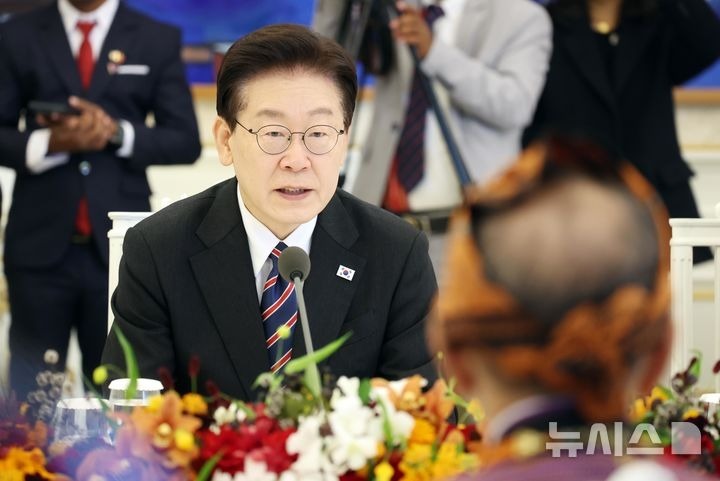
[Suwon Ilbo=Park No-hun Reporter] Gyeonggi Province Governor Lee Jae-myung argued that to minimize economic downturn amid COVID-19 damages affecting not only tenants but also landlords, universal distribution of disaster basic income through local currency should be implemented.
Governor Lee stated on the 22nd via SNS, "Since this crisis is no one's fault, rather than passing the burden to another person in the same building or neighborhood, bearing it together is in line with community principles," and added, "the method should be universal distribution of disaster basic income through local currency, whose effectiveness has already been proven."
He continued, "In the second quarter of this year when the first round of universal disaster basic income was distributed, household income increased across all income classes compared to the previous year and overall household consumption expenditure rose 2.7% year-over-year. However, after the second selective distribution of support funds, the bottom 50% of households saw income decrease and overall household consumption expenditure declined 1.4%," and stated, "In particular, we must carefully consider why small business owners and self-employed workers, who were the subjects of pinpoint support, are instead requesting universal distribution through local currency."
Finally, Governor Lee concluded, "Everyone is struggling. We cannot overcome this together if we support some while excluding others. Since the current adversity is not due to anyone's fault, we must assure the people that the state will extend its hand when national social security is in peril. The nation's presence is more urgently needed than ever."
The following is the full text of Governor Lee's SNS post.
<The Loss of Tenants Should Not Be Passed to Landlords, but Borne Together by All>
One of the fundamental principles of civil law is the 'principle of personal responsibility,' which states that losses due to someone's fault should be borne by the responsible party, but responsibility cannot be imposed without fault. Since the current economic crisis is not the landlord's fault, it is unjust to shift responsibility that is no one's fault onto landlords.
This is not to ignore the suffering of tenants. Currently, an economic crisis due to infectious disease, akin to a natural disaster, is affecting all households. For this very reason, we must not resolve the pain and loss from this crisis by shifting it to another group within the community.
Currently, the National Assembly is discussing so-called 'rent freeze bills' for small business owners and self-employed workers pushed to the brink by COVID-19. Some proposals include measures that first place the burden on landlords to ease tenants' burden, and then compensate landlords by lowering loan interest rates. Not receiving rent according to existing legal relationships would have low practicality and only cause social unrest, and lowering loan interest rates for landlords at banks would ultimately shift that burden to financially vulnerable groups with low creditworthiness.
Commercial landlords are not only 'building owners above the property owner.' Many are small business owners and self-employed workers themselves, living off the monthly rent they receive as landlords. Since this crisis is no one's fault, rather than shifting it to another person in the same building or neighborhood, bearing it together aligns with community principles.
The core direction of economic policy to solve the problem is minimizing economic downturn. Therefore, the economic loss of tenants should be borne by national finances. The method should be universal distribution of disaster basic income through local currency, whose effectiveness has already been proven.
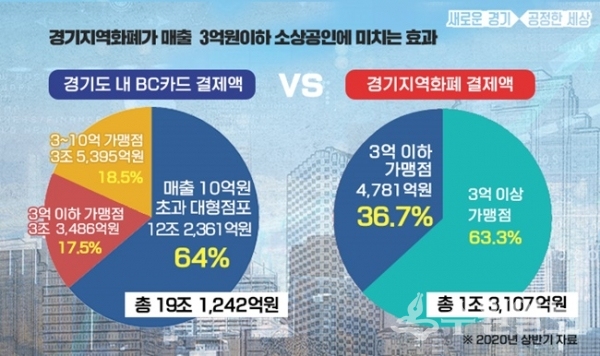
According to an analysis commissioned by Gyeonggi Province to a big data analytics company, when distributing 10,000 won in disaster basic income universally, consumption occurred for an additional 8,500 won or more beyond that 10,000 won. Looking at Gyeonggi Province alone to see the effect of 'consumable local currency,' 77.8% of spending was concentrated in traditional markets and alley commercial districts (excluding commercial facilities).
The People Power Party, conservative economic journals, and even some members of the ruling party keep mentioning selective pinpoint support. While it looks excellent in theory, the reality shows its effectiveness is poor, as demonstrated in the second round of emergency support fund distribution.
In the second quarter of this year when the first round of universal disaster basic income was distributed, household income increased across all income classes compared to the previous year and overall household consumption expenditure rose 2.7% year-over-year. However, after the second selective distribution of support funds, the bottom 50% of households saw income decrease and overall household consumption expenditure declined 1.4%.
Ultimately, selective distribution pursued under the logic of saving national funds actually lowered the efficiency of fiscal execution and resulted in policy failure amounting to budget waste.
In particular, we must carefully consider why small business owners and self-employed workers, who were the subjects of pinpoint support, are instead requesting universal distribution through local currency. To minimize the damage of sales decline due to COVID-19, supporting the sales of these businesses is the only fundamental solution.
Everyone is struggling. We cannot overcome this together if we support some while excluding others. Since the current adversity is not due to anyone's fault, we must assure the people that the state will extend its hand when national social security is in peril. The nation's presence is more urgently needed than ever.


Loading comments…