


U.S. Control Center Communication Outage Causes Nationwide Airport Takeoff Halt…Around 10,000 Flights Delayed or Canceled

On the 13th (local time), the U.S. Federal Aviation Administration (FAA) implemented a nationwide ground stop, halting all aircraft takeoffs from American airports. It marks the first nationwide takeoff ban since the September 11, 2001 terrorist attacks—occurring 3 years and 10 months after January 2023.
Both incidents share a similarity: not external attack but FAA internal system failures paralyzing the aviation network of the superpower United States. However, upon examining the point of impact on the systems and the timing of the incidents, assessments indicate this crisis reveals far more severe structural vulnerabilities than the 2023 incident.
'Pre-takeoff briefing' vs. 'airborne nerve network' paralysis
The most decisive difference lies in the operational stage and risk level of the failed systems.
The source of the January 2023 incident was the NOTAM (Notice to Airmen) system—a kind of 'advance warning board' that alerts pilots before takeoff to hazards such as runway closures or deteriorating weather. When NOTAM went down, new takeoffs were prevented, but the radar and voice communication systems controlling already-airborne aircraft operated normally.
In contrast, this incident struck the entire communication network of 22 regional Air Route Traffic Control Centers (ARTCC) nationwide, which divided U.S. airspace to control aircraft routes and altitudes in real time. If the 2023 incident was like 'pre-departure navigation road control guidance going offline,' this incident is more akin to 'the radio itself between the vehicles on the highway and the control tower going dead.' This explains why the FAA not only blocked new departures but also struggled to safely land approximately 3,100 airborne aircraft.
Early morning surprise vs. Friday afternoon peak-time direct hit
The timing of the incident also determined the scale of damage. In January 2023, a computer error that started the previous night led to a full takeoff halt around 7:20 a.m. Eastern time, but was resolved in roughly one hour and 40 minutes. While commuters experienced inconvenience, airlines had room to manage schedules starting in the afternoon.
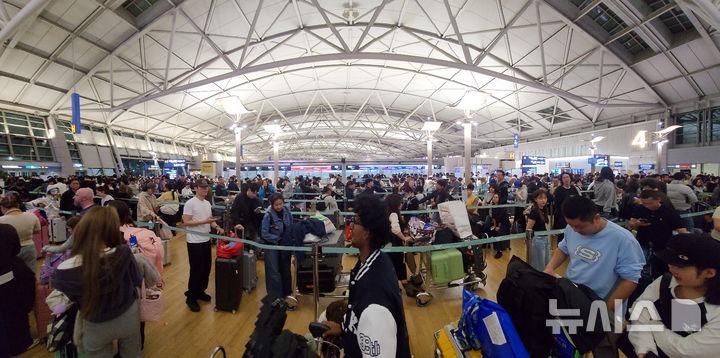
However, this incident struck directly at 3:54 p.m. on Friday—the absolute peak of air travel demand. With approximately 30,000 aircraft awaiting takeoff due to weekend travel demand, the sudden halt created cascading chaos, with passengers at major hub airports like Chicago, New York, and Denver disembarking in-flight and returning to terminals.
Repeated human error…$30 billion modernization budget under spotlight
The cause investigation shows the nightmare of three years ago repeating itself. Early on in the 2023 incident, cyberattack theories circulated, but investigation revealed it was human error—a contractor employee accidentally deleted critical database files during maintenance. This time, while the U.S. Department of Homeland Security and Federal Bureau of Investigation have ruled out terrorism or hacking signs, a software update error is emerging as the likely cause under investigation.
Underlying this is the long-neglected deterioration of America's aging air traffic control infrastructure. Reliance on outdated hardware and copper-wire communications networks has caused frequent large and small failures, yet fundamental replacement has been delayed even since 2023. Following this incident, the $30 billion air traffic control modernization budget that U.S. Transportation Secretary Sean Duffy requested from Congress is expected to emerge as the top priority.



Loading comments…