[Ruling Party Chair Kim Min-seok] Grassroots members nurtured by Jung Cheon-guk chose Kim Min-seok
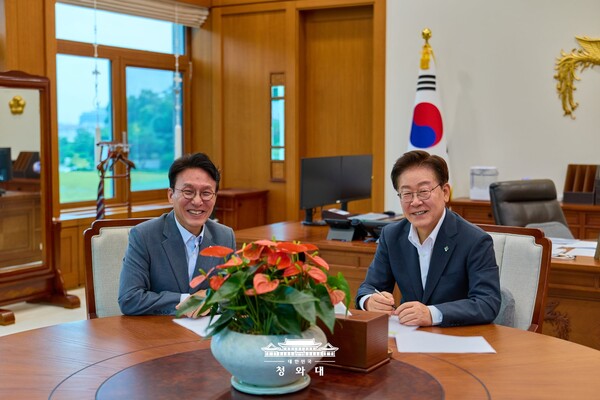
At the Democratic Party convention where the relative value of each grassroots member's vote increased approximately 17-fold through the introduction of a "one person, one vote" system, newly elected Chair Kim Min-seok secured party leadership by gaining advantage in both delegate and grassroots member voting.
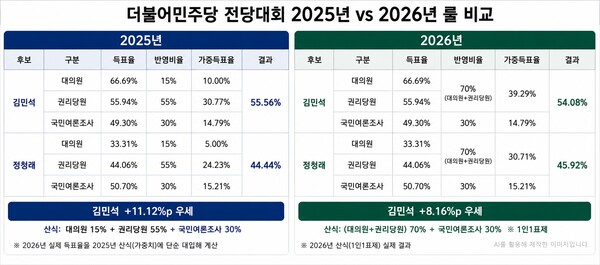
According to the Democratic Party on 18th, Chair Kim obtained 54.08% in the final preferential voting at the 3rd Regular National Party Convention held the previous day at Daejeon Convention Center, defeating candidate Jung Cheon-guk who scored 45.92% by a margin of 8.16 percentage points and was elected party chair.
As no candidate exceeded 50% in the first round of voting, a preferential voting system was applied that redistributed second-preference votes from voters who selected third-place candidate Song Young-gil.
For the first time at this convention, a one person, one vote system was applied that assigns equal value to delegate and grassroots member votes.
At last year's convention where candidate Jung was elected party chair, the formula reflected 15% delegates, 55% grassroots members, and 30% national polling. Although the delegate electorate was considerably smaller than grassroots members, separately allocating 15% of total results meant one delegate vote held influence equivalent to approximately 17 grassroots member votes.
This year, delegate and grassroots member votes were combined at a 1:1 ratio, reflecting 70% of total results. National polling maintained the same 30% weighting as last year.
While maintaining the overall party member reflection ratio at 70%, the "voting value" of delegates and grassroots members was equalized within party voting. Consequently, the relative value of each grassroots member vote compared to delegate votes rose approximately 17-fold from last year.
The one person, one vote system was a reform initiated during candidate Jung's tenure as party chair.
At last year's convention, candidate Jung secured party leadership based on overwhelming grassroots member support.
At that time, candidate Jung obtained 428,470 votes in grassroots member voting, significantly ahead of candidate Park Chan-dae who received 212,195 votes. In percentage terms, candidate Jung scored 66.48% and candidate Park 33.52%.
Among delegates, however, candidate Jung trailed with 6,142 votes compared to candidate Park's 6,951 votes. In percentage terms, candidate Jung scored 46.91% and candidate Park 53.09%.
In national polling, candidate Jung led with 60.47% over candidate Park's 39.53%.
Although losing among delegates, candidate Jung secured advantages in grassroots voting and national polling, obtaining final results of 61.74% and being elected party chair.
The one person, one vote system, first applied one year later, represented an institutional change that relatively elevated the voting value of grassroots members, where candidate Jung had shown strength last year.
However, party members' choice differed at this convention.
Chair Kim scored 55.94% in grassroots member voting, ahead of candidate Jung's 44.06% by 11.88 percentage points.
The gap widened among delegates. Chair Kim obtained 66.69% while candidate Jung scored only 33.31%. The margin was 33.38 percentage points.
The only category where candidate Jung led Chair Kim was national polling. Candidate Jung scored 50.70%, ahead of Chair Kim's 49.30% by 1.40 percentage points.
Candidate Jung, who showed advantages in both grassroots voting and national polling last year, this time led only in national polling.
Particularly, applying this convention's results to last year's electoral method reveals the impact of institutional changes on both candidates.
If 2026's actual delegate, grassroots member, and national polling vote shares are simply applied to the 2025 formula, Chair Kim would calculate to 55.56% and candidate Jung to 44.44%. Chair Kim would lead by 11.12 percentage points, exceeding the actual convention's final margin of 8.16 percentage points by 2.96 percentage points.
This is because if 15% separate weighting were applied to delegate voting as last year, where Chair Kim obtained 66.69%, the advantage secured in delegate voting would be more substantially reflected in final results.
However, this is a simple conversion assuming each electoral group's vote share would have been identical under last year's system. Had the electoral system differed, candidate strategies and voting behavior could have varied, meaning this does not represent actual election results.
Nonetheless, the simple conversion demonstrates that this year's one person, one vote system reduced the influence of delegate votes, which had favored Chair Kim.
While Chair Kim led candidate Jung by 33.38 percentage points among delegates, the grassroots member margin was 11.88 percentage points. Unlike last year's system allocating 15% separately to delegates, this year's equal calculation of both electorates meant Chair Kim's substantial delegate advantage was diluted within overall member voting.
Ultimately at this convention, while delegate weighting where candidate Jung was relatively weak last year disappeared and grassroots member voting value where he was strong increased, Chair Kim prevailed in both delegates and grassroots voting, with institutional changes failing to change the victor.
A political insider stated, "Applying this voting result to last year's method would actually broaden Chair Kim Min-seok's victory margin given his overwhelming delegate advantage," and "Even without delegate weighting and securing grassroots member support, the party sentiment emphasized early administration stability and President Lee Jae-myung's government success appears to have influenced the outcome."