


Growing Calls for 'Integration'… "Must Find Solutions for Mutual Prosperity"
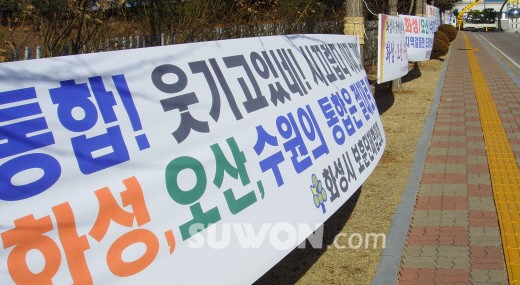
● Hwaseong Western Zone - Anti-Integration Banners Take Over Streets
Public sentiment in Hwaseong has sharply diverged between the eastern and western zones. The western zone, situated far from Suwon and Osan geographically and home to many rural-urban composite areas where long-time Hwaseong residents have settled, held little expectation for integration. During a field trip to the area on the 26th, the streets of Namyang-dong, where Hwaseong City Hall is located, and the western zone were dominated by anti-integration banners hung under the names of unfamiliar organizations. Hwaseong residents seemed to treat the very topic of integration as something disgraceful, without fully understanding it.
The owner of an H Kalguksu restaurant in Namyang-dong said, "To be honest, I'm not very interested and don't even know what's good about integration. However, I've heard that banners are everywhere with text saying my son (11) opposes it, so I understand it as something bad."
Most citizens met that day expressed frustration, saying that those in power should first explain what is good and bad about integration and then ask whether citizens support or oppose it. A merchant in his 40s selling bungeoppang (fish-shaped pastry) at Jeonjok Port questioned, "Anyway, don't the higher-ups just do whatever they want regardless of citizens' opinions? Wouldn't they be opposed precisely because those in power say it's not beneficial?"
Kang Soon-mi, 54, from Jeonjok, expressed concern about the location of City Hall in case of integration: "I'm worried that if integration happens, people living in the western part of Hwaseong will have to go all the way to Suwon to visit government offices. If integration occurs, won't courts and government agencies be concentrated in Suwon, which has everything? The eastern part is close to Suwon, so they would support it, but the western part even finds transportation to Hwaseong City Hall inconvenient."
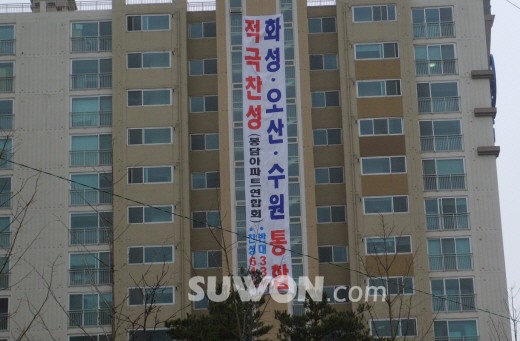
● Hwaseong Eastern Zone - Should Inform Residents of Pros and Cons and Hold Referendum
In contrast, the eastern zone of Hwaseong was different. The overwhelming view was that the pros and cons of integration should be communicated to residents, unilateral "anti-integration banners" should be removed, and integration discussions should begin from scratch. During reporting conducted in the Dongtan, Bongdam, and Byeongjeom areas, a Hwaseong municipal official residing in Dongtan said, "The proportion of Suwon and Hwaseong City officials living in Dongtan is quite high, and while opinions vary among them, there's a general atmosphere of recognizing the necessity of integration."
With pro-integration public opinion forming centered on apartment associations in the eastern zone, from Gibae-dong to Bongdam and Dongtan New Town, consensus emerged that the decision on integration should be made through a "referendum" rather than a city council vote. The Gibae·Bongdam District Apartment Associations, which began active response based on the results of citizen surveys on integration support and opposition, are taking a strong stance against the unconditional opposition of the city and city council. They have been taking practical action through various methods, including sending petitions supporting integration to relevant agencies, launching campaigns to vote out local politicians who made unilateral decisions without gathering citizen opinions, and demanding incorporation into Suwon.
Mi-kyung Choi, manager of Hanmaeum Real Estate in Dongtan Central Shopping District, said, "Rather than immediate visible factors affecting property values, there will be acceleration in expanding infrastructure such as roads and schools," while Hwaseong taxi driver Lee Min-yong, 55, argued, "A private taxi license costs around 70 million won in Suwon but over 100 million won in Hwaseong. We cannot stand by while our property rights are violated. I've heard that integration is likely in the long term, and if it happens, measures must be prepared to support individual taxi drivers."
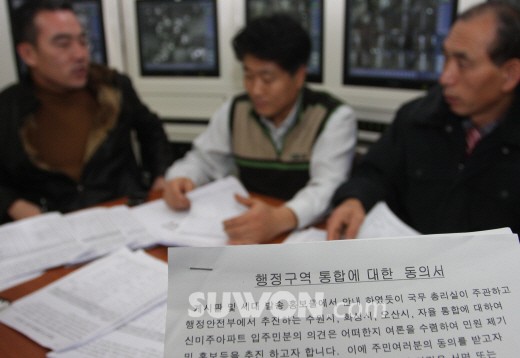
● High Expectations for Integration Synergy
Particularly, residents of these areas did not hide their expectations for integration synergy effects through the formation of a single living sphere and economic zone. According to research materials from the Korea Research Institute for Human Settlements on integration, 9.4% of Suwon citizens, 17.5% of Osan citizens commute to Hwaseong, while 14.1% of Hwaseong citizens commute to Suwon. Additionally, daily traffic between the three local governments totals 78,375 vehicles, with traffic between Suwon and Hwaseong accounting for 41.4%, Suwon and Osan 32.9%, and Hwaseong and Osan 25.1%.
Furthermore, the Hwaseong·Osan areas will enjoy a cost reduction effect in urban service supply per capita. Currently, Hwaseong costs 1.12 million won per capita and Osan 1.13 million won, but these are projected to decrease to 910,000 won after integration. However, Suwon, which has sufficient population and infrastructure, is estimated to see costs rise from the current 780,000 won. The construction of Korea's largest industrial cooperation cluster centered on semiconductors, electronic components, and display materials, along with substantial government integration support funds, adds to the appeal. Government financial incentives of 165.4 billion won, support plans, guaranteed transfer grants for five years after integration (152.4 billion won), expanded special transfer tax support (15 billion won), and SOC expansion are estimated to generate 215.1 billion won in total production induced by related industries and create approximately 2,530 new jobs.
● Osan - Must Maintain Advantages as Environmental City
Osan citizens held mixed views: some feared Osan would become marginalized if an integrated city is created and would have to bear various disadvantages, while others believed there was a need to grow by breaking out of general-purpose city status.
Heo Jin-ju, 32, from Yangsan-dong, who commutes to Suwon with her husband, supported integration: "I do consumption activities like dining out and culture in Suwon, while paying all kinds of taxes in Osan. I hope Osan maintains its status as an environmental city and that the three cities quickly find a way for all to 'win-win' and then pursue integration."
In contrast, Ji In-hoe, 52, from Gasu-dong, argued, "Osan has excellent environmental conditions, but if integrated, Osan would play a supporting role to Suwon and Hwaseong as the main actors. It's clear that Osan would decline to the periphery of the integrated city, so it's better to remain as is."
● Suwon - "Integration is an Irresistible Trend"
Suwon citizens look forward to the birth of a mega-integrated city with a population of 1.75 million and an area of 852 square kilometers, surpassing Ulsan Metropolitan City (1.13 million), Gwangju Metropolitan City (1.44 million), and Daejeon Metropolitan City (1.50 million). Consequently, Suwon citizens hoped that the "Sasajeong politicians" from Hwaseong·Osan areas, whom they view as obstacles to integration, would stop focusing on individual trees and adopt a broader perspective to see the entire forest.
Kim Mu-saeng, 48, from Jeongja-dong, said, "I understand the sentiment of politicians reluctant to give up vested interests, but even if you place a well-prepared meal before someone, it's useless if they don't eat it on time. Even if we delay the government's timeline a bit, proper integration discussions must take place."
Suwon City, the city council, and citizens evaluated the administrative district integration of Suwon·Hwaseong·Osan as an irresistible trend. However, there was consensus that the decision should be made through a referendum to ensure that political interests, vested interests of local power brokers, or influence from administrative bureaucrats do not interfere, and that the residents' true intentions are properly reflected.

Loading comments…