


Lee Jae-myung, 'Rebuttal to Basic Income Criticism'..."Basic Income is Better But..."

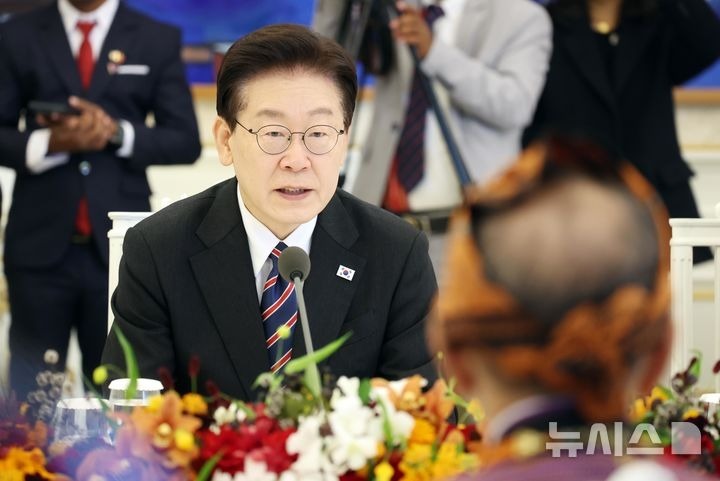
[Suwon Ilbo=Park No-hun Reporter] Gyeonggi Province Governor Lee Jae-myung posted a lengthy article titled 'Rebuttal to Basic Income Criticism' on SNS on the 9th.
In particular, Governor Lee drew attention by mentioning the names of former Democratic Party leader Lee Nak-yeon and former Prime Minister Jung Se-gyun, and offering point-by-point solutions to the issues they raised.
The governor also stated "basic income is better" while also appealing for interest in assured income.
The following is the full text of Gyeonggi Province Governor Lee Jae-myung's SNS post.
<Rebuttal to Basic Income Criticism>
Policies that concern the people's livelihood and the nation's future, particularly those attempted for the first time, must be meticulous and flawless. Constructive criticism and debate, rather than emotional attacks or political disputes, enhance policy completeness, and I always welcome them.
1. Basic Income is a Welfare Economic Policy Beyond Welfare Policy
The assured income advocated by the opposition is discriminatory cash welfare policy, but basic income is a universal income support that, while having a welfare character, is primarily an economic policy aimed at boosting sales for small business owners through local currency and revitalizing the economy.
The greatest problems of modern capitalism are employment-less growth due to neoliberal unlimited competition and technological revolution, inefficiency in resource and opportunity utilization due to extreme polarization of assets and income, and low growth due to insufficient demand relative to supply capacity.
The economy is cyclical, and the core axis is supply and demand. Since the economy rolls only as fast as the smaller wheel of the supply-demand pair, resources must be concentrated on supply when it is insufficient, and on demand when it is inadequate.
In an era when "there were many places to invest but insufficient money to invest," concentrating efforts on supply enabled high-growth through a positive cycle of investment-employment-income-consumption-demand and repeat. However, with the qualitative transformation of the economic environment, now when "there is abundant money to invest but few places to invest," low growth has become entrenched, and efforts must be concentrated on strengthening demand.
Local currency basic income is useful for economic recovery by increasing sales of small business owners and channeling sales concentrated in large distribution enterprises back to alley commercial districts with large multiplier effects.
The first emergency relief payment, accounting for only one-third of 200-400 trillion won in second to fourth round selective cash support, clearly demonstrated enormous economic effects through universal local currency distribution.
Local currency (consumption vouchers) for supporting small business owner sales is not welfare for the poor but an economic policy tool for everyone, so its benefits should be distributed equitably to all citizens.
2. Rebuttal to Basic Income Criticism
Basic income faces criticism not only from the opposition but also from the ruling party. It is proper to respond, so I will share my views on several important points.
a. Financial Resources
Former Democratic Party leader Lee Nak-yeon stated that "basic income without financial resources is fiction" and "300 trillion won annually is half the national budget" with no feasibility.
Unlike assured income where only low-income earners benefit and high-income earners, the actual taxpayers, are excluded, basic income has fewer tax resisters since taxpayers are also beneficiaries. However, it remains difficult to secure national consensus on increased burden.
Thus, in the short term, without increasing national burden, by securing 2.5 trillion won through budget cuts and distributing 500,000 won per capita in two installments, we form national consensus on basic income's inequality mitigation and economic effects.
In the medium term, we reduce 2.5 trillion won from tax concessions (50-60 trillion won annually) and distribute quarterly in four installments. In the long term, subject to national consensus on basic income tax, we sequentially introduce and expand dedicated basic income purpose taxes (carbon tax, data tax, robot tax, unearned income land tax, etc.) aligned with GDP growth to 3-4,000 trillion won and national budget increases to 1,100-1,200 trillion won, targeting monthly 500,000 won per capita equivalent to basic living expenses. Please refer to the above financial resources plan in your judgment.
With a long-term goal of 10-20 years or more, when achieving the final target of providing 500,000 won monthly per capita as national income reaches 3-4,000 trillion won and national budget reaches 1,100-1,200 trillion won, the required budget is 300 trillion won. This should not be compared with the current budget.
b. Pilot Program
Candidate Lee Kwang-jae pointed out that full implementation is risky and pilot programs are necessary, with which I agree.
According to national opinion, it is good to flexibly expand the program by changing from "small to large amounts for the entire population" to "large amounts for specific ages and regions expanding nationwide" or implementing both concurrently.
Gyeonggi Province is already implementing youth basic income for 24-year-olds, a specific age group, and is preparing pilot programs for "rural basic income" targeting rural areas at town level with high risk of extinction.
c. Basic Income Amount
Former Prime Minister Jung Se-gyun and candidate Lee Kwang-jae point out that the short-term target of 500,000 won annually, when converted to 40,000 won monthly, is too small an amount.
One cannot be satisfied on the first spoonful of rice. There is no need to divide 250,000 won distributed quarterly or semi-annually into monthly amounts, but 500,000 won annually is merely a short-term target of a gradual medium-to-long-term policy. For most citizens, 2 million won or 4 million won annually for a four-member household is significant money affecting survival.
If necessity is acknowledged but small amount is problematic, there is also a method of expanding from specific sectors and ages to all ages and sectors.
3. Pay Attention to Assured Income, Season 2 of Discriminatory Meal Distribution.
Policy is not a matter of right and wrong truth but a question of value judgment and choice regarding efficiency and priority.
While our nation is advanced in economy and culture, regarding welfare, we are a low-burden low-welfare state with elderly poverty rates and suicide rates far exceeding OECD averages, low social safety nets, insufficient household income support with high household debt, and low national (tax) burden. We face the task of progressing from medium burden and welfare to high burden and welfare.
I am not saying that only basic income is correct and assured income is wrong as a means to increase burden rates and welfare expenditure for income support, inequality mitigation, and economic growth. Rather, I am saying that basic income is better.
Assured income and traditional welfare expansion are ultimately funded by taxes. If "taxpayers and beneficiaries are separate," tax resistance from high-income earners questioning "why should I pay taxes for poor support when I don't benefit" is inevitable.
Assured income means an unemployed four-member household receives 30 million won, but even earning 2 million won monthly (24 million won annually), assured income decreases by 12 million won, resulting in only 1 million won additional income from working. This creates labor avoidance incentives, a noted problem of selective welfare.
Assured income and traditional cash welfare, being cash payments, have limited economic effects, but local currency basic income has enormous economic effects beyond income support—supporting alley commercial district small business owner sales.
Local currency basic income has no labor avoidance incentive, large economic effects, and since everyone is a beneficiary, faces lower tax resistance, facilitating sustainable resource acquisition.(Due to 9:1 income inequality, nine out of ten likely receive more basic income than taxes paid),
As a Democratic Party member pursuing universal welfare, I request attention to the opposition's selective welfare policy of assured income.
Through debate, I hope assured income will be supplemented with labor avoidance solutions and realistic financial measures through careful future design, and economic utility surpassing local currency basic income. As candidate Lee Kwang-jae mentioned, piloting both assured income and basic income by region and age, and comparing and verifying policy effects through policy competition is also a good approach.
The People Power Party adopted basic income as party platform policy and criticizes cash welfare, yet advocates selective cash welfare that discriminates by selecting those below certain standards, providing more cash the poorer one is.
As a member of the Democratic Party pursuing universal welfare, I request attention to assured income, Season 2 of discriminatory meal distribution, even while hanging the basic income banner.


Loading comments…