


Lee Jae-myung: "South Korea Lags Behind in Welfare...That's Why Universal Basic Income Is Easier to Implement Here"
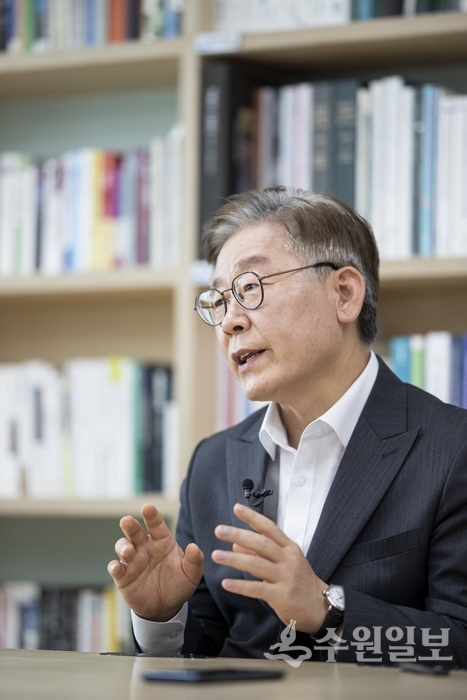
[Suwon Ilbo=Park No-hun] Gyeonggi Province Governor Lee Jae-myung reiterated the necessity of universal basic income while critiquing the nation's welfare reality.
Governor Lee stated on SNS on the 5th, "While South Korea is generally an advanced nation overall, in terms of welfare, we cannot escape the label of being backward in both scale and quality." He added, "Advanced welfare nations have well-established social safety nets and welfare systems with high tax burden rates, so the need for and ease of implementing universal basic income is not great."
He elaborated, "Paradoxically, universal basic income is harder to implement in advanced welfare nations and easier in welfare-backward nations like ours. It is regrettable that many people believe Korea is advanced in all aspects, including welfare, simply because it is an advanced nation overall."
Regarding specific measures for universal basic income, the governor explained, "In the short term, we can secure 25 trillion won (500,000 won per capita) through budget cuts and prove the effect of basic income by distributing 250,000 won twice a year. In the mid-term, assuming public consensus on basic income, we can secure an additional 25 trillion won by reducing tax incentives (5-60 trillion won annually) and distribute quarterly payments. In the long term, we can gradually introduce and expand various purpose-specific taxes for basic income—such as carbon tax, data tax, robot tax, and land tax—with the premise of public consent for tax increases dedicated to basic income."
Finally, he added, "When South Korea's GDP reaches 3-4 quadrillion won and the national tax burden rate rises to advanced nation levels, resulting in state budgets of over 1,000 trillion won, universal basic income of 500,000 won per capita monthly (equivalent to basic livelihood support levels) will become entirely feasible."
Below is the full text of Governor Lee Jae-myung's SNS post.
<In welfare-backward nations, basic income as a welfare-oriented economic policy is both possible and necessary>
. Highest elderly poverty rate in the world
. Highest elderly suicide rate, youth suicide rate, and overall suicide rate in the world
. Among the world's highest industrial accident mortality rates
. Welfare spending at half the OECD average
. Government support for household income among the world's lowest => Household debt ratio among the world's highest, national debt ratio among the world's lowest
. Tax (national) burden rate falls far short of OECD average
Which country is this? It is the regrettable reality of Korea's backward welfare system. While South Korea is generally an advanced nation, in welfare matters it remains backward in both scale and quality. We must correct policies that are unusually stingy toward citizens and make Korea an advanced nation in welfare as well.
The economic effect and income inequality mitigation effect of the first disaster relief payment at 13.4 trillion won were greater than the second to fourth selective cash support that cost 40 trillion won, because it was distributed fairly through local currency, increasing sales for small business owners.
If the first disaster relief payment becomes regularized—whether once a year or twelve times a year—it becomes universal basic income.
Advanced welfare nations have well-established social safety nets and welfare systems with high tax burden rates, so the necessity and feasibility of basic income implementation is not great. This is because implementing basic income would require either pushing already-high tax burden rates even higher or burdening the system with consolidating and converting existing welfare programs into basic income. Don't you understand why national referendums on basic income proposals failed even in advanced welfare nations like Switzerland?
Welfare-backward nations like ours with low-burden, low-welfare systems must progress from mid-burden, mid-welfare toward long-term high-burden, high-welfare, which requires substantial increases in both burden rates and welfare spending.
Of the increased welfare spending, some should be used to strengthen social safety nets or expand traditional welfare (targeted or universal), and some should be used to introduce and expand universal basic income, which has significant economic effects.
That is why, paradoxically, basic income implementation becomes more difficult in advanced welfare nations and easier in welfare-backward nations like ours. It is regrettable that many people believe Korea is advanced in all aspects, including welfare, simply because it is an advanced nation.
Tax increases are sensitive matters requiring governmental resolve, so they cannot be raised arbitrarily without public consent. Universal basic income, as a welfare-oriented economic policy, is not a traditional welfare method that excludes taxpayers but allows taxpayers to benefit as well, with high-income earners gaining more from economic growth gains, making it easier to obtain public consent.
In the short term, we can secure 25 trillion won (500,000 won per capita) through budget cuts and prove the effect of basic income by distributing 250,000 won twice a year. In the mid-term, assuming public consensus on basic income, we can secure an additional 25 trillion won by reducing tax incentives (5-60 trillion won annually) and distribute quarterly payments. In the long term, we can gradually introduce and expand various purpose-specific taxes for basic income—such as carbon tax, data tax, robot tax, and land tax—with the premise of public consent for tax increases dedicated to basic income.
When South Korea's GDP reaches 3-4 quadrillion won and the national tax burden rate rises to advanced nation levels, resulting in state budgets of over 1,000 trillion won, universal basic income of 500,000 won per capita monthly (equivalent to basic livelihood support levels) will become entirely feasible.
Postscript.
The short-term goal of 2 million won annually for a family of four appears small when divided monthly per person to about 40,000 won, but it is money as precious as life not only to those who steal bread out of hunger and end up in prison or whose entire families commit suicide for survival costs of 300,000 won, but also to the vast majority of ordinary people.

Loading comments…