


Lee Jae-myung: "Basic Finance, a Multi-Purpose Welfare Financial Policy"
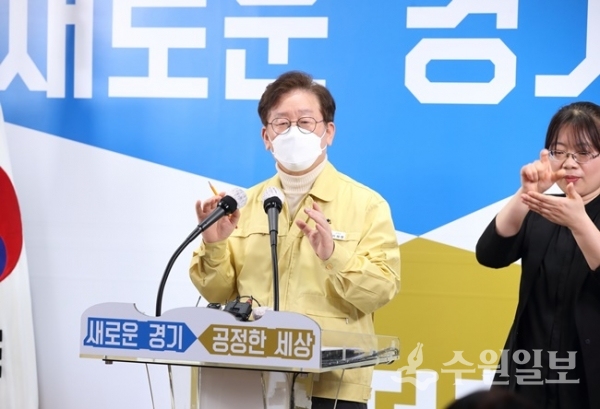
[Suwon Ilbo = Reporter Park No-hun] Gyeonggi Province Governor Lee Jae-myung once again expressed the necessity of basic finance.
On the 2nd, Governor Lee presented his position through SNS, explaining issues with monetary and financial policy as well as the difficulties faced by those with poor credit and early-career workers.
The Governor stated, "According to a Gyeonggi Province survey, even if we lend 5 million won each to 200,000 young people at an annual 2.8% rate over 10 years for a total of 1 trillion won, and assume a final loss rate of 5%, the required amount is only approximately 5 billion won annually," and added, "This is less than one-tenth of the 50 billion won annual welfare loan budget that Gyeonggi Province currently operates for those with extremely poor credit."
He continued, "In addition, basic finance is conceived as allowing anyone to open a basic account, as adopted in developed Western countries, to use an interest-bearing overdraft account within 10 million won that cannot be seized, while allowing long-term savings at 1% within the 10 million won range. This is precisely a multi-purpose welfare financial policy that restores monetary and financial policy to its proper function to revive the economy, overcomes financial exclusion to realize inclusive finance, and alleviates income polarization," he argued.
The following is the full text of Gyeonggi Province Governor Lee Jae-myung's SNS post.
<Welfare Economic Policy that Alleviates Polarization and Activates the Economy (Basic Finance = Basic Loan + Basic Savings)>
Monetary and financial policy is a major policy tool for economic adjustment, and in modern society, the source of credit is not the money held by individual banks but the state's right to issue currency based on national sovereignty.
There was a time when there were many places to invest but insufficient funds to invest, so by concentrating monetary and fiscal policy on the supply side, the supply capacity would expand, leading to sequential increases in investment-employment-household income-consumption-demand, and then investment-employment-income would sequentially increase again, creating a virtuous cycle while the economy achieved high growth.
However, despite having more capital and infrastructure, higher-quality technology and labor force than before, due to technological revolution and deepening polarization, money to invest abounds but there are nowhere to invest, and with relative decline in household income, consumption and demand have decreased, making economic recession and low growth routine.
It is an era where even if interest rates fall to 0%, there is excess money to invest, so as a result of high-credit borrowers pursuing asset speculation rather than investment through low-interest loans, asset prices skyrocket and polarization only worsens, while those with poor credit excluded from financial benefits (financial exclusion) have no money for education, capacity development, investment, entrepreneurship, and consumption, leaving them with no choice but to turn to loan companies charging over 20% annual interest or illegal financial lenders charging murderous 400% or higher rates.
Providing opportunities for small, long-term, low-interest loans so anyone can use small amounts for consumption or investment, impossible to cause moral hazard, is precisely the inclusive and fair finance recommended by the international community, and is basic lending.
Finance based on state power should not be a monopoly of those with good credit, and finance, while pursuing profit, should not ignore its public character. However, unfortunately, housing banks for supporting low-income housing and national banks for low-income finance have all become commercialized banks through mergers and acquisitions, resulting in public interest being ignored and focus on profit alone, leading to financial exclusion becoming routine, not only depriving ordinary citizens of financial benefits but also preventing monetary finance from functioning as a policy tool.
Loan companies are lending money averaging around 9 million won at rates exceeding 20% annually to millions of people without collateral or credit, and this amount is one that must be repaid to the extent of one's ability, meaning moral hazard is impossible. Among them, approximately 93% properly repay principal and interest despite the murderous high interest rates.
But why should we bear on behalf of others the money that approximately 7% of them cannot pay, simply because they are poor and struggling? It is the result of predatory finance that goes against the principles of community, and is no different than the shameful national disease of making a neighbor pay military service fees on behalf of a fellow villager.
If those who cannot receive financial benefits as early-career workers or those with poor credit are given opportunities for small loans at typically low interest rates over 10 to 20 years, they can avoid the risk of permanent inability to recover due to temporary difficulties, and by facilitating the flow of money, it will also help stimulate the economy.
It is difficult to assume that one would deliberately not repay money under 10 million won despite incurring disadvantages from poor credit record listing, and if someone cannot repay despite decades of effort while enduring poor credit record listing, they are already a welfare recipient.
Given that basic livelihood security benefits reach 7-8 million won annually, even if the shift to welfare recipient status through basic lending is delayed by 1-2 years, the state's welfare burden is reduced accordingly, so basic lending actually benefits national finances, and the fiscal burden from basic lending is not significant.
According to a Gyeonggi Province survey, even if we lend 5 million won each to 200,000 young people at an annual 2.8% rate over 10 years for a total of 1 trillion won, and assume a final loss rate of 5%, the required amount is only approximately 5 billion won annually. This is less than one-tenth of the 50 billion won annual welfare loan budget that Gyeonggi Province currently operates for those with extremely poor credit.
In addition, basic finance is conceived as allowing anyone to open a basic account, as adopted in developed Western countries, to use an interest-bearing overdraft account within 10 million won that cannot be seized, while allowing long-term savings at 1% within the 10 million won range.
This is precisely a multi-purpose welfare financial policy that restores monetary and financial policy to its proper function to revive the economy, overcomes financial exclusion to realize inclusive finance, and alleviates income polarization.

Loading comments…