After 'Insolvency' Comes Caution or Crisis? ... Gyeonggi Province Struggles with 'Insolvency' Standards
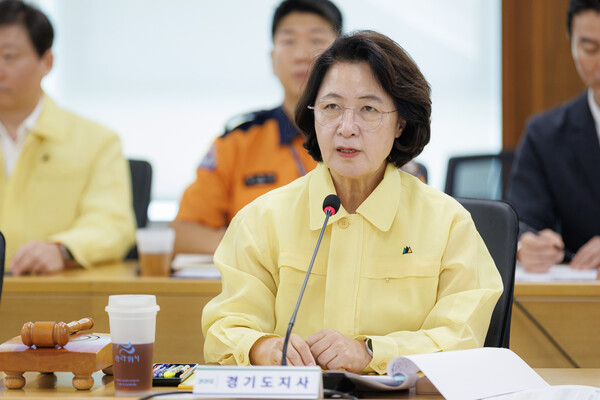
Gyeonggi Province Governor Choo Mi-ae has stepped back from declaring Gyeonggi Province's financial situation as "practically insolvent" to "would be insolvent if this continues." The diagnosis of an already-occurring 'insolvency' has shifted to a potential 'possibility of insolvency' in the future.
On the 14th, Governor Choo posted on social media: 'Please understand and evaluate Gyeonggi Province's actual situation,' comparing the province's finances to 'household finances,' stating that "the debt-to-budget ratio is merely an empty figure that looks good on paper."
Governor Choo has argued that Gyeonggi Province's fiscal maneuverability has significantly decreased, citing 7 trillion won in debt, declining acquisition tax, increased local bonds, and burdensome fixed expenditures. She additionally presented 2024 assets of approximately 43.3 trillion won and liabilities of approximately 6.6 trillion won, a 36.1% increase in debt from 2023 to 2025, and dependence on acquisition tax which accounts for roughly half of local tax revenue.
However, she did not provide criteria for determining at what level these figures would constitute 'insolvency.'
The Local Finance Act contains no legal term called 'insolvency.' Instead, a system exists to designate Financial Caution Units, Financial Crisis Units, and more severe Emergency Financial Management Units based on the degree of fiscal risk faced by local governments.
Notably, Article 60-3 of the Local Finance Act allows designating an Emergency Financial Management Unit when a local government cannot pay employee salaries for 30 or more days, or cannot repay principal or interest on maturing debt for 60 or more days. This is the provision closest to defining a local government 'insolvency' in the current legal system.
Prior stages of financial caution and crisis also have quantitative standards. The debt-to-budget ratio exceeding 25% is the 'caution' threshold, and exceeding 40% is the 'crisis' threshold. The debt service ratio standards are 12% and 17% respectively.
However, all six financial indicators for Gyeonggi Province that the Ministry of the Interior and Safety monitors quarterly fall below the caution threshold. The ministry stated "all indicators are below the caution level," and Gyeonggi Province is aware it does not meet the criteria for a Financial Crisis Unit under current Local Finance Act provisions (as reported on August 10: "[Exclusive] Gyeonggi Province Claims 'Practically Insolvent' While Government Says Otherwise—'Crisis' or 'Overstatement'?").
Person A, involved in Gyeonggi Province finances, stated: "It is important that local finances operate according to the legal framework, and if current standards do not properly reflect reality, the government or National Assembly should be asked to revise relevant laws," adding "If Gyeonggi Province, which currently does not meet 'caution,' is already called 'insolvent,' does that mean 'caution' comes after 'insolvency,' followed by 'crisis'?"
Governor Choo also compared Gyeonggi Province's finances to 'household finances,' arguing that statutory indicators alone cannot explain actual financial conditions. Her point: borrowed funds have already been spent on living expenses, owned assets are not abundant, fixed expenditures continue to rise, and future income is unstable. She asked: "Is it responsible for a family provider to say there's no problem because the loan maturity hasn't arrived yet?"
Governor Choo presented 2024 Gyeonggi Province assets of approximately 43.3 trillion won and liabilities of approximately 6.6 trillion won, stating "the fundamental problem is that debt is high while the means to repay it are not abundant." Based on an asset-to-liability ratio of 15.3%, she claimed this was the highest among metropolitan governments.
However, Gyeonggi Province's total assets include social infrastructure like roads and rivers that are difficult to liquidate for debt repayment, making simple comparison to cash or real estate held by individuals inappropriate.
However, comparing liquid assets and liquid liabilities—which represent assets that can be liquidated within a short period and debt due within one year—Gyeonggi Province's 2024 liquid assets are 4.7779 trillion won and liquid liabilities are 1.6342 trillion won. Liquid assets exceed liquid liabilities by 3.1437 trillion won, approximately 2.9 times the size.
Using Governor Choo's 'household finances' analogy and calculating per capita for the 14.2 million provincial residents: liquid assets per resident are approximately 330,000 won, and liquid liabilities approximately 110,000 won. Subtracting the two yields approximately 220,000 won in remaining liquid assets per resident.
Even when determining individual 'insolvency'—inability to pay—courts do not judge based solely on the fact of debt or asset-to-liability ratios.
The Supreme Court judges insolvency by comprehensively considering the debtor's occupation, career, qualifications, skills, work capacity, family relations, and details and scale of assets and liabilities, determining whether the debtor cannot generally and continuously repay currently maturing debt with current assets, credit, and income (Supreme Court Decision 2008Ma1651, March 2, 2009).
Person A stated: "If comparing to household finances, you must look not only at total debt but also at money currently due, immediately available assets, and whether future income can cover this," adding "Currently available sources are limited to Local Finance 365 and the 'Gyeonggi Province Debt Map' created by Provincial Councilor Kim Han-seul, but even these make it difficult to determine who creditors are for each debt, their respective interest rates, and annual principal and interest payment obligations."
Another problem Governor Choo emphasized is the unstable revenue structure.
Governor Choo stated: "This year, approximately half of Gyeonggi Province's local tax revenue is acquisition tax," arguing the dependence is overwhelmingly higher than Seoul at 23.5% and Daejeon at 21%. She continued: "Even if the industrial economy improves, assets and revenue do not improve," saying "there is no tax source besides acquisition tax."
High dependence on acquisition tax is confirmed by the numbers.
In 2024, Gyeonggi Province collected 15.1114 trillion won in total local taxes. Of this, acquisition tax accounted for 7.7655 trillion won, or 51.4%. Governor Choo's point that more than half of local taxes being acquisition tax means high revenue volatility from real estate transaction changes is well-founded.
However, the claim that "there is no tax source besides acquisition tax" differs from the actual revenue structure.
That same year, local consumption tax was 3.6295 trillion won (approximately 24.0%), local education tax was 2.0791 trillion won (approximately 13.8%), registration and license tax was 613.7 billion won (approximately 4.1%), regional resource facility tax was 501.4 billion won (approximately 3.3%), and leisure tax was 445.5 billion won (approximately 2.9%).
These five tax categories excluding acquisition tax combined total 7.2692 trillion won, approximately 48.1% of total local taxes. Compared to acquisition tax of 7.7655 trillion won, this is only approximately 496.3 billion won (approximately 6.4%) less.
Person A stated: "High dependence on acquisition tax and vulnerability to real estate market changes are entirely different from having no tax source besides acquisition tax," arguing "Mentioning the acquisition tax problem without efforts to address real estate market changes, then declaring 'insolvency' when current standards don't apply, puts the cart before the horse."
Governor Choo has progressively heightened warning levels about Gyeonggi Province's finances by repeatedly presenting increased debt, fund borrowing, declining acquisition tax, rising fixed expenditures, and asset-to-liability ratios. However, to date she has not publicly disclosed separate criteria for determining at what level these indicators combined would constitute 'insolvency.' A Gyeonggi Province official stated: "The Governor judges the current financial situation as insolvency," and "specific criteria for judgment are being confirmed through comparative analysis of various indicators."