[Exclusive] Lee Says "Integrated Military Academy to Prevent Coup"... What Checks Against New 'Three-Service Unified Military Network'?
President Lee Jae-myung directly raised the issue of past military actions by Korea Military Academy (KMA) graduates and their monopoly over military leadership as a reason for integrating the Army, Navy, and Air Force academies, drawing attention to whether the academy integration debate will expand to military power structure issues.
During a defense ministry briefing on the 5th, President Lee pointed out that while the KMA was at the center of repeated military actions in the past, no accountability was pursued. He stated: "We must make it structurally impossible to repeat this going forward." He also noted the increasing proportion of KMA graduates among senior generals, emphasizing: "If we integrate, won't such possibilities be reduced somewhat?"
However, some argue that military academy integration could create a new form of military network alongside weakening the existing KMA-centered one. If officers of the same class educated together at an integrated academy subsequently spread across the Army, Navy, and Air Force, a unified three-service military network with greater authority than existing service-based networks could emerge.
A military network refers to an informal personal network formed within the military through shared educational background, commissioning path, and class year. When a specific cohort occupies key command and personnel positions for extended periods, it functions as an influential relationship network within the organization, separate from the official chain of command.
News S interviewed Rep. Bu Seung-chan(Air Force Academy class 43, Democratic Party, Yongin-B, Gyeonggi), who supports academy integration, and Rep. Lim Jong-deuk(Korea Military Academy class 42, People Power Party, Yeongju, Yeongyang, and Bonghwa, North Gyeongsang Province), who opposes it, regarding the possibility of military network formation after integration. Both acknowledged the possibility of new personal networks forming, but disagreed sharply on the risks and solutions.
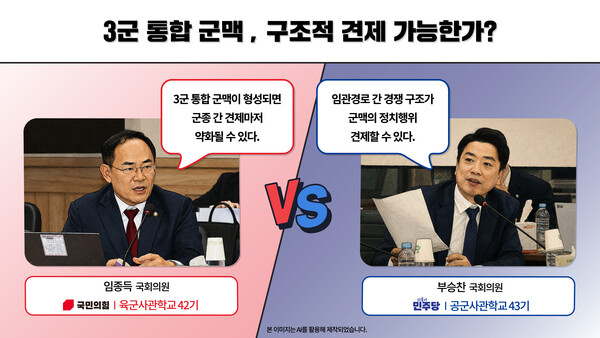
Both representatives agreed that integrating military academies alone cannot prevent military network formation. However, they differed on how to view and check the newly formed networks.
Rep. Bu stated: "The logical grounds for believing that academy integration can block military network formation are quite weak. It's natural for personal networks to form everywhere, not just the military, and the same applies to an integrated academy."
However, Rep. Bu viewed the problem as not the existence of military networks themselves, but rather specific cohorts monopolizing military leadership positions. As a solution, he proposed activating diverse commissioning pathways such as ROTC and the Army's alternative military academy alongside the integrated academy to foster competitive dynamics among different cohorts.
Rep. Bu stated: "If we maintain the integrated military academy, reduce mandatory service to five years, and activate the alternative academy and ROTC, natural competition will occur. Active competition enables natural checks and oversight, and many negative effects from military networks such as cartel formation and backroom martial law attempts will likely disappear."
Conversely, Rep. Lim stated: "Academy classmates naturally form personal networks. If officers who shared the same class at an integrated academy disperse to the Army, Navy, and Air Force after graduation, a personal network connecting all three services could form, unlike existing service-based networks."
Rep. Lim particularly emphasized that the current existence of the Army, Navy, and Air Force as independent organizations with distinct identities, traditions, and interests functions as an internal checks mechanism within the military.
Rep. Lim stated: "There are concerns that the inter-service checks function itself may collapse when academies are integrated. The independence of each service through inter-service checks and cooperation performs an internal mutual oversight function separate from civilian control."
While Rep. Bu views competition among commissioning pathways as a check against military power monopoly, Rep. Lim emphasizes service independence and mutual checks. Regarding potential military networks after integration, Rep. Bu believes adverse effects can be reduced through competition with different cohorts, while Rep. Lim expressed concern that school-based and class-based networks connecting all three services could weaken existing inter-service checks.
This has prompted calls for establishing separate structural oversight and checks mechanisms to prevent newly formed military networks from developing into closed power groups alongside academy integration.
A military expert stated: "If integrated academy graduates simultaneously advance to leadership positions in the Army, Navy, and Air Force, a new military network penetrating all three services could form. Since the president cited coup prevention as the rationale for integration, discussions should not stop at merely weakening existing KMA networks."
The expert continued: "While it's difficult to prevent new military networks from forming, it's necessary to monitor concentration of high-ranking positions by background and strengthen oversight and control by the National Assembly to prevent specific networks from monopolizing personnel and command authority. Furthermore, institutional checks must be discussed to ensure military networks don't lead to political intervention."
Hong Kyou-deok, chair professor at Sookmyung Women's University, also expressed concern in a recent media interview that countries operating unified military academies for the Army, Navy, and Air Force lost inter-service checks and balance, suggesting consolidation could lead to a 'cartel without checks'.
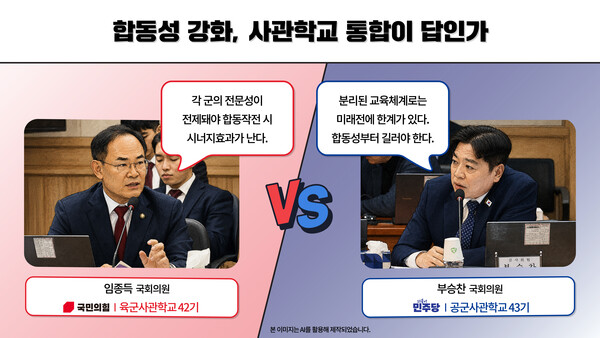
The government's primary justifications for military academy integration have been enhanced jointness for future warfare and improved talent recruitment. As battlefields expand to include space and cyber domains alongside traditional military services, the government maintains that jointness must be strengthened from the officer training phase. The plan involves integrating separate military academies to improve educational conditions, implementing common training during the cadet phase to develop jointness, and providing service-specific specialized training.
Both sides of the integration debate showed different perspectives on this rationale.
Rep. Bu explained that the purpose of military academy integration is not solely dismantling military networks but reforming officer training systems to match changing future warfare environments.
Rep. Bu stated: "With battlefields expanding to space and cyber domains beyond the traditional Army, Navy, and Air Force, the existing separate service-based education system has limitations. Issues with talented personnel recruitment, including declining academy applicants, post-enrollment attrition, and early retirement, can also be addressed through integration."
Conversely, while Rep. Lim agreed on the need to strengthen jointness in future warfare, he argued there is no reason to link this to physical integration of academies. He maintains that physical constraints can be overcome through common courses and distance education, so physical academy integration is not a prerequisite for jointness.
Rep. Lim stated: "Jointness means integrating each service's specialties at necessary times and places based on each service's expertise to create synergy. If cadet-level understanding of other services is needed, this can be achieved without merging schools."
In fact, existing debates surrounding military academy integration focus on jointness versus specialization and integration methods. While the government emphasizes 'enhanced jointness' as the core rationale for integration, alumni associations of the Army, Navy, and Air Force academies opposing integration and opposition parties argue that each service's identity and specialization could be compromised.
With President Lee presenting coup prevention as one reason for military academy integration, the scope of discussion has expanded beyond officer training to military power structure.
Notably, as military officers from both ruling and opposition parties recognized that military networks could form even after integration, how to check such networks has emerged as a new issue.
With arguments being raised that separate structural oversight and checks mechanisms must be established to prevent unified three-service military networks from leading to monopolization of command and personnel authority by specific cohorts or political intervention after integration, attention is growing on whether future military academy integration discussions will extend to issues of dispersing and controlling military power.