


Korean Local Government Delegation Visits Costa Rica's First Vice President
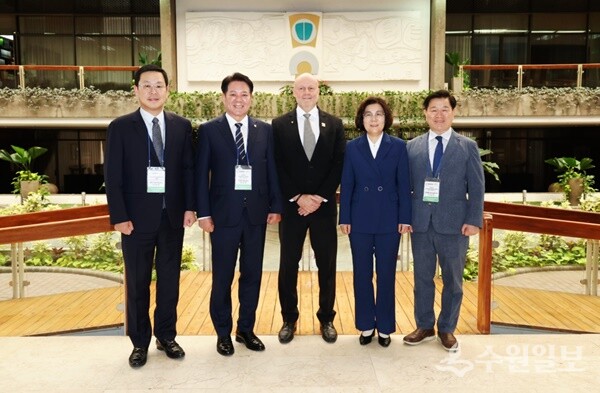
[Suwon Ilbo=Reporter Park Chan-hyuk] A Korean local government delegation organized by the National Council of Local Governments for Social Solidarity Economy (Chairman Anseong Mayor Kim Bo-ra, hereinafter "Council") visited Costa Rica, a global leader in sustainable development, on June 30, paid a courtesy call on the First Vice President, confirmed the achievements of bilateral cooperation and exchange over the past decade, and discussed practical measures to strengthen cooperation between the two countries following the launch of South Korea's new administration.
The delegation was composed of Anseong Mayor Kim Bo-ra, Chairman of the National Council of Local Governments for Social Solidarity Economy; Park Seung-won, Gwangmyeong Mayor and Vice Chairman of the Council; and Anyang Mayor Choi Dae-ho, Chairman of the Democratic Party's Basic Local Government Council. The visit was undertaken to expand the scope of cooperation between the Council, which has maintained steady exchanges centered on the social economy sector, and the Costa Rican government.
The meeting, held at the Presidential Palace in San José, Costa Rica's capital, was attended by the local government delegation, Costa Rica's First Vice President Stephan Brunner, Jorge Valerio, Costa Rican Ambassador to South Korea, Kim Gwang-ryong, Counselor at the Korean Embassy in Costa Rica, and other officials overseeing Korea-Costa Rica diplomacy.
Council Chairman Kim Bo-ra summarized the progress of cooperation between Korean local governments and the Costa Rican government since 2016 and emphasized the need to further activate private exchanges between the two countries to enrich the fruits of Korean local government diplomacy. To this end, Chairman Kim Bo-ra proposed establishing a new youth exchange program between the two countries in the fields of sustainable development and social economy.
Gwangmyeong Mayor Park Seung-won noted that Costa Rica's leadership in sustainable development was the result of efforts toward coexistence such as conservation and development, and the elimination of economic inequality, and explained the achievements of bilateral cooperation in the social economy sector, such as Gwangmyeong City's fair trade coffee promotion project in Korea since 2023. Mayor Park also emphasized that many points of correspondence exist between Gwangmyeong City's garden city policy and Costa Rica's development policy centered on ecological conservation, and proposed concrete future cooperation.
Anyang Mayor Choi Dae-ho highly evaluated the potential of bilateral cooperation and presented practical measures for Korean local governments and Costa Rica to cooperate in various fields including not only the social economy sector but also sports. In particular, Mayor Choi noted that Costa Rica is leading Central and South America not only in primary industries such as agriculture and service industries such as tourism, but also in cutting-edge industries such as AI, and requested greater interest from the Costa Rican government in expanding exchanges with Anyang City enterprises.
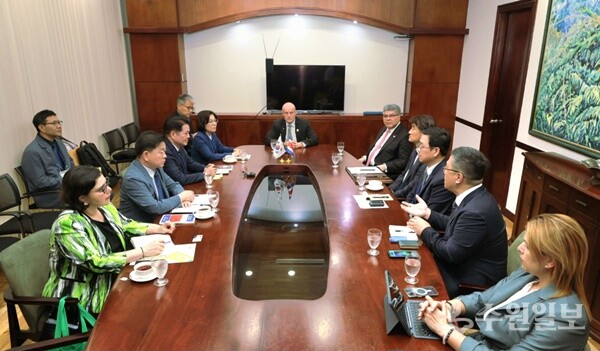
First Vice President Brunner, who oversees Costa Rica's economic policy, commended the Korean local government diplomacy for advancing bilateral cooperation to the next level, and highly praised the fact that, through the Council's continued efforts since 2016, exchanges and cooperation between the two countries have produced tangible results rather than remaining at the level of declarations.
First Vice President Brunner also noted that Korea and Costa Rica share aspirations for peace, coexistence, and sustainability despite different circumstances, and emphasized his hope that cooperation between the two countries will help citizens of both nations recognize the importance of these values. He further praised the cooperation measures proposed by the Korean local government delegation and expressed his desire to realize them as concrete business programs through official diplomatic channels and local government diplomacy channels including the Council.
The local government delegation has been visiting Costa Rica since June 29 to explore policy models that will help establish domestic local governments' sustainable development models through consultations with the Costa Rican government and to conduct local government diplomacy. In addition to the courtesy call on the Vice President, the delegation plans to visit major government institutions and businesses in Costa Rica to continue creating tangible results in bilateral cooperation.
The exchange between Korean local governments and Costa Rica, which began with the occasion of the Costa Rican President's state visit to Korea in 2016, was launched in earnest when a "Korean Local Government Delegation," led by the Council in 2017, visited Costa Rica at the invitation of the Costa Rican government. Subsequently, cooperation between the two countries has been practiced in various ways, including △ sister city relationships between local governments of both countries △ Korean local government visits to Costa Rica for benchmarking best practices in social economy △ visits by Korean government delegations to Costa Rica △ a dinner gathering during the 2021 state visit to Korea by then-Costa Rican President Carlos Alvarado △ fair trade projects between the two countries.
The local government delegation's visit to Costa Rica is expected to serve as an opportunity to reflect on a decade of cooperation achievements and to elevate bilateral diplomatic results to a higher level as South Korea launches its new administration.
Meanwhile, the National Council of Local Governments for Social Solidarity Economy, which led this Korean local government delegation's visit to Costa Rica, is an administrative council established in 2013 to promote social economy activation. It is promoting various projects to revitalize the regional social economy, including developing social economy policies and promoting institutional improvements, discovering and supporting excellent regional social economy enterprises, providing innovative public services through social economy methods based on private-public cooperation, and international cooperation.
Loading comments…