


First Half of Locally-Elected 8th Term Provincial Administration Summary Securing Comfortable Commutes with New Transportation Policies
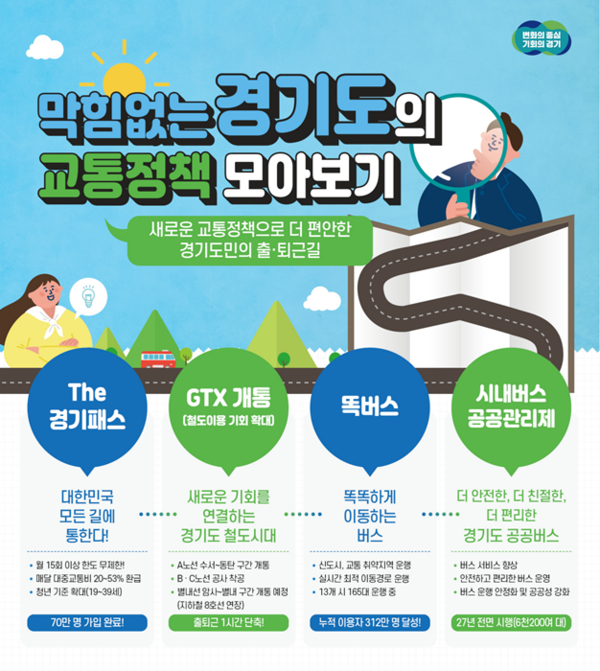
[Suwon Ilbo=Reporter Kim Gab-dong] The first half of the 8th term of Gyeonggi Province's locally-elected administration has seen an outpouring of new transportation policies and results, including △implementation of The Gyeonggi Pass, which 'connects all roads in South Korea' △successful settlement of Ddokbus, the 'smartly moving bus' △first opening of GTX (Capital Area Express Railway) after a 15-year wait △175% expansion of annual local road budget. Here is a summary of major transportation policies and projects.
■ The Gyeonggi Pass - Connecting All Roads in South Korea
The Gyeonggi Pass is a public transportation promotion policy and climate crisis response policy of Gyeonggi Province, based on the Ministry of Land, Infrastructure and Transport's public transportation fare refund support project (K-Pass) with additional benefits exclusive to Gyeonggi residents.
The Gyeonggi Pass provides fare refunds of 20% (30% for young adults in their 20s and 30s, 20% for general adults 40 and older, 53% for low-income groups) when using public transportation 15 or more times per month. While K-Pass has a monthly 60-trip refund limit, The Gyeonggi Pass expanded the 60-trip limit to unlimited. Additionally, the age criteria for young adults eligible for 30% refunds was expanded from 19-34 to 19-39 years old. The province is also promoting the 'Gyeonggi Province Children and Youth Transportation Fee Support Project,' which provides annual support of 240,000 won to reduce transportation costs for children and teenagers under 19, who are not eligible for the K-Pass project.
The Gyeonggi Pass subscribers can receive fare refunds when using any public transportation nationwide, including express buses, Bundang Shinbundang Line, and GTX (Capital Area Express Railway), which opened in March this year.
Service began on May 1, and as of June 12, 680,000 people have registered for The Gyeonggi Pass. Of the new Gyeonggi Pass subscribers, 380,000 are new sign-ups (exceeding 50%), and 300,000 are transfers from the existing Aelteul Transportation Card. The province aims to achieve 1 million Gyeonggi Pass subscribers by the end of this year.
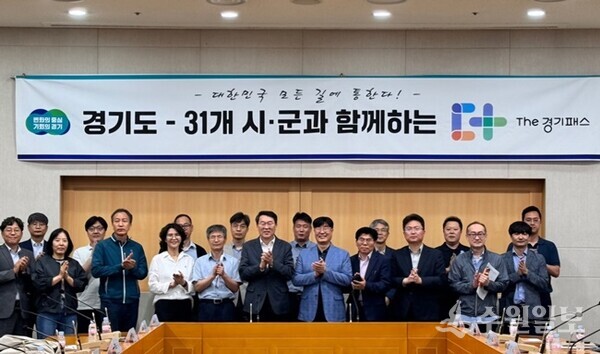
Gyeonggi Province held two city and county department head meetings chaired by the Director of Transportation since the end of last year through this year, requesting cooperation from cities and counties in securing stable finances and promoting The Gyeonggi Pass. The province recognizes that public promotion from front-line locations is crucial for continued subscriber growth, requesting that each city and county conduct independent promotional activities using residential service centers, bus stops, and subway stations, and operate consultation centers for digital underprivileged groups who have difficulty using smartphones. Additionally, the province requested attention to supplementary budget allocation following increases in subscribers.
■ Ddokbus - The Smartly Moving Bus
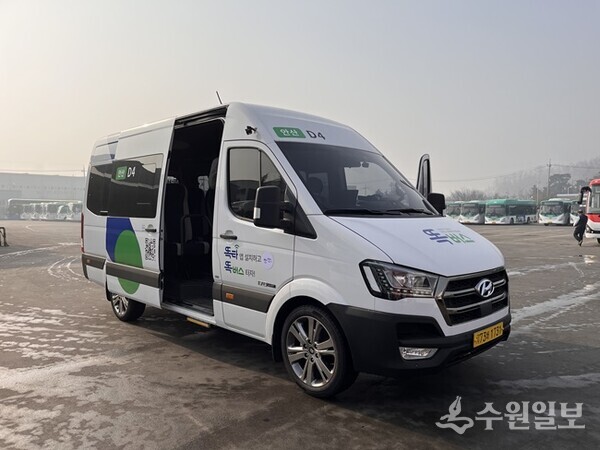
'Ddokbus' is the proprietary brand of Gyeonggi Province's demand responsive transport system (DRT), meaning 'smartly moving bus.' Ddokbus is a customized public transportation service that flexibly transports passengers in response to rider requests in new cities or transportation-disadvantaged areas without fixed routes and predetermined operating schedules. Unlike conventional buses with set routes, it uses the latest IT technology based on user location information to create real-time optimal travel routes in response to passenger demand.
Ddokbus began as a pilot operation in Paju in December 2021, and launched full-scale operations starting with Daebu in Ansan in March 2023. This year, it has expanded to operations in 20 cities and counties with 265 buses. As of June 12, cumulative users exceeded 1.603 million. In particular, Ddokbus is also operating in northern Gyeonggi areas such as Gimpo and Yangju, establishing itself as a new transportation mode. Ddokbus won the Presidential Award at the 2023 Government Proactive Administration Excellence Competition and was selected as an outstanding case in the 'Joint Evaluation of Local Governments' conducted by the Ministry of the Interior and Safety this year.
■ Expansion of City Bus Public Management System
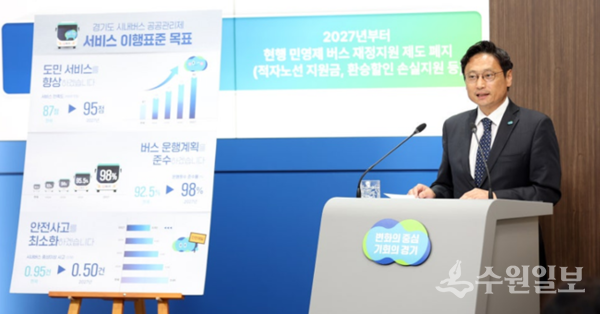
Beginning January 1, 2024, Gyeonggi Province's quasi-public operation 'City Bus Public Management System' has been implemented.
As the quasi-public operation system has proven effective in ensuring stable bus company operations, improving employee treatment, and thereby enhancing transportation services, the need for its introduction has been continuously raised in Gyeonggi Province. Governor Kim Dong-yeon pledged 'implementation of city bus quasi-public operation' as a transportation sector campaign promise, and after taking office in September 2022, announced the 'Gyeonggi Province City Bus Stabilization Comprehensive Plan,' which included plans to transition city bus routes to quasi-public operation by 2027.
The 'Gyeonggi Province City Bus Public Management System,' which debuted this year, focuses on strengthening public management of city buses. Its core is enhanced accountability through annual comprehensive evaluations at the route level covering safety management and improved passenger service, with decisions on renewal of the public management system made every three years to strengthen publicness and transparency.
Gyeonggi Province plans to transition approximately 6,200 city buses throughout Gyeonggi Province to the public management system by 2027, starting with 1,200 city buses in 2024.
To reduce the financial burden of operating the city bus public management system, Gyeonggi Province plans to make comprehensive efforts to efficiently reorganize routes, progressively reduce private operation financial support, and prevent unnecessary budget allocation and duplicate financial support. The province is also promoting the establishment of an 'integrated ERP system' that comprehensively manages bus companies' management activities, including accounting, transportation costs, and driving habit management, for transparent and swift cost settlement.
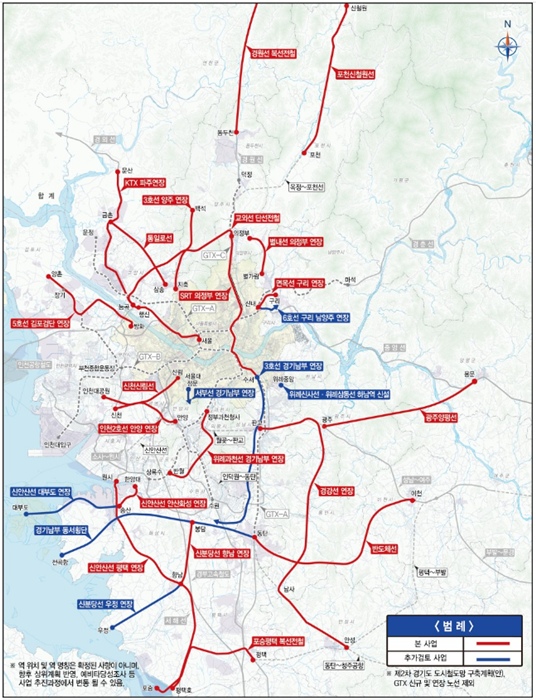
■ Opening the Gyeonggi Province Railway Era - Connecting New Opportunities
In March, the province announced the 'Gyeonggi Province Railroad Basic Plan (2026-2035),' presenting an extensive railway vision of 42 total routes (total length 645km, total project cost 40.7 trillion won): 27 routes of high-speed rail, regular rail, and metropolitan rail, and 15 routes of urban rail. Through this, the province promised residents to expand high-speed rail benefit areas, such as northern Gyeonggi Province, and create more opportunities, including the southern semiconductor line.
In relation to this, several railway projects have been completed or are underway in the 8th term of Gyeonggi Province's locally-elected administration. On March 30, the Seoser-Dongtan section of the Capital Area Express Railway (GTX) Line A opened. GTX's origins trace back to April 2009, when Gyeonggi Province and the Korean Transportation Association first proposed the GTX three-line project to the Ministry of Land, Infrastructure and Transport; 15 years later, it became the transportation lifeline for province residents.
On December 16, 2023, the Gyeongwon Line electric railway between Dongducheon and Yeoncheon opened, reducing travel time from 30 minutes to 16 minutes and enabling travel to Seoul's Yongsan in about 1 hour and 40 minutes, contributing to improved transportation conditions in northern Gyeonggi. Additionally, the Seohae Line Daegok-Sosa section opened on July 1, 2023, connecting Wonsik Station in Ansan to Ilsan Station in Goyang without transfers, making the journey possible in 1 hour and 10 minutes. The Daegok-Sosa Line is classified as a general railroad project, which should be entirely funded by the state; however, it is the only case where a local government covered 10% of project costs.
The Byeolnae Line (Amsa-Byeolnae section), which began construction in 2015, has started test operation ahead of August opening. The line connects six stations over a total length of 12.9km, from Amsa Station in Gangdong-gu, Seoul to Byeolnae Station in Namyangju. With the Byeolnae Line opening, trains will operate at 4.5-8.0 minute intervals on weekdays, making the Byeolnae-Jamsil section journey possible in approximately 27 minutes. Transfers are also possible to Lines 2, 3, 5, 9, the Suin-Bundang Line, the Gyeongui-Jungang Line, and the Gyeongchun Line, promising to improve transportation conditions and promote regional development in the northeastern Gyeonggi area.
■ Accelerating Citizens' Steps! Road Budget Significantly Expanded
The annual local road budget during the 8th term of locally-elected administration increased 175% compared to the 7th term. From an average of 1.705 billion won annually during the 7th term—1.508 billion won in 2019, 1.530 billion won in 2020, 2.235 billion won in 2021, and 1.545 billion won in 2022—it rose to an average of 2.983 billion won annually during the 8th term, with 2.144 billion won in 2023 and 3.821 billion won in 2024.
Aided by such expanded investment, Provincial Road 359 (Munsan-Naipo 1) opened in June 2023, National Road 98 (Onam-Sudong) in March 2024, and Provincial Road 391 (Yamil Pass) in April 2024. Notably, National Road 98 (Onam-Sudong) completed construction in 6 years and 3 months, typically requiring 13 years, with weekend travel time between Sanggye-dong in Seoul and Daeseong-ri in Gapyeong expected to be shortened by over 1 hour.
To expand road infrastructure through private investment, the province also completed the feasibility study for the Siheung-Suwon private-invested road (March 2023) and the Yongin-Gwangju private-invested road (September 2023).

Loading comments…