


Suwon Emergency Runway Dedesignation Stalled: 'Harrowing' Road Without Safety Facilities Continues to Hamper City Development
| The discussion on dedesignating Suwon's emergency runway has been languishing. Nine months have passed since the Defense Minister's remarks on "positive consideration," yet there has been no progress. Given the difficulty of even installing a single road sign on the emergency runway currently, it is understandable. However, vague waiting grows tiresome. The political circles that raised their voices for dedesignation have fallen silent, and local governments simply wait endlessly for official documents without tangible results. As the emergency runway issue—one of the most pressing concerns for residents of Suwon and Hwaseong—continues with only meaningless "futile debates," citizens and road users' safety is being threatened. <Editor's Note> |
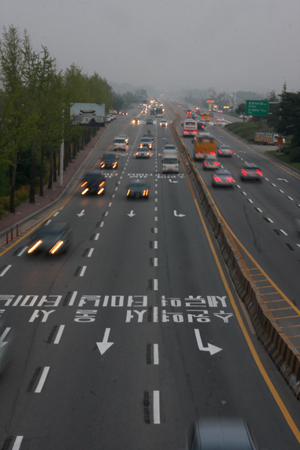
In 2004, Suwon South Police Station installed speeding detection cameras to monitor excessive speeding, but removed them again in 2006. The nearby military engineering unit requested the removal because its area was designated as Zone 1 of the military aviation base emergency runway, and removal was necessary for facility protection. Despite being a high-speed section, a median barrier was installed only about two years ago, and bus shelter canopies were installed not long before that.
● Even installing a single sign is difficult... Facilities that were installed have even been removed
This is due to an operating agreement signed in 1986 between the Defense Ministry and Suwon and Hwaseong cities, which stipulates that traffic signs and bus stops can be installed only by mutual agreement. In principle, nothing can be installed on the emergency runway, but partial installations are permitted on the condition of removal plans in case of emergency.
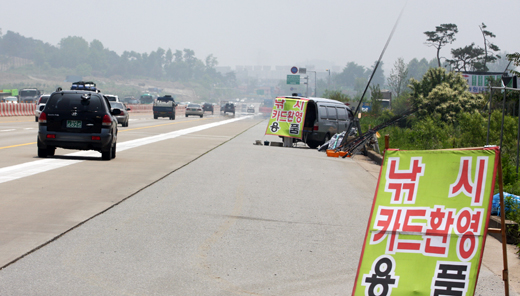
Moreover, because it is a border area between Suwon and Hwaseong, large vehicles are parked along both sides of the two-way 10-lane road (40m wide) in the gaps of lax management. Additionally, commercial activities selling fishing equipment and adult products are openly conducted. With unclear road markings, many vehicles mistake the roadside for the road and travel at speeds over 100km/h, creating a significant accident risk.
One merchant said, "I have been operating here for over three years, but have never faced sanctions from the city."
Furthermore, nearby residents using buses and some citizens cycling from Byeongjeom to Suwon are in a safety blind spot. Statistics from police alone showing that approximately 30 traffic accidents of varying severity occur annually in this area speak volumes.
There is no separate sidewalk, and if one wants to use the bus on the opposite lane, one must take a considerable detour, making road usage extremely inconvenient.
A resident near National Route 1 complained, "Even though there are not many residents, we pay taxes and live here, yet we cannot enjoy public transportation convenience, nor can we properly exercise our property rights."
However, installing pedestrian paths or bicycle lanes is not even being considered. Due to the nature of military-protected facilities with restricted access, coordination with the military is difficult, and even drawing a single line on the road requires coordination with the military.
● Why does an emergency runway with 'zero' utilization for 36 years exist?
The emergency runway, designated for national security, is now deteriorating into a safety hazard zone beyond property damage. Therefore, since its designation in 1973 for Team Spirit training exercises, public opinion questioning the very existence of an emergency runway that has never been used even once is mounting.
Last September, Representative Kim Jin-pyo (Yeongtong), former Representative Lee Ki-woo (17th National Assembly, Gwonseon), and Suwon Mayor Kim Yong-seo met with former Defense Minister Kim Jang-soo to propose dedesignation of the emergency runway, igniting public discourse. At that time, the Defense Ministry promised "positive consideration" of the proposal to dedesignate the functionally obsolete emergency runway, but no concrete news has emerged yet.
Subsequently, a special committee on the airfield (chaired by Lee Jong-pil) was established within the Suwon City Council, and efforts to dedesignate the emergency runway began in earnest. In particular, about 3,000 households in a 4.5-square-kilometer area from Daehwang-gyo-dong to Jinan-ri, Taean-eup in Hwaseong are increasingly opposed, as the runway has adversely affected property rights exercise for 36 years.
A resident operating a flower garden nearby argued, "The emergency runway was designated only 1.5km away from Suwon Airfield, so if war broke out, this entire area would be devastated—what use would it be? The flight safety zone only expands, hindering property rights and urban development."
In 2006, after comprehensive reviews of emergency runways scattered nationwide, the Defense Ministry dedesignated only a few and decided to maintain the Suwon Airfield emergency runway and four others as they were.
● Emergency runway dedesignation review at an impasse
In three more months, it will be exactly one year since the "positive consideration" directive was issued. In the meantime, the administration changed. It is noted that with the regime change came organizational restructuring and the movement of many working-level officials, possibly returning the dedesignation discussion to square one.
Official documents sent by Suwon City several times have received no response, and it is understood that no proper discussion on emergency runway dedesignation has yet taken place.
An official at Suwon Air Force Base said, "There has not been a single instruction from superiors on whether to review emergency runway dedesignation at all," adding, "How can we conduct independent investigations when there is no review directive? All coordination channels should be directed to the Defense Ministry or Air Force Headquarters, not Suwon Air Force Base."
In particular, since emergency runway dedesignation requires only revision of a Defense Ministry regulation rather than a law, the minister's will is paramount. It appears the current Defense Minister lacks the will to address emergency runway dedesignation, one of Suwon's most pressing priorities.
● Political circles, local governments, civil society all need to step up, yet they fall short
More significantly, with the departure of Lee Ki-woo, a key figure from the 17th National Assembly who had publicized the issue and persistently requested dedesignation, there is no further progress.
The 18th National Assembly representatives elected from Suwon included emergency runway dedesignation in their main campaign promises, but no concrete news has been reported. However, primarily representatives from the Grand National Party are planning press conferences and forums on major issues in early July, and it remains to be seen what issues they will raise at such venues.
Despite political circles, local governments, and citizens sharing recognition of the need for emergency runway dedesignation, there is no establishment of cooperative bodies or intermediary mechanisms to continuously convey opinions for practical countermeasures.
A city official stated, "Unless it is reflected in national policy, it is virtually difficult," adding, "We are continuously proposing it to political circles and the central government along with the airfield relocation issue."

Loading comments…