


Prospects Uncertain for Seosuwon Terminal 'High-Speed Bus Terminal Conversion'… "Revitalization through Active Recruitment of New Intercity Bus Routes"
Revitalization plans for Seosuwon Terminal, which sought to separate functions from Suwon Terminal and activate it as a dedicated express bus terminal, have become uncertain due to the operating entity's reserved position. Suwon City responded to this effect during the City Council's 2nd Regular Session plenary session administration inquiry on August 5th, regarding Councilmember Lee Jong-pil's question about Seosuwon Terminal revitalization plans.
Suwon City stated that when Suwon Terminal was sold from Daewoo Corporation to Hi-Parking Corporation on May 30th of this year, it requested Hi-Parking Corporation to submit a consent letter regarding terminal function separation on August 31st. However, Hi-Parking Corporation notified the city that it would reserve its position and submit its opinion after internal deliberation.
The Seoul National University College of Agriculture and Life Sciences site, which has been left vacant for four years since the relocation, is an area where residential development is impossible, and will be comprehensively developed as a park and citizen leisure space in the future.
Large-scale parks will also be developed in the southern Suwon area centered on the southern bypass road in Yeongdeungpo-gu. The city announced plans to create a park of approximately 70,000 square meters around the new Bangji Station near Mangpo-dong, Yeongdeungpo-gu.
The following is a summary of the responses to the 251st session administration inquiries.
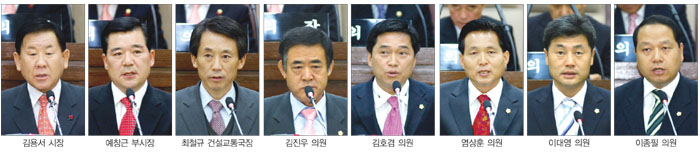
Councilmember Yom Sang-hoon (Pajang, Yulcheon, Jeongja 1-dong)
―Are there plans to develop Ilwol Park?
▲Mayor Kim Yong-seo: Ilwol Park comprises 381,800 square meters, and in the first phase, approximately 14,500 square meters were developed as a park in 2005. Currently, land compensation has been completed for 18,900 square meters across 19 parcels. The 20,100 square-meter park site in front of Sungkyunkwan University's main gate remains undeveloped, but we are conducting consultations to conclude a long-term usage agreement. Once this agreement is concluded, we plan to develop a lawn plaza, outdoor concert hall, and ecological park to serve as a cultural facility for Yulcheon-dong residents, Sungkyunkwan students, and others.
―What are the measures to improve water quality and prevent environmental pollution in Ilwol Lake Park, and what is the development direction for Ilwol Lake Park?
▲Mayor Kim Yong-seo: Since there is no natural water inflow to Ilwol Reservoir, wastewater from Sungkyunkwan University is treated and 1,300 tons per day is maintained as maintenance water. We are removing floating waste in the reservoir and managing poor soil that has been washed down through sewage pipes and rainwater. Additionally, we are conducting facility construction to block sewage inflow into the reservoir. In the future, we will install initial rainfall treatment facilities and when the Seoho Wastewater Treatment Plant is completed, we will discharge 5,000 tons per day of treated water to supply it as reservoir maintenance water.
Councilmember Kim Jin-woo (Seodun, Guun, Ipbuk-dong)
―What are the plans to restore the damaged Chilbo Mountain hiking trail?
▲Mayor Kim Yong-seo: To preserve and manage Chilbo Mountain, the city has invested 4.507 billion won in 19 projects since 2003, including hiking trail maintenance, urban forest management, toilet installation, and development of Kkachee Children's Park. In the future, we will conduct eco-friendly hiking trail maintenance and management and install convenience facilities and fitness equipment along the trails. Additionally, we plan to restore damaged hiking trails, close unauthorized shortcuts, conduct citizen trust movement activities, and implement habitat improvement projects.
―What are the comprehensive investigation and conservation measures for the natural ecosystem, such as Chilbo Mountain wetlands?
▲Mayor Kim Yong-seo: According to the investigation, rare flora and fauna inhabit the Chilbo Mountain area, and it is determined that the area has sufficient conservation value. The city will conduct a natural environment survey and, based on the survey results, hold a public hearing with environmental experts, civic organizations, and citizens. We will develop natural ecosystem conservation measures for Chilbo Mountain, including natural environmental preservation and the development of natural learning spaces, and the operation of experiential environmental programs.
Councilmember Lee Jong-pil (Seodun, Ipbuk, Guun-dong)
―What are the plans and measures for utilizing Seoul National University College of Agriculture and Life Sciences site?
▲Mayor Kim Yong-seo: In the 2020 Urban Master Plan, the site is to be maintained as conservation land in its existing use, but will introduce administrative and public functions utilizing existing facilities to the maximum extent, and culture and leisure facilities for citizens' leisure and rest. Therefore, we plan infrastructure such as parks and green spaces utilizing existing resources to the maximum extent to provide convenience to residents, and once the central government's public institution relocation site utilization plan is confirmed, we will establish comprehensive development plans in coordination with relevant organizations.
Councilmember Lee Dae-young (Yeongdeung 1, 2-dong, Taejang-dong)
―Are there plans to develop large-scale neighborhood parks similar to Manseok Park in the southern Suwon area centered on the southern bypass road in Yeongdeungpo-gu?
▲Vice Mayor Ye Chang-keun: When the city reorganized the urban management plan in August 2006, a 33,000 square-meter sports park was designated on the silkworm breeding farm site. On August 28, 2007, a neighborhood park of 16,000 square meters was additionally designated between Hyundai Apartment and Byeoksan Apartment in Mangpo-dong. Additionally, with the construction of Bangji Station (Bundang Line), the formation of a station area is expected to increase floating population in this region, so we are planning a neighborhood park of 70,000 square meters around the station. To make this concrete, we plan to determine it as a neighborhood park through consultation with the Ministry of Agriculture and Forestry in the 2008 urban management plan reorganization process. If these plans proceed without delay, approximately 117,200 square meters of neighborhood parks will be secured, which will serve as a rest and leisure space for local residents.
―Regarding plans to expand the park on the silkworm breeding farm site in Taejang-dong.
▲Vice Mayor Ye Chang-keun: Taejang-dong silkworm breeding farm is scheduled for regional relocation by 2012 along with the adjacent National Seed Management Service, and regarding the relevant site, we held consultations on utilization plans with the Ministry of Construction and Transportation's 'Public Institution Regional Relocation Promotion Task Force' on April 9th and reflected this in the 2020 Urban Master Plan revision. The utilization plan involves introducing residential and convenience functions, culture and welfare functions, and neighborhood park functions. While comprehensive park development for the entire 186,724 square-meter site is not feasible, we will actively review park expansion plans when public institutions are relocated to part of the site.
Councilmember Kim Ho-gyeom (Makyo, Maesan, Goheung, Hwaseo 1, 2-dong)
―Regarding comprehensive maintenance plans for Seoho Stream and Woncheonri Stream.
▲Vice Mayor Ye Chang-keun: Seoho Stream has a target completion date of next June and a total project cost of 22.2 billion won, with annual implementation plans established. We are currently implementing river environment maintenance projects for the 2-kilometer section from Seoho Reservoir to Pyeonggo Bridge. Additionally, we will secure 2.5 billion won in provincial funding next year to complete landscape planting between Nongdae Bridge and Pyeonggo Bridge, and will maintain walking paths between Pyeonggo Bridge and Seoho Reservoir in the western Suwon area to provide leisure space for citizens by connecting it with the Silkworm Museum and Seokbing Storage. Additionally, we plan to invest 230 million won next year over the 4.7-kilometer section from Seoho Reservoir to Sampung Bridge to implement embankment maintenance (2.9 km), wetland purification (4,000 square meters), and reservoir dredging (2,300 square meters).
The section between Pyeonggo Bridge and Hwanggu Stream confluence is scheduled to be maintained by the Seoul Regional Construction and Management Administration with 20 billion won in national funding from 2009, so the complete natural stream maintenance project for the entire Seoho Stream is expected to greatly contribute to disaster prevention and improvement of residents' convenience. For Woncheonri Stream, we plan to plant perennial plants and flowers in a 0.7-kilometer section next year to secure ecological friendly water space and provide leisure space for citizens in the urban area.
―What are the fundamental countermeasures for Woncheonri Stream pollution and plans for creating ecological streams and ecological learning centers?
▲Vice Mayor Ye Chang-keun: We will establish a basic plan for water quality improvement and maintenance water supply of the reservoir within the Gwanggyo New City development project site in the upper reaches of Woncheonri Stream. Additionally, we plan for Gyeonggi Urban Development Corporation, the project developer, to implement water quality improvement projects in earnest from next year.
The implementation plan includes installing water quality improvement facilities in Woncheon and Sindae Reservoirs and dredging sediments, as well as creating natural streams in the upper reaches of the reservoir and installing initial rainfall treatment facilities to reduce non-point source pollution. We are also consulting on reprocessing the discharge water from Sanghyeon Wastewater Treatment Plant upstream of Sindae Reservoir and using it as maintenance water. According to the Suwon City stream and lake water quality management basic plan, from 2009 to 2015, we will create ecological experience facilities and biotopes as biological habitat spaces in the section from Sindae Reservoir to Mearne Ecological Park, and will plant wetland plants and aquatic plants in the lower reaches of Woncheonri Stream.
―What are the pollution status countermeasures for Seoho Reservoir and Seoho Stream, and plans for creating ecological streams and ecological learning centers?
▲Vice Mayor Ye Chang-keun: To address the deterioration of water quality in the upper reaches of Seoho Stream, we will establish a natural stream purification project plan for the Seoho Stream basin and implement it annually, including blocking pollution sources, securing stream maintenance water, water quality improvement and dredging within the reservoir, and ecosystem restoration. We will install water quality improvement facilities in Ilwang Reservoir, which is upstream of Seoho Reservoir, and after removing concrete blocks within the reservoir, we will create a water quality purification wetland. We have set the river and lake water quality improvement target at Grade 3 and plan to implement water quality improvement projects annually by 2010. The creation of Seoho Stream ecological stream and ecological learning center will be implemented annually from 2009 to 2011 according to the Suwon City stream and lake water quality management basic plan, coordinating with Yeogisan to create bird observation centers and natural observation trails to develop it as a lake ecological park.
―There are concerns that the processing capacity of Seoho Stream Wastewater Treatment Plant may be exceeded. What are the countermeasures?
▲Vice Mayor Ye Chang-keun: According to Suwon City's sewage system improvement basic plan, the total facility capacity of wastewater treatment plants by 2025 is 614,000 tons per day, and among the already secured facility capacity, we currently operate the 520,000-ton-capacity Suwon Wastewater Treatment Plant in Songsan-dong, Hwaseong City. In preparation for wastewater treatment capacity being exceeded in 2011, we are promoting the construction of Seoho Stream Wastewater Treatment Plant with a capacity of 47,000 tons with a target completion date of the first half of 2010. Therefore, the Seoho Wastewater Treatment Plant facility plan was determined to include planned wastewater generated during SK site and Haetae Dairy development, so there are no concerns about capacity being exceeded. Additionally, we are planning the Hwanggu Stream Wastewater Treatment Plant with a target completion date of 2016.
Councilmember Lee Jong-pil (Seodun, Ipbuk, Guun-dong)
―What are the revitalization measures for Seosuwon Terminal?
▲Director Choi Chul-kyou of Construction and Transportation Department: Currently, 15 intercity bus routes operated by 14 companies run 82 times per day, of which 72 trips operate through Seosuwon Terminal with approximately 80-90 users per day.
In January of this year, a terminal function separation plan was established that would transfer 5 express bus routes from Suwon Terminal to Seosuwon Terminal and transfer 15 intercity bus routes from Seosuwon Terminal to Suwon Terminal. On March 28th, we presented July 1st as the implementation date for terminal function separation, but Daewoo Corporation, the Suwon Terminal operator, submitted an opinion that consultation with Geumho, its major shareholder, was necessary, effectively failing to reach agreement on terminal function separation. When Suwon Terminal was sold from Daewoo Corporation to Hi-Parking Corporation on May 30th this year, we requested Hi-Parking Corporation to submit a consent letter regarding terminal function separation on August 31st, but Hi-Parking Corporation notified the city of a reserved position.
The city will work to actively recruit new intercity bus routes through consultation with Hi-Parking Corporation and Gyeonggi Province. Additionally, we will operate a transfer center based on the results of the regional public transportation plan project to promote terminal revitalization. Once the infrastructure is completed, including the Homaesilz district residential development, the Shinbundang Line, the western bypass highway between Suwon and Gwangmyeong, and the circular road system, we will establish revitalization measures to reach 24,000 to 29,000 daily users by 2016.
Loading comments…