


'Soaring as a Self-Sufficient City with Population of 1.3 Million'
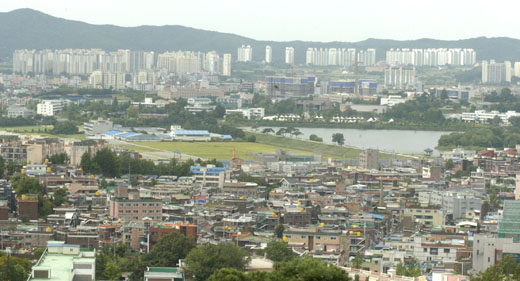
● What Will Suwon Look Like in 2020
According to the '2020 Suwon Urban Basic Plan,' Suwon in 2020 will become a city with a population of 1.29 million occupying a total of 121.103㎢ coinciding with administrative boundaries. This represents an increase of approximately 200,000 residents compared to the 2005 baseline population of 1.04 million.
In addition, the plan expands Samsung Electronics currently located in Yeongtong-gu and the 'Gosaek-dong Suwon Regional Industrial Complex' in Gwonseon-gu, positioning Suwon as a self-sufficient city. Relatively underdeveloped West Suwon will undergo various developments to achieve balanced growth. Educational and cultural facilities will also be established. West Suwon, which had remained peripheral, will emerge as a new urban center. Light rail transit and subway systems will take root as urban transportation means. The city's spatial structure is organized as one primary city center (Suwon Station-Suwon Hwaseong Fortress-City Hall), two secondary centers (Gwanggyo District, Yeongtong District), and three regional hubs (Jeongja, Homae-sil, Regional Industrial Complex).
Suwon City initially modified and established the 2025 Suwon Urban Basic Plan through consultation with the Ministry of Construction and Transportation as the 2020 Suwon Urban Basic Plan. Based on this, the city is currently revising the urban basic plan documents and plans to undergo preliminary review by Gyeonggi Province, the approval authority. The '2020 Suwon Urban Basic Plan' will be approved as early as October and announced to citizens.
A city urban planning official explained the purpose, stating, "This basic plan was established to respond to changes in urban conditions such as the Gwanggyo and Homae-sil residential development projects and to pursue city growth with a focus on environmentally friendly and sustainable land use."
● 'Suwon Regional Industrial Complex' Expands to Phase 3, Becomes Self-Sufficient City
According to the city, Suwon with a population of 1.3 million by 2020 will create a self-sufficient city by expanding Samsung Electronics located in Yeongtong-gu on the east side with reference to the Gyeongbu Line and the 'Gosaek-dong Suwon Regional Industrial Complex' in Gwonseon-gu on the west side. Additionally, to resolve civil complaints regarding the SK Chemical factory site in Jeongja-dong and achieve balanced development between east and west, the factory site will be relocated to Gosaek-dong, and the relocated site will be developed as residential land.
From 2003 to 2006, the Gosaek-dong Suwon Regional Industrial Complex Phase 1 (287,246㎡), developed with approximately 60 billion won in project funds in the Gosaek-dong 917 area, currently houses seven non-polluting high-tech industries including assembled metals, electronic products, and audiovisual equipment. Phase 2 (123,727㎡), which began construction in August and is scheduled for completion in August 2008, will invest approximately 30 billion won and accommodate three industries including machinery and equipment.
Phase 3 (823㎡) to be developed according to the '2020 Suwon Urban Basic Plan' will be promoted by 2012 with approximately 290 billion won in project funds, and the city has currently secured a budget of 1.5 billion won for basic planning and various environmental impact assessments for the complex.
A city official stated, "Phase 3 of the Gosaek-dong Suwon Regional Industrial Complex will relocate factories in the Pyeongdong area and the SK Chemical factory in Jeongja-dong. Within the scope of not increasing the total area of industrial zones, we will reallocate scattered industrial land to this location and develop it into a high-tech industrial park without smokestacks."
The SK Chemical industrial complex in Jeongja-dong 600-1, Jangan-gu, Suwon City, covering an area of 490,000㎡, is designated as a general industrial zone producing fine chemicals, acetate yarn, polyester resin, and polyurethane products. However, due to the closure of the Huvis factory, which accounted for 60% of the total operation as of 2006, annual operational losses exceeding 10 billion won are occurring. Additionally, complaints from residents in apartment complexes in Jeongja 1, Cheoncheon 1, and Cheoncheon 2 districts regarding odors and noise have reached approximately 1,000 cases.
To resolve residents' complaints and pursue balanced development between east and west, the '2020 Suwon Urban Basic Plan' as its main framework will relocate the SK Chemical industrial complex to Gosaek-dong Suwon Regional Industrial Complex, with plans to develop the relocated site as residential land. Additionally, when establishing development plans, the city intends to secure and provide public infrastructure such as parks, green spaces, and cultural facilities that have been lacking for North Suwon residents, accounting for over 40% of the development.
● West Suwon Development Pursues Balanced Urban Growth
According to the '2020 Suwon Urban Basic Plan,' West Suwon, which has been marginalized due to east-west division from the Gyeongbu Line crossing, noise restrictions and altitude limitations from the Air Force airbase, and green belt designations, is expected to be revitalized. In addition, to improve residents' quality of life following West Suwon revitalization, the foundation for parks, cultural facilities, and educational facilities is expected to be established.
Approximately 720,000㎡ of parks across eight locations in the Imok-dong, Homae-sil-dong, Gosaek-dong, Omokcheon-dong, Gwonseon-dong, and Mangpo-dong areas will be secured to improve residents' quality of life.
Methods for utilizing 3.23 million㎡ of relocation sites for 12 public institutions that relocated to other regions within Suwon City, concentrated in West Suwon, were also explored. Suwon City intends to prioritize the placement of parks, schools and educational facilities, social welfare facilities, and cultural facilities on public institution relocation sites in underdeveloped West Suwon areas.
A city official stated, "In the short term, we plan to place welfare facilities and other facilities that can improve residents' lives in West Suwon," and added, "Development of West Suwon will provide effects of balanced regional development between east and west." Subsequently, the official explained that in the long term, more concretely addressing and actively resolving the airbase relocation issue will have significant positive effects on West Suwon's development.
Additionally, the Gwanggyo New Town, encompassing a total area of 11.2825 million㎡ including the Maetan-dong, Iui-dong, Woncheon-dong, Ha-dong, Uman-dong, and Yeonmu-dong areas of Suwon City, will be completed by 2011 as an eco-friendly new residential complex and self-sufficient new city through high-tech industry placement.
The Homae-sil Residential Complex, to be completed by 2012, is part of a national policy project for residential stability, with 1 million national rental housing units to be constructed. The overall 3.11 million㎡ complex is expected to accommodate approximately 58,000 residents. Three kindergartens, five elementary schools, and four each of middle and high schools will be established.
A city official stated, "The city has established the '2020 Suwon Urban Basic Plan' based on the above content, and will subsequently undergo preliminary review by Gyeonggi Province, the approval authority, and announce it for public viewing by October."
● Building Well-Connected Transportation Network
The Suwon Urban Light Rail North-South Line, promoted as a private proposal project by Suwon City, will be completed by 2013. The light rail, passing through Seryou Station-Bus Terminal-City Hall-World Cup Stadium-General Sports Complex-Jeongja and Cheoncheon Districts-Sungkyunkwan University Station, spans a total length of 18.75km with 22 stations.
Upon completion of the light rail, it is expected to resolve traffic congestion in the Suwon area. The light rail not only passes through Suwon city districts but also connects with Seryou and Sungkyunkwan University stations on the Gyeongbu Line and passes through World Cup Stadium Station on the Sinbundang Line, linking with metropolitan rail transit. Accordingly, commute time predictability will be ensured and it is expected to contribute to balanced urban development.
Additionally, the completion of the Bundang Line, Suin Line, and Sinbundang Line connecting east and west will pursue balanced urban development and distribute city transportation means, previously dominated by personal vehicles and buses, to rail transit.
The Bundang Line spans 19.55km, with 8.8km of the section connecting Suwon City scheduled for completion by 2010. Currently, construction on four sections is underway, with the route passing through Ori-Jukjeon-Giheung-Yeongdeok-Yeongtong-Bangjuk-Maetan-City Hall-Maegyo.
The Suin Line, totaling 52.4km, passes 4.9km through Suwon City and is scheduled to begin construction in 2009. Currently, Section 1, the underground portion of Suwon Station, is under construction. The route connects Seowon Station-Gosaek-Omokcheon-Ansan-Incheon. The Sinbundang Line, divided into Phase 1 and Phase 2, spans 23.04km, with 13.7km passing through Suwon City. Phase 1 construction runs until 2014, and Phase 2 construction runs from 2014 to 2019. The route connects Seongnam Jeongja-Suji-Gwanggyo-Hwaseo-Homae-sil.
A city official stated, "When the light rail, Suin Line, Bundang Line, and Sinbundang Line passing through Suwon City and connecting with the metropolitan rail network are completed, Suwon City will have established a well-connected transportation network."
Loading comments…