


Companies with Remote Work: "Satisfied Due to Increased Employee Satisfaction and Reduced Office Space and Overhead Costs"
[Suwon Ilbo=Park Nohun, Reporter] As remote work has increased following the spread of infectious disease, a survey found that companies cited 'increased employee job satisfaction' and 'reduced office space and overhead costs' as top priorities regarding remote work satisfaction.
Workers in Gyeonggi Province engaging in remote work also expressed preference for working at companies that allow remote work under the same conditions, with three days per week emerging as the most preferred frequency.
According to the Gyeonggi Research Institute on the 14th, these results emerged from a survey conducted from March 15-21 on 300 workers residing in Gyeonggi Province and 100 personnel managers from businesses nationwide.
The institute released a report titled 'Remote Work Establishing Itself as a New Standard in How We Work' based on the findings.
The report identified that 18.7% of workers (56 people) are currently working remotely.
The frequency of remote work implementation showed: ▲1-2 times per month 26.8% ▲5 or more days per week 21.4% ▲2 days per week 16.1% ▲1 day and 3 days per week each 12.5% ▲4 days per week 7.1%.
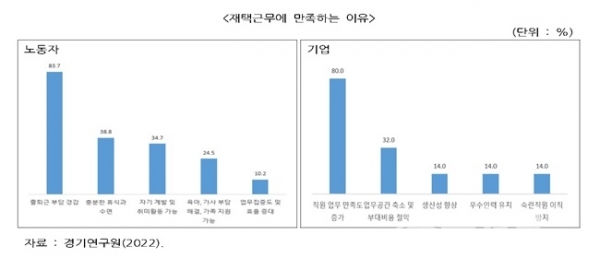
87.5% of workers expressed satisfaction with remote work, citing reduced commuting burden, sufficient sleep and rest, and the ability to engage in self-development and hobbies through efficient time management as primary reasons.
79.4% of companies, surveyed through personnel managers, were satisfied with remote work implementation, with increased employee job satisfaction identified as the primary reason.
Reasons for dissatisfaction included decreased productivity, communication difficulties, and challenges in performance management and evaluation. 75.0% of workers and 76.2% of companies reported that productivity either improved or remained unchanged due to remote work.
Workers currently implementing remote work most preferred 3 days per week (25.0%) as their desired remote work frequency following COVID-19.
This was followed by 1 day per week (17.9%), 2 days per week (16.1%), 5 or more days per week (14.3%), and 4 days per week (10.7%).
When asked if working conditions were identical, 85.3% of workers responded they would work for companies offering remote work, raising concerns about potential labor shortages in small and medium enterprises facing difficulties implementing remote work.
The report presented support promotion strategies for small and medium enterprises to expand remote work: ▲providing comprehensive consulting on remote work adoption ▲expanding support systems for IT infrastructure costs and indirect labor expenses related to remote work.
Choi Hoon, research fellow at Gyeonggi Research Institute, stated, "Since workers recognize remote work as important employee benefits and prefer it, there is a possibility of intensifying labor shortages in small and medium enterprises not implementing remote work," and added, "It is necessary to implement comprehensive support related to remote work for small and medium enterprises that cite difficulties such as burdens in personnel and labor management, concerns over productivity decline, and infrastructure construction costs."


Loading comments…