


Across Gyeonggi Province, Before and After Designation of Land Transaction Permission Zones... Corporate Housing Transactions Down 85%, Foreign Nationals Down 39%
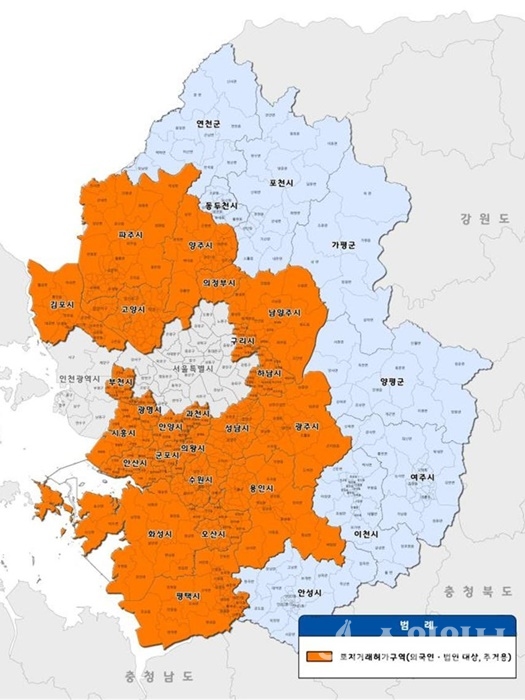
[Suwon Ilbo=Park Nohoon, Reporter] As a result of Gyeonggi Province designating the entire territory of 23 cities including Suwon as land transaction permission zones targeting corporations and foreign nationals to suppress speculative demand, housing transaction volumes by corporations and foreign nationals have decreased by 85% and 39% respectively compared to before the designation, according to analysis.
The province compared housing transaction volumes for 8 months before designation (March to October last year) and 8 months after designation (November last year to June this year) in the land transaction permission zones for corporations and foreign nationals in 23 cities including Suwon, which were designated on October 31 last year.
As a result, corporate housing transaction volumes decreased by 85%, from 10,376 cases before designation to 1,543 cases after designation. Foreign national housing transaction volumes decreased by 39%, from 2,550 cases before designation to 1,565 cases after designation.
In contrast, in 8 cities and counties such as Anseong, which were not designated as land transaction permission zones, corporate housing transaction volumes decreased by only 4%, from 926 cases to 887 cases during the same period, while foreign national housing transaction volumes surged by 40%, from 162 cases to 226 cases.
In areas designated as land transaction permission zones for corporations and foreign nationals, when corporations and foreign nationals wish to acquire land that includes housing, they must obtain permission from the mayor of the relevant city considering mandatory use periods and actual demand.
Accordingly, land transaction permission zones make actual residence mandatory for housing buyers, making so-called "gap investment"—purchasing with a jeonse loan—virtually impossible.
Additionally, with a mandatory two-year use requirement, there is no longer an advantage to purchasing in hopes of short-term capital gains.
Violations of permission-related regulations result in imprisonment of up to two years or fines of up to 30% of the individual publicly announced land price at the time of contract execution.
Kwon Kyung-hyun, director of the Land Information Division of Gyeonggi Province, said, "As a result of designating land transaction permission zones to suppress speculative demand by corporations and foreign nationals who, backed by massive capital, fuel real estate price increases, the real estate transaction volumes of these two entities have decreased. We can consider this as evidence that speculative demand has been suppressed, and we will continue to implement strong and effective measures for real estate market stabilization going forward," he said.
Meanwhile, the province has been designating and operating 5,249.11 ㎢ of the entire territory of 23 cities as land transaction permission zones for foreign nationals and corporations since October 31 last year, excluding Yeoncheon County, Pocheon, Dongducheon, Gapyeong County, Yangpyeong County, Yeoju, Icheon, Anseong, and other areas.
The province re-designated the zones in April ahead of the expiration of the initial six-month designation, and the land transaction permission zones will be maintained through April 30 next year.
This measure by the province was taken based on the judgment that, amid a sharp increase in real estate transactions by corporations and foreign nationals, a substantial portion of real estate acquired by them was for speculative purposes rather than business or residential use.
From January to July 2020, apartments in Gyeonggi Province acquired by corporations totaled 9,580 units, a surge of 370% (7,544 units) compared to 2,036 units during the same period in 2019.
Building transaction volumes including apartments, commercial buildings, and villas acquired by foreign nationals also increased by 32% (1,338 units) from January to July 2020, reaching 5,423 units compared to 4,085 units during the same period in 2019.

Loading comments…