[评论] 'An Min-seok's Education Director Recruitment System' – Are There Points That Need Improvement?
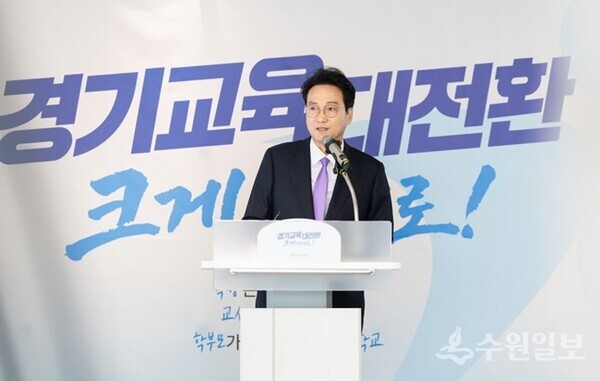
The phrase that Gyeonggi Province Superintendent of Education An Min-seok has emphasized since before taking office is 'Gyeonggi Education Grand Transformation.' "Though it is an untrodden path, it is a path we must take, so I will muster the courage to proceed," reflects Superintendent An's determination. Among the 'five policies for Gyeonggi Education Grand Transformation' promised by Superintendent An, the 'Education Director Recruitment System' is included. Superintendent An's thinking is that "the first step in solving school problems is to select competent and capable education directors as a priority."
Previously, education directors have been uniformly recruited by the Provincial Office of Education – it was the superintendent's prerogative. However, the announcement by Superintendent An to introduce a community-recommended recruitment system departing from existing methods and involving teachers, students, parents, and community residents naturally caused a stir in educational circles. "A new educational autonomy model that recruits personnel knowledgeable about regional educational issues and strengthens community-centered educational administration," was Superintendent An's explanation.
The Education Director Recruitment System was then immediately implemented. In the 'Community-Recommended Education Director Recruitment System' conducted for the first time in Korea by the Provincial Office of Education, the list of 11 education directors who passed through a 3.4-to-1 competition rate was announced. Superintendent An announced the results directly, stating, "The greatest achievement of this recruitment is that I, as superintendent, have relinquished the vested power in appointing education directors and returned that authority to the local community and society."
The appointed education directors have a two-year term, and Superintendent An's explanation that one year is spent understanding unfamiliar local conditions, during which roles, authority, and responsibilities cannot be properly utilized, is reasonable. The 11 community-recommended education directors were selected based on comprehensive evaluations of △educational expertise △leadership △vision for local education △communication and collaboration capabilities: Suwon (Kim Hye-ri), Seongnam (Lee Sang-chul), Goyang (Kang Hyun-joo), Hwaseong-Osan (Kim Young-gi), Siheung (Kim Byung-san), Uijeongbu (Kim Gyu-soo), Dongducheon-Yangju (Kang Jeong-soo), Gimpo (Kwon Sung-gyu), Yeoncheon (Lee Moon-gu), Pocheon (Ryu Gwi-yeol), and Anseong (Kim Beom-jin). The Education Director of Yeoju Office of Education (Kim Sang-seong) was retained in their position.
Overall public opinion is positive toward the 'Community-Recommended Education Director Recruitment System.' However, concerns have been raised about the need to improve fairness and transparency in the implementation process. Lee Geon-han, councilor of the Gyeonggi Provincial Council Education Planning Committee (Democratic Party·Yongin 8), called for a comprehensive review of the overall system. On the 29th of last month, during the Provincial Office of Education's business report, Councilor Lee pointed out that "the initiative was pursued without sufficient prior consultation and institutional preparation." He revealed that the recruitment system proceeded as an 'internal-type recruitment' rather than 'community recommendation.' This raises questions about whether the local community substantially participated in candidate recommendations and the selection process. He also demanded the establishment of objective selection principles and institutional safeguards.
The composition and operation of evaluation committees, evaluation criteria for candidates, and online peer evaluation methods should be comprehensively reviewed, and the Provincial Office of Education should heed Councilor Lee's argument that problems revealed in this implementation process should be addressed. Given the high level of public interest in the Education Director Recruitment System at the Provincial Office of Education, we hope that the shortcomings identified in this recruitment will be supplemented.