Gyeonggi Province Declares 'Financial Emergency', Cuts 546.5 Billion Won Budget to Allocate to People's Livelihoods
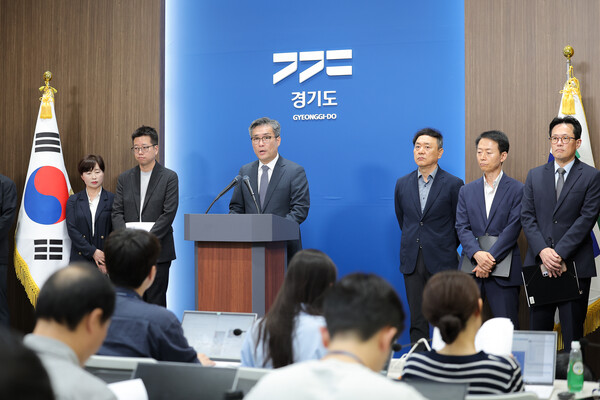
Gyeonggi Province, which officially declared its financial situation as an 'emergency,' has undertaken strong budget cuts of approximately 550 billion won to protect essential livelihood projects including subsistence and care for vulnerable groups, response to low birth rates, public safety, and welfare and healthcare initiatives.
Jeong Du-seok, director of the Gyeonggi Province Planning and Coordination Office, held a press conference at the Gyeonggi Province Government Office on the 19th, announcing the compilation of a 42.242 trillion won supplementary budget for 2026 and its submission to the Gyeonggi Province Assembly.
Director Jeong stated, "Although the province faces difficult fiscal conditions, we have implemented comprehensive fiscal restructuring to protect essential livelihood projects directly linked to residents' lives" and "We aim to respond to the financial emergency by prioritizing allocation of limited resources to projects that are truly necessary."
The supplementary budget was compiled to respond to worsened fiscal conditions, including an expected 300 billion won shortfall in local taxes such as acquisition tax—a major revenue source for provincial taxes—due to sluggish real estate transactions, accumulated debt burden, and the near-complete depletion of available funds, while ensuring the uninterrupted implementation of essential livelihood projects.
The province implemented strong fiscal restructuring by adjusting event-type and one-time projects as well as redundant and overlapping projects, and comprehensively reviewing project scales and implementation schedules, resulting in a reduction of 546.5 billion won from the existing budget.
Key projects subject to reduction and their reduction amounts include △non-disbursed election commission entrusted funds of 23.648 billion won △compensation expenses for Bukok local road construction of 19 billion won △Gyeonggi Credit Guarantee Foundation contributions of 16.35 billion won and other project budgets adjusted downward.
Additionally, the province demonstrated responsibility toward the financial emergency by reducing administrative operating expenses such as office management costs by 222 billion won and cutting official business promotion funds for senior civil servants (grade 3 and above) by 400 million won. Unnecessary overseas business trips and training programs are also being discontinued or minimized. The Gyeonggi Province Assembly also participated in the fiscal restructuring by self-reducing overseas travel expenses for assemblymen and the assembly secretariat by 1.4 billion won and personnel expenses by 900 million won.
With resources secured through these measures, the province first allocated 246.4 billion won to livelihood projects that could not be reflected in the 2026 main budget.
Major projects include △long-term care facilities for the elderly and in-home care benefits of 123.4 billion won △school meal support for kindergarten, elementary, middle and high schools under the Provincial Office of Education of 58.4 billion won △Gyeonggi Province farmers and fishermen opportunity income support of 21.5 billion won △Gyeonggi Province youth basic income of 16.3 billion won △meal support for children with poor nutrition of 7.5 billion won △school meal support for eco-friendly and premium agricultural and livestock products of 3.5 billion won △operation support for mobility assistance centers of 3.7 billion won and others.
A total of 86.3 billion won was allocated to respond to the low birth rate crisis and essential welfare and healthcare projects. These include △infertility treatment support for couples of 22.3 billion won △maternal and newborn health management support of 11.5 billion won △transportation fee support for children and youth of 6 billion won △activity support benefits for persons with disabilities of 3 billion won, mitigating childbirth and childcare burdens while minimizing welfare gaps. Additionally, budgets were allocated to essential healthcare projects including △medical aid benefits of 38.9 billion won △national preventive vaccinations of 600 million won.
A total of 29.8 billion won was allocated to railway and road SOC projects with high execution urgency. In this supplementary budget, projects scheduled for completion within the year or those requiring mandatory execution this year, such as land compensation final decisions, were selected and reflected. Major projects include △Dobongsan-Okjeong metropolitan railway of 4.2 billion won △Anseong Gongdo-Yangseong road expansion and paving project of 4.1 billion won △Hwaseong Ujeong-Hyangnam road expansion and paving project of 3 billion won and others.
Gyeonggi Province's second supplementary budget proposal will be reviewed at the Gyeonggi Province Assembly's 393rd special session held from September 1 to 18. Gyeonggi Province plans to closely coordinate with the Provincial Assembly during the review process and, once the budget is finalized, establish implementation plans for each department to pursue projects promptly.
Previously, Gyeonggi Province Governor Choo Mi-ae officially declared Gyeonggi Province's financial situation as an 'emergency' on the 5th.