Gyeonggi Province Declares 'Fiscal Emergency,' Cuts 546.5 Billion Won Budget to Support People's Livelihoods
Gyeonggi Province, which has officially declared an 'emergency situation' regarding its fiscal condition, is undertaking a drastic budget cut of approximately 550 billion won to protect essential livelihood projects including childcare and living allowances for vulnerable groups, measures to address low birth rates, resident safety, and welfare and medical services.
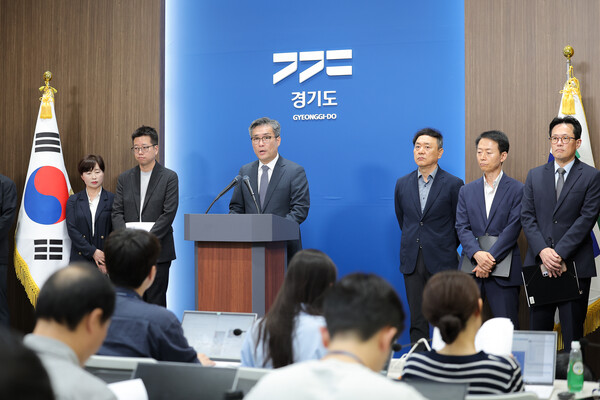
Jung Du-seok, director of the Gyeonggi Province Planning and Coordination Office, held a press conference at the Gyeonggi Provincial Government building on the 19th and announced that a 42.242 trillion won second supplementary budget for 2026 has been compiled and submitted to the Gyeonggi Provincial Assembly.
Director Jung stated, "Although the province's fiscal conditions are difficult, we have pursued a comprehensive restructuring of government spending to protect essential livelihood projects that are directly tied to residents' lives," and added, "We aim to respond to the fiscal emergency by prioritizing the allocation of limited resources to necessary projects."
This supplementary budget was compiled in response to worsened fiscal conditions, including an expected 300 billion won shortfall in local taxes such as acquisition tax, a major tax source for the province due to the slowdown in real estate transactions, accumulated debt burdens, and the depletion of most available funds. The budget aims to implement essential livelihood projects without disruption.
The province has implemented strong restructuring of government spending by adjusting event-based and one-time projects as well as overlapping or duplicate projects, and has thoroughly reviewed project scales and implementation timelines, cutting a total of 546.5 billion won from existing budgets.
Major projects and budget reductions include △23.648 billion won in unpaid delegation funds to the Electoral Commission △19 billion won in compensation for the Bugok national route road construction △16.35 billion won in contributions to the Gyeonggi Credit Guarantee Foundation, among other project budget adjustments.
Additionally, demonstrating a responsible stance toward the fiscal emergency, the province reduced administrative operating expenses such as office management fees by 22.2 billion won and cut official duty allowances for grade 3 and above senior civil servants by 400 million won. Unnecessary overseas business trips and training are also being halted or minimized. The Gyeonggi Provincial Assembly also participated in the spending restructuring by making voluntary cuts of 1.4 billion won in overseas travel expenses for assembly members and staff, and 900 million won in personnel expenses.
Using the funds secured, the province has allocated 246.4 billion won to livelihood projects not reflected in the 2026 main budget.
Major projects include △123.4 billion won for elderly long-term care facilities and home care services △58.4 billion won for school meal support for kindergarten, elementary, middle and high schools under the Provincial Office of Education △21.5 billion won for Gyeonggi Province farmer and fisherman opportunity income support △16.3 billion won for Gyeonggi Province youth basic income △7.5 billion won for meal support for underfed children △3.5 billion won for school meal support with eco-friendly and premium agricultural and livestock products △3.7 billion won for operation of transportation support centers.
A total of 86.3 billion won has been allocated to respond to the low birth rate crisis and essential welfare and medical projects. △22.3 billion won for infertility treatment support for couples △11.5 billion won for maternal and newborn health management support △6 billion won for children and youth transportation support △3 billion won for disabled persons activity assistance services are reflected to ease the burden of childbirth and childcare while minimizing welfare gaps. Additionally, budgets have been allocated for essential medical projects including △38.9 billion won for medical assistance △600 million won for national preventive vaccinations.
A total of 29.8 billion won has been allocated to railroad and road SOC projects with high execution urgency. In this supplementary budget, projects scheduled for completion within the year or that require execution this year, such as land compensation adjudication, were selected and included. Major projects include △4.2 billion won for the Dobongsan-Okjeong metropolitan railroad △4.1 billion won for the Anseong Gongdo-Yangseong road expansion and paving project △3 billion won for the Hwaseong Ujeong-Hyangnam road expansion and paving project.
The Gyeonggi Province second supplementary budget proposal is scheduled to be reviewed at the 393rd extraordinary session of the Gyeonggi Provincial Assembly to be held from September 1st to 18th. Once the budget is confirmed, Gyeonggi Province plans to establish implementation plans by department and expeditiously promote projects in close consultation with the provincial assembly during the review process.
Earlier, Gyeonggi Province Governor Choo Mi-ae officially declared the province's fiscal condition as an 'emergency situation' on the 5th.