People Power Party Leadership Holds Cards in Local Organization 'Reshuffle'
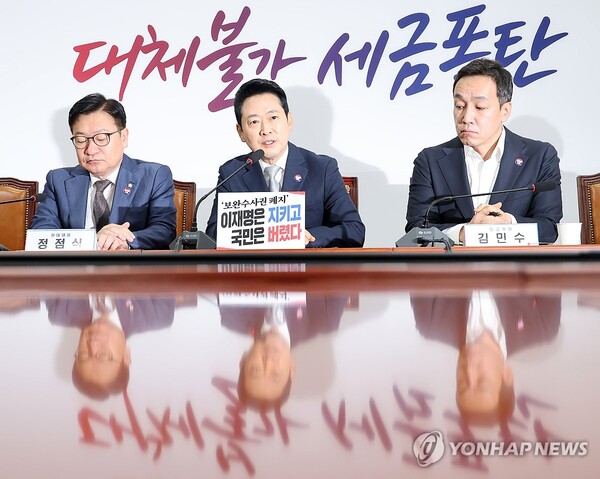
The People Power Party faces internal strife over a plan for wholesale resignation and re-election of local party cooperation chairmen nationwide, but emphasis is placed on the fact that the Supreme Council ultimately holds the key to reshuffling local organizations.
According to political circles on the 22nd, discussion over reshuffling the party cooperation council leadership began in earnest starting on the 12th.
On that day, party chief Jang Dong-hyuk raised a plan to re-elect local cooperation chairmen reflecting party members' will through all-member voting or responsible member voting, rather than operating party cooperatives in the conventional manner where incumbents were automatically extended upon the end of their terms.
In particular, he singled out local cooperation chairmen who did not actively fight against the Democratic Party and Lee Jae-myung's government or showed interest only in local election nominations as targets for replacement. Chief Jang emphasized the need for party cooperation reorganization, stating, "Right now 20 percent are fighting, but we need to become a party where 80 percent fight."
Incumbent National Assembly members were not exempted. On the same day, Secretary-General Jung Hee-yong, chair of the Special Committee on Organization and Discipline, explained that there are no separate exceptions for incumbent lawmakers under party rules and regulations when asked whether local areas with sitting lawmakers could be included in recruitment targets for party cooperation chairmen.
The Special Committee also discussed on that day a plan to expand recruitment areas beyond re-recruitment of existing problem party cooperatives. Re-evaluation of 27 locations where party cooperation chairman replacement was recommended in the previous party affairs audit and the issue of regular local cooperation chairman elections were also placed on the table for review.
Prior to this, both inside and outside the party raised theories of large-scale personnel renewal. Former Candidate Management Committee Chair Lee Jeong-hyun diagnosed the People Power Party as being in a "coma" on the 11th and presented a generational shift theory that young people around the age of 45 should occupy more than 51 percent to participate in the party's decision-making.
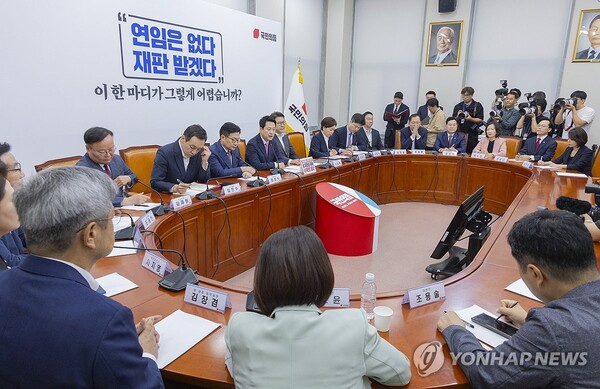
Plans for party cooperation reorganization became concrete through discussions at the Supreme Council on the 13th. The leadership decided to discuss a plan to re-elect local cooperation chairmen reflecting member voting, rather than customarily retaining existing chairmen, and to gather opinions from provincial and municipal party chairpersons.
Discussion expanded on the 20th to a plan to place all local cooperation chairmen, including incumbent lawmakers, on a clean slate and re-elect them through member voting.
Chief Jang and the pro-party faction pushed for a comprehensive re-election plan at the Supreme Council on that day, but floor leader Jung Jeom-sik and Supreme Council member for youth Woo Jae-jun raised issues with procedures and interpretations of party rules, failing to reach a conclusion. After continuing discussions from morning into afternoon, the vote was ultimately postponed, and it was decided to further hear opinions from the general lawmakers' assembly.
Opposition from incumbent lawmakers surfaced at the general assembly. At two general assemblies held on the 20th, opposition to comprehensive re-election was dominant, and at another general assembly held again on the 21st, opinion favoring maintaining the existing method of the party cooperation steering committee selecting the chairman was stronger.
Senior spokeswoman Min-jin Choi said immediately after the general assembly, "It seems better to do it the existing way, that is, the method of re-election by the steering committee," and said floor leader Jung would convey such opinion to the Supreme Council.
However, opposition from incumbent lawmakers alone is not a structure capable of blocking wholesale resignations or comprehensive re-elections.
Chief Spokeswoman Choi Bo-yoon explained shortly after the Supreme Council on the 20th, "General assembly decisions do not bind Supreme Council decisions," indicating that lawmakers' opinions would serve as reference for Supreme Council members' judgment.
Assessment is that the voting structure within the Supreme Council is not unfavorable to Chief Jang either. At the Supreme Council on the 20th, Chief Jang and Supreme Council members Kim Min-soo, Kim Jae-won, Yang Hyang-ja, and Jo Gwang-han—five members total—showed positions in favor, while youth Supreme Council member Woo Jae-jun was opposed, and Supreme Council member Shin Dong-wook abstained, according to reports. If the current structure is maintained, Supreme Council members supporting the comprehensive re-election plan would constitute a majority.
Separate from party rule interpretation disputes, there is also a channel through which the Supreme Council can make incumbent local cooperation chairmen resign.
Article 28 of the People Power Party's Local Organization Operating Regulations allows the Supreme Council to pass a resolution on resignation of local cooperation chairmen after hearing opinions from the relevant provincial and municipal party chairpersons and secretaries-general. It is structured so that even if party cooperation chairmen do not voluntarily resign, the Supreme Council can pass a resolution on resignation after hearing opinions.
Leadership influence can also work in the selection of successors. According to Article 30 of the Local Organization Operating Regulations, the organization chairperson is appointed by the party chief after examination, recommendation by the Special Committee, and resolution by the Supreme Council. Ultimately, if Chief Jang secures consent from the Special Committee and Supreme Council, a structure is in place where he can exercise influence from existing chairmen's resignation to the selection of successor organization chairpersons.
Accordingly, the scope of party cooperation reshuffle is expected to vary depending on the Supreme Council decision coming on the 24th.
If a comprehensive re-election plan is passed, all local party cooperation chairmen nationwide, regardless of incumbent or non-incumbent status, could become subjects of re-confirmation. It could lead to a major organizational overhaul with re-election of chairmen reflecting party members' will targeting all 254 local party cooperatives nationwide.
Conversely, if the Supreme Council accepts the opinion from the general lawmakers' assembly, the existing selection method through local party cooperation steering committees could be maintained. However, even if comprehensive re-election fails, the path to reshuffle is not closed. Priority can be given to reorganizing problem party cooperatives and those with inadequate party affairs audits, and if necessary, incumbent local cooperation chairmen can be selectively replaced under Article 28.
In particular, if the scope of replacement expands to include incumbent National Assembly members, political repercussions are expected to be significant. If incumbent lawmakers are displaced from their local constituency party cooperation chairman positions and new figures assume leadership of local organizations, changes could occur in control of local party member organizations ahead of the next general election.
The dividing line is the Supreme Council meeting on the 24th. Floor leader Jung is scheduled to convey the opinions of incumbent lawmakers favoring maintaining the existing method, but general assembly opinion has no authority to bind the Supreme Council. Ultimately, both whether comprehensive re-election takes place and the scope of party cooperation reshuffle depend on the Supreme Council's judgment.
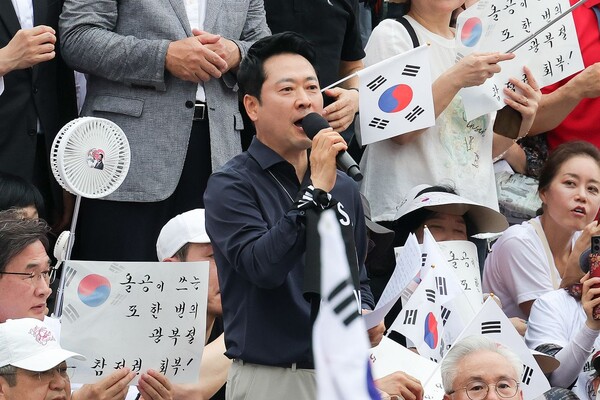
An official with the People Power Party said, "Chief Jang has secured political momentum from party members and supporters through voting rights protection activities at the Olympic Park and beyond, and leadership has the authority under party rules to reorganize party cooperatives. Given that placing all 254 party cooperatives on a clean slate would entail significant burdens in time, cost, and internal party opposition, there is a possibility of moving in the direction of reshuffling a certain scale with clear rationale and standards rather than wholesale replacement."
전시언 기자 yourside@news-s.kr