[Gwanggyo Column] Gwanggyo Reservoir Perimeter Trail, a Cool Walk in the Heat
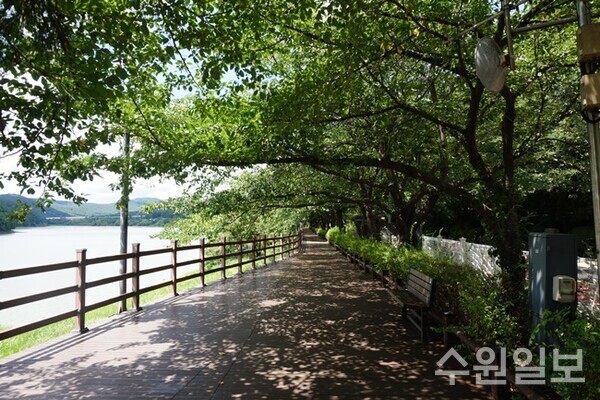
Even after the last of the summer heat season had passed, it was still sweltering.
I was heading to my favorite restaurant, Jaeseon Farm, a barley rice restaurant on Gwanggyo Mountain Trail after a long time. This establishment is also listed in the "100 Best Restaurants of Suwon" selected by Suwon City. The dish I particularly love here is doenjang-jjigae. After mixing barley rice with all kinds of wild greens and vegetables and eating it with doenjang-jjigae, I can distinctly feel my body appreciating it.
The homemade Hyudongmak makgeolli they sell also stimulates the appetite, but these days I only take small sips due to concerns about blood sugar spikes.
I walked as I always do.
The sun was scorching and the air was full of humidity.
I found myself longing for the weather in Kunming and Lijiang, China, which I had visited from August 6 to 10 for a summer overseas research trip with the Hwaseong Research Institute.
These cities have high altitudes. Because they are similar in height to Baekdu Mountain, they always have spring-like weather. That is why Kunming is also called the City of Spring, "Chunseong."
Some higher areas are at 3,500 meters, and the Glacier Park observation deck at Yulong Snow Mountain, which we were able to climb, is as high as 4,680 meters.
I climbed in thin early autumn clothing and thought I would freeze to death. The oxygen was also sparse, causing dizziness. It was altitude sickness, which I had only heard about. I had to use oxygen tanks frequently.
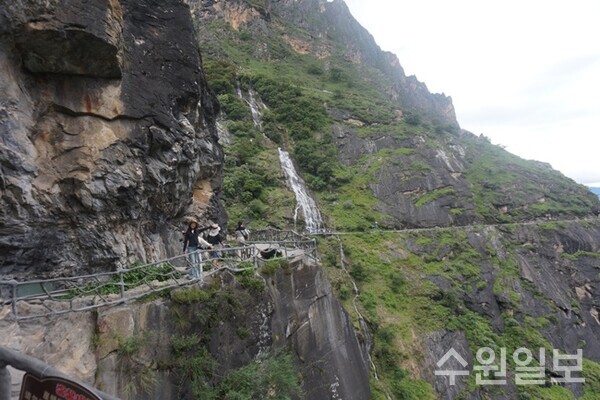
Although only a portion of it, I also walked the Tea Horse Road. It is a path I have always dreamed of. A path walking with the majestic and beautiful Yulong Snow Mountain at fingertips and overlooking Hutiao Gorge thousands of meters below. The scenery was so surreal that one might wonder if this is an immortal realm.
I don't know if I will be able to return there, and while I worry whether my physical strength will support it, if I get the chance later, I want to walk this path again. I want to walk over the snow mountain to Shangri-La on the other side.
I stopped reminiscing and resumed walking the deck path around Gwanggyo Reservoir.
As I have revealed in this column before, the paths I like most are the course along the Hwaseong Fortress walls and the Gwanggyo Reservoir perimeter trail.
In particular, the Gwanggyo Maru Trail, which is the cherry blossom path at Gwanggyo Reservoir, has a special connection with me.
I participated in the work of planting cherry blossom trees along the approximately 1.5-kilometer deck path.
It was during the tree-planting ceremony for "Planting One Million Life Trees" on March 23, 2000, during the tenure of Mayor Shim Jae-deok, who is now deceased.
I still vividly remember planting trees with Mayor Shim at that time. The trees we planted then had diameters of about 10 centimeters, but now they have grown as thick as an adult's waist, and their branches have flourished.
At the time, Mayor Shim said the following to those who participated in the tree-planting work:
"Although this doesn't look impressive now, in just 10 years this place will become a famous landmark of Suwon, and an enormous number of citizens and tourists will flock here to see the cherry blossoms."
Mayor Shim's words were accurate. When spring arrives, this place is crowded with visitors wanting to see the spring season, with hardly a place to step.
Mayor Shim initiated the bathroom culture movement, attracted the World Cup, had Hwaseong registered as a UNESCO World Heritage site. He restored Hwaseong Haenggung and revived Suwon Stream and Seo Lake, among other achievements. His wisdom extended to the cherry blossom tree-planting project at Gwanggyo Reservoir.
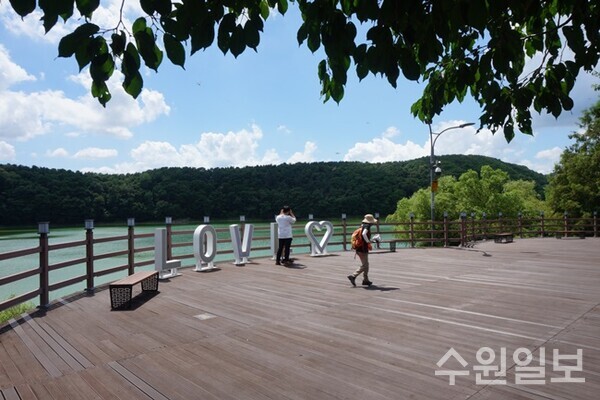
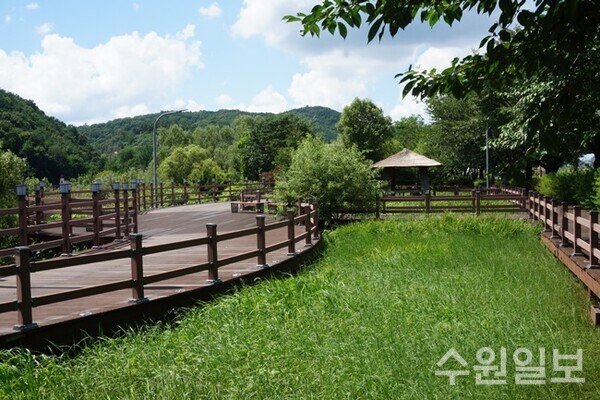
This summer, due to extreme heat, I was unable to walk this trail frequently.
And after a long time, I returned to the Gwanggyo Maru Trail.
It is truly wonderful. The lush trees have created cool shade along the entire path.
The shimmer of the lake and the shadows of the mountains on the opposite bank refreshed my tired eyes from writing. Rest areas are provided along the walk, and small gardens are also created, leaving no room for boredom. In fact, it's a shame that this trail ends so quickly.
Moreover, you can hear an orchestra of cicadas—long-tailed cicadas, Korean cicadas, small cicadas, and evening cicadas—sounds rarely heard in the city.
If you wish to walk longer under the cool shade, you can cross a small suspension bridge upstream of the reservoir and enter a mountain trail.
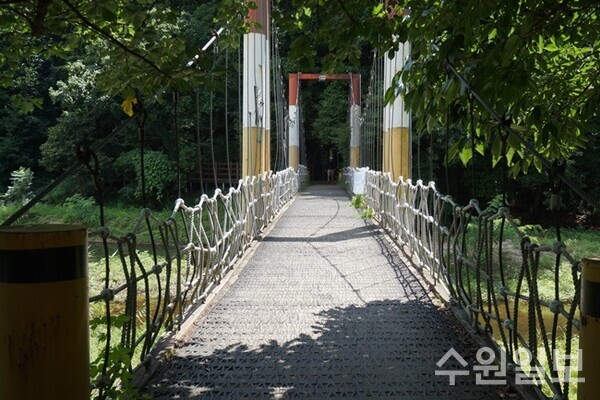
The scenery here is excellent. Sanmak-i Old Road in Goesan County, North Chungcheong Province is also beautiful, but if you are inclined, the landscape of the Gwanggyo Reservoir mountain trail, which you can easily visit anytime, is in no way inferior.
Narrow ledge paths are created throughout to allow experiencing the charm of mountains and lakes simultaneously, making the walk enjoyable. Although it is called a mountain trail, it is not rugged, so you can walk comfortably in casual sneakers without hiking boots and light clothing.
Now summer is ending. Yet the sun is still hot.
I recommend experiencing summer turning toward autumn on the Gwanggyo Reservoir perimeter trail.