[Liberation Day Pilgrimage] "A Man Who Leaves Home Does Not Return Alive" - Yun Bong-gil at 25
A visit to Shanghai, China ahead of Liberation Day on August 15 was undertaken to reflect upon the spirit of independence movements and the achievements of Dr. Yun Bong-gil. However, difficulties emerged upon arrival at the location.
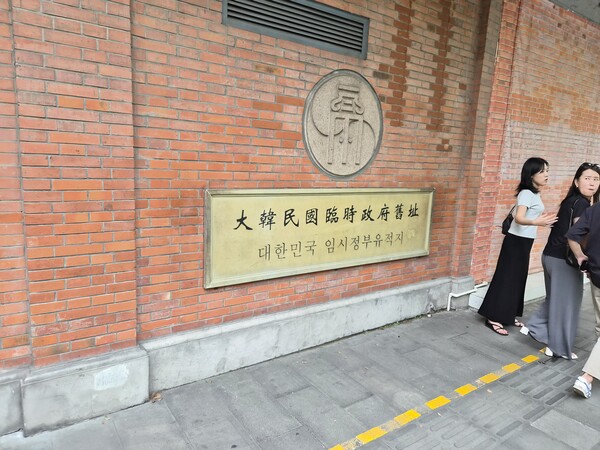
Upon arriving at the Provisional Government of the Republic of Korea building located in Shanghai, China, we learned that it was ‘under renovation.’ We had to settle for taking photographs in front of the building.
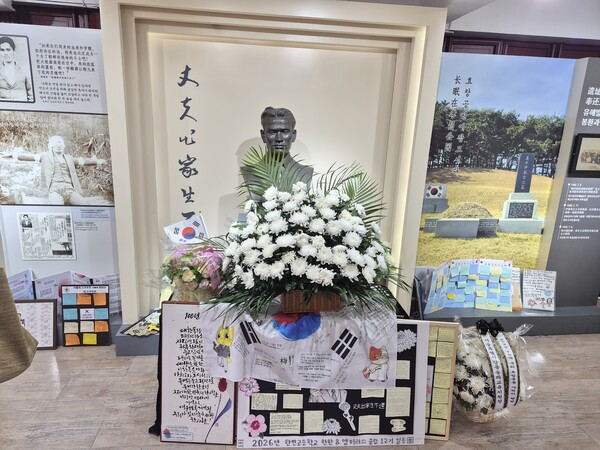
We then visited Hongkou Park, the site of Dr. Yun Bong-gil's patriotic act, paid our respects to the doctor, and examined the exhibits. Age 25. 1908 ~ 1932. The young patriot Dr. Yun Bong-gil pledged before President Kim Gu to eliminate Japanese military officers for the sake of Korea and China. The paper on which this pledge was written became a national treasure of the Republic of Korea.
I wish to introduce here the photograph taken before the act, showing the handwritten text worn around Dr. Yun Bong-gil's neck and chest.
[Oath] With sincere devotion, I pledge to become a member of the Korean Patriotic Corps and eliminate Japanese military officers invading China in order to recover the independence and freedom of our nation. Korean Provisional Government Year 14, Month 4, Day 26. Sworn by Yun Bong-gil.
Before the Korean Patriotic Corps. This document is held by the National Museum of Korea and is designated and managed by the government as National Treasure No. 568.
This is the oath written in Dr. Yun Bong-gil's own hand three days before carrying out the act on April 29, 1932, at Hongkou Park in Shanghai, China, where a ceremony celebrating the Japanese Emperor's birthday and the Japanese military's victory in Shanghai was being held.
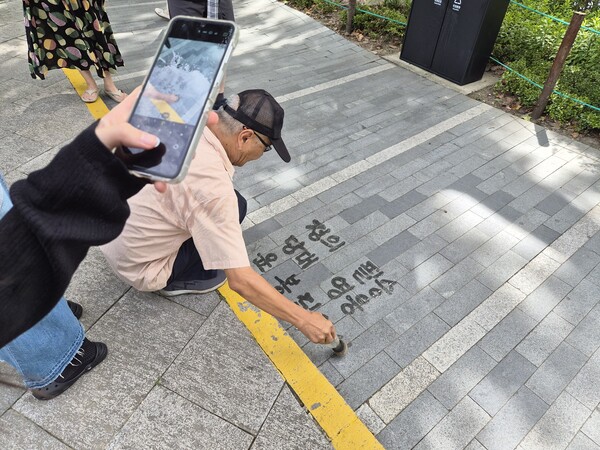
<Justice Prevails: The Hero of Our Time, Dr. Yun Bong-gil> An elderly man in his eighties, appearing to be of Korean ethnicity or a descendant of those who migrated to Shanghai for the independence movement, demonstrated calligraphy on the pavement using a brush pen filled with water. Our group waited until the tour was complete to witness this skillful penmanship.
It weighs heavily on our hearts that those who participated in the independence movement and their descendants still live in difficult circumstances. What appears to be a descendant of a patriotic independence activist received great applause from our group for this calligraphy performance honoring Dr. Yun Bong-gil.
Dr. Yun said, "When a man leaves home, he does not return alive." (丈夫出家生不還) It appears that when he went to China, he had resolved to dedicate his life to national liberation. One comes to realize that at age 25, making a commitment to sacrifice oneself for one's country, nation, and people is no simple matter.
One reflects on oneself—what thoughts occupied one's mind at age 25, and what commitment does one make now toward one's role in society and nation?
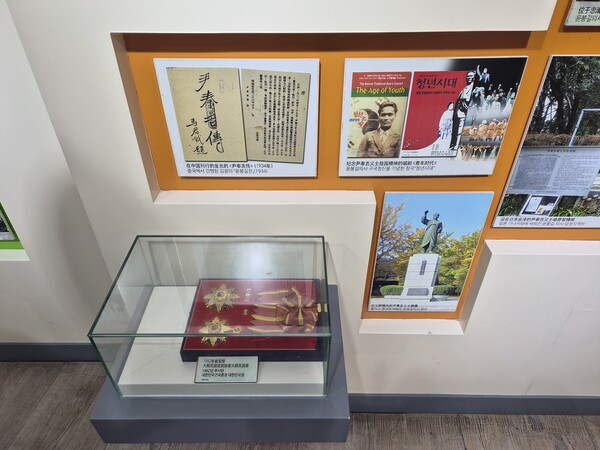
In a small space less than five pyeong, I carefully examined the portrait, photographs, medals, and various artifacts enshrined there. I came to realize that a single sheet of paper or a piece of metal, depending on its purpose, can become a national treasure in the future and a national heritage that the entire nation wishes to see.
Dr. Yun Bong-gil's remains were repatriated to his homeland on May 15, 1946, along with Doctors Lee Bong-chang and Baek Jung-gi, and were interred at the Tomb of the Three Patriots in Hyochang Park, Yongsan-gu, Seoul on June 30 of that year. The government of the Republic of Korea posthumously awarded Dr. Yun Bong-gil the Order of Merit for the Founding of the Republic in 1962.
After retiring from public service, I have had opportunities to give lectures at small gatherings and have explained the story of Dr. Yun Bong-gil through photographs on several occasions. The core of my talk at that time emphasized the fact that at the young age of 25, Dr. Yun left his wife and children behind to go to China for the independence movement.
I also mentioned that the oath appearing in the photograph taken three days before the act is designated as a national treasure of our country and is being preserved. I also emphasized to young civil servants that a single sheet of paper they handle may be a document as precious as a treasure to the citizens who receive it.
Having visited the historical site of Dr. Yun Bong-gil again, I am now prepared to explain more concretely in future lectures and to emphasize even greater significance regarding Dr. Yun's love for his homeland. The fact that the relics of the Korean patriot Yun are well preserved in China also holds great meaning.
During this trip, I wish to boast of the diligence of our group, recounting that we viewed the statue of Guan Yu, which the others did not see. The guide said that if we took a wooden boat upstream, it would take only about ten minutes. So we went further upstream and met the statue of Guan Yu there. We saw a clear statue of the face of the protagonist from the drama Pao Zheng. Just as in life, when one is diligent during travel, one can see, feel, and encounter more.
Author
Lee Gang-seok
Ombudsman of Hwaseong City · Former Director of Gyeonggi Techno Park · Former Vice Mayor of Osan City