


New Semi-Metropolitan 'Suwon Model' Proposed... Staff Expansion Around 400 Personnel
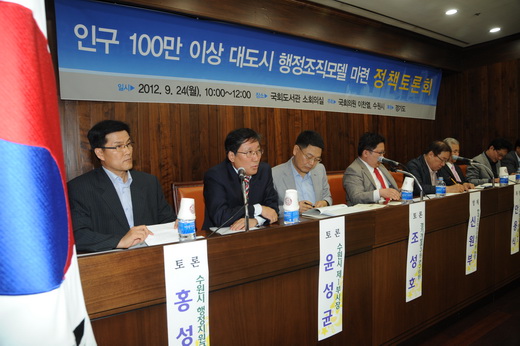
The 'Suwon Model' presented at the 'Policy Forum on Preparing Administrative Organization Models for Major Cities with Populations Over 1 Million' jointly organized by Suwon City and National Assemblyman Lee Chan-yeol on the 24th proposes granting 'special basic self-governing body' status to cities with 1 million residents, rather than pursuing direct conversion to metropolitan cities. The model is centered on administrative functions performing both basic and metropolitan-level duties, financial arrangements, organizational structure, and personnel management.
Shin Won-bu, director of the Korea Organizational Diagnosis and Evaluation Institute who delivered the keynote speech, stated, "As Suwon City currently exceeds 1 million residents and cities like Seongnam, Goyang, and the integrated self-governing bodies of Anyang and Gunpo are emerging, the administrative organization model for cities with populations over 1 million is no longer a task that can be postponed." He added, "I propose a new semi-metropolitan administrative organization, the 'Suwon Model'."
Director Shin explained, "The 'Suwon Model' addresses the situation where cities have rapidly grown into massive basic self-governing entities, yet operationally still function under administrative structures designed for cities of 500,000 residents, causing difficulties in providing administrative services to citizens. There is a need to discuss and institutionalize administrative organization models for cities like Suwon, Seongnam, and Goyang with populations of 1 million or more."
The most distinctive feature of the Suwon Model is expanding existing basic functions by including 50% of metropolitan-level duties. This expansion of functions is linked to finances and subject to the total personnel cost system; however, it is a model that actively responds to administrative demands appropriate for a city of 1 million through organizational autonomy.
Additionally, regarding finances, the model proposes raising the financial transfer rate currently set at 47% to 75%, positioned between basic and metropolitan entities, taking into account the expanded roles and duties.
Regarding organizational structure, the proposal drew attention by suggesting securing 'organizational autonomy' linked to 'fiscal soundness'.
When fiscal soundness is maintained, the key provisions include: 10% increase in operations under the existing personnel establishment system, autonomy in organizational composition, elevation of the First Vice Mayor's rank, and elevation of department and team ranks. This emphasizes that rather than simply exempting the total personnel cost system, the model seeks autonomous management of organizations and personnel while still operating under the total personnel cost framework.
Regarding civil servant personnel, the Suwon Model's workforce scope was calculated by applying the 'area' variable—an important consideration in providing administrative services—in addition to 'population per civil servant'.
Director Shin stated, "After calculating by combining and mixing the 500,000-resident city type and the Changwon City type in relation to area, the Suwon City personnel establishment currently requires an additional 400 to 415 personnel."
Mayor Yeom Tae-young, who organized the forum, said, "Suwon City's population is similar to Changwon in South Gyeongsang Province or Ulsan Metropolitan City, but it is classified under the 500,000-resident self-governing entity category, creating severe imbalances in civil servant personnel and ranks." He added, "Improvements are urgent to provide residents with high-quality administrative services."
National Assemblyman Lee Chan-yeol stated, "It is time for discussions on a new direction for development of self-governing entities aimed solely at megacities to begin." He continued, "There is a need to redefine what basic self-governing entities are, with rigidly fixed frameworks, and implement bold institutional reforms in the administrative and financial sectors."
Professor Choi Byung-dae of Hanyang University, who participated as a discussant, said, "The central government must fundamentally change its perspective." He suggested, "Moving away from a uniform standard that applies a 500,000-resident organizational structure to cities of 1 million, we must develop detailed administrative organization manuals that categorize cities by population—500,000, 700,000, and 1 million—and adopt an upward-directed and open approach."
Park Sung-ho, director of the Local Administration System Division at the Ministry of Interior and Safety, promised, "As new types of major cities are emerging, we will prepare improvements to the administrative organization model for cities with populations over 1 million by targeting 2013."
Meanwhile, following the Local Administration System Reform Promotion Committee's passage of the 'Basic Plan for Local Administration System Reform' in June, Suwon City commissioned its own research and developed an administrative organization model for cities with populations over 1 million. Suwon City plans to convey the administrative organization model to the Ministry of Interior and Safety and the Local Administration System Reform Promotion Committee, incorporating the results of the forum discussions, and will actively advocate for its institutionalization.
Loading comments…