


Paldal Mountain Monorail Must Secure Both Profitability and Attractions
The Paldal Mountain monorail still faces numerous review stages to go through, including obtaining approval for changes to cultural heritage sites and conducting various impact assessments. Additionally, opinions within the committee are divided on the monorail installation.
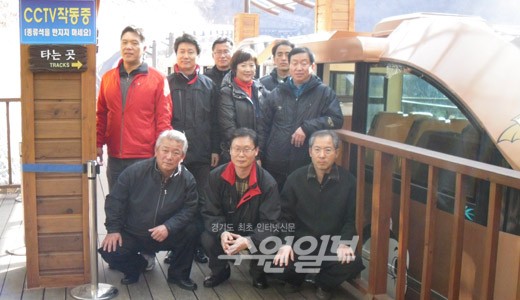
In this regard, the Hwaseong Tourism Vitalization Committee—including Chair Hong Seung-geun, Secretary Lee Hee-jung, Council Members Kim Ho-gyeom, Lee Yun-pil, Jin Heung-guk, Kim Jong-gi, and Choi Joong-sung, as well as Culture and Sports Director Kim Young-gyu and Hwaseong Project Manager Kim Chung-young—visited the Daegeum Cave monorail in Samcheok on the 6th to conduct a benchmark study. This reporter accompanied the entire benchmarking process of the committee to examine whether matters ranging from monorail installation to operational conditions and tourism revenue could be applied to the Paldal Mountain monorail.
● Daegeum Cave Opened in 2007, Daily Tourism Revenue of 5 Million Won
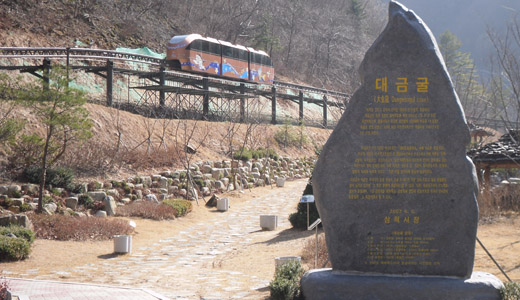
The Daegeum Cave, first discovered on February 25, 2003, had its name officially designated as 'Daegeum Cave (大金窟),' meaning 'a cave that shines with gold,' on June 20, 2006. After seven years of exploration and construction for opening, it was made available to the public on June 5, 2007.
The Daegeum Cave, believed to have been formed approximately 530 million years ago, has a total length of 1,610 meters, with an open section of 793 meters. (The viewing route extends 1,356 meters)
The Daegeum Cave monorail, completed at the end of July 2006, has a total length of 610 meters, with 470 meters from the exterior to the cave entrance and 140 meters within the cave.
With total project costs of 3.544 billion won, the Daegeum Cave monorail serves as the sole means of transportation for cave tourism, accommodating 42 passengers per ride, with viewing time taking approximately 45 minutes.
The Daegeum Cave monorail operates at 30-minute intervals, with approximately 600 users in winter to 700 users during peak seasons daily. According to the Samcheok Daigeum Cave Management Office and Chair Hong Seung-geun of the committee, reservations must typically be made one to two months in advance to secure passage. The Daegeum Cave monorail admission fee is 12,000 won for individuals and 10,000 won for groups (based on adult rates).
An official from the management office stated, "Daily average revenue is 5 million won, which translates to 150 million won per month and 1.8 billion won annually."
● Local Governments Rushing to Install Monorails
As the Daegeum Cave monorail tourism grew in popularity, Samcheok City is pursuing a project to install dual-track monorail cars over a 499-meter section in the Hwanseon Cave, another limestone cavern, spending approximately 9 billion won, with completion expected by the end of this year.
Chair Hong Seung-geun explained, "Recently, local governments have been competing to install monorails to maximize tourism revenue."
He emphasized that the monorail, unlike the currently operating Hwaseong tourism train (which uses diesel fuel), uses electricity and is therefore eco-friendly as well as a 'well-being' tourism means.
Furthermore, there is a need for measures to substantively promote Hwaseong, a UNESCO World Heritage site, and increase tourism revenue through it.
According to Chair Hong, only about 10 percent of tourists visiting Hwaseong proceed to Seojangdae, located at the summit of Paldal Mountain, meaning Hwaseong tourism is essentially limited to being a 'transit-type' destination.
He stated, "While Hwaseong restoration projects are urgent, what is more pressing is building tourism infrastructure centered on Hwaseong," arguing that the monorail is a means of drawing in tourists and properly promoting Hwaseong.
Since the 'monorail' itself becomes a tourism resource, and given the characteristic that one must ascend Paldal Mountain to tour Hwaseong facilities, Chair Hong explained it is a convenient tourism means accessible to all age groups without restriction.
● "Paldal Mountain Monorail's Unique Scenery and Profitability Must Be Prioritized"
However, some argue that sufficient profitability review is necessary before directly applying the Samcheok Daegeum Cave monorail model to Hwaseong tourism.
In the case of Daegeum Cave, the point is that the monorail is the sole means to tour the site, and its attractions and scenery—ancient mystique and geological formations—differ from those of Hwaseong Palace. The contention is that should a monorail be installed in Hwaseong, where various tourism means already exist such as the Hwaseong tourism train, walking tours, and trekking, the monorail must possess differentiated characteristics capable of attracting tourists.
Moreover, the profitability aspect is a matter that must be examined. Daegeum Cave's admission fee is 12,000 won for individuals and 10,000 won for groups on an adult basis. Although it generates 1.8 billion won annually, when monorail installation costs and interior cave construction costs are combined, they reach 18 billion won, requiring at least 10 years or more to break even, according to calculations.
Committee members who toured the Daegeum Cave monorail on that day agreed that the Paldal Mountain monorail would need to charge at least 5,000 won (based on adult rates) to ensure profitability.
Secretary Lee Hee-jung of the committee stated, "We must consider whether there are sufficient attractions and scenery worthy of paying admission to use the monorail, as well as profitability."
Culture and Sports Director Kim Young-gyu also said, "We will carefully review this for the convenience of Hwaseong tourism," while adding, "We should consider whether it possesses scenic value and what attractions it can provide."
Director Kim further presented the opinion that three stages of thorough review are necessary: 'whether monorail installation is necessary,' 'if installation proceeds, what methods should be pursued,' and 'when should installation take place.'
Hwaseong Project Manager Kim Chung-young stated in advance that "Hwaseong Palace is subject to the Cultural Heritage Protection Act and must obtain approval for changes to the heritage site from the Cultural Heritage Administration," adding, "We will coordinate with the Cultural Heritage Administration to discuss what impact the monorail installation will have on Paldal Mountain's form and scenery."
Concluding the Samcheok Daegeum Cave benchmark study, Chair Hong Seung-geun said, "We plan to visit approximately two more regions where monorails have been installed for additional benchmarking," and explained, "We will conduct sufficient data investigation and research for Paldal Mountain monorail installation."

Loading comments…