


Suwon Already a 'Metropolitan City', Administrative Restructuring Consideration Necessary
In late August last year, both ruling and opposition political circles raised their voices in unison on the principle of reorganizing local administrative divisions, integrating 234 local autonomous entities into 70 metropolitan cities, bringing discussions on administrative system restructuring back to the forefront.
In particular, with President Lee Myung-bak and political circles from both parties showing more active willingness for administrative division reorganization than ever before, the possibility of implementation is being closely watched.
● Ruling and Opposition Political Circles 'in Unison', Implementation Possibility Greater Than Ever
The Democratic Party presented on August 28 the reorganization of local administrative divisions, integrating 234 local autonomous entities into 70 metropolitan cities, as a key policy task.
Han Heo Tae-yeol, top policymaker of the Grand National Party, also sparked discussions on administrative division reorganization at a press conference on the 31st of the same month, saying, "It would be desirable to abolish provinces in the current three-tier administrative system of metropolitan city/province-city/county/district-eup/myeon/dong and reorganize the nation into approximately 70 metropolitan cities."
In fact, administrative division reorganization had been discussed since the early days of the new administration. On March 12 this year, a major media outlet reported that the government was pursuing a plan to comprehensively reorganize the administrative system from the current 246 local autonomous entities to 40-70 entities beginning in 2010.
Additionally, the Ministry of Public Administration and Security was reported to plan to submit work report materials including such content to the president on the 15th, prompting observations that the new administration would pursue administrative division system reorganization upon its launch.
The Ministry of Public Administration and Security issued a clarification, emphasizing that this was an 'internal document' collecting various ideas including discussions from academia to prepare presidential work briefing materials, but it was an example demonstrating that administrative division reorganization discussions had already been proceeding at the government level.
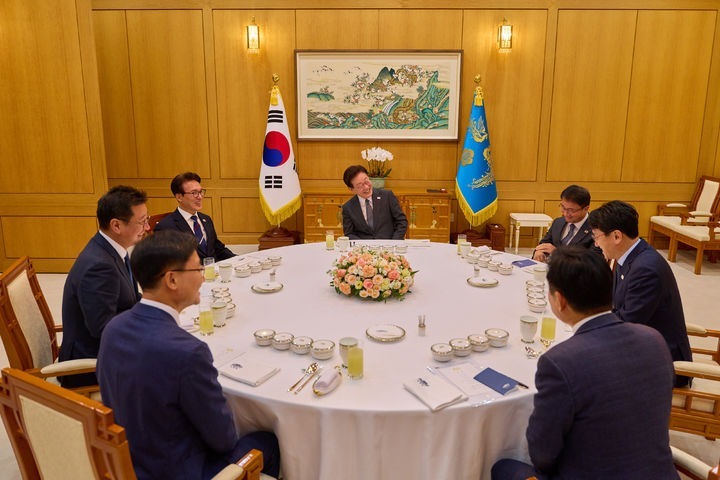
Moreover, at a luncheon meeting between President Lee Myung-bak and Democratic Party Representative Jung Se-gyun on the 25th of last month, Representative Jung conveyed the opinion that "reorganization of 100-year-old administrative divisions should be pursued promptly."
President Lee responded by saying the government would present its plan and called for cooperation between ruling and opposition parties, signaling that specific discussions on administrative division reorganization would proceed going forward.
● "High-Cost, Low-Efficiency Administrative System Must Be Reorganized"
The core of administrative division system reorganization discussions is the need to improve the current administrative system structure that brings about 'high-cost, low-efficiency.'
In particular, there are calls for metropolitan integration centered on Suwon City, with a population scale of nearly 1.1 million, approaching that of metropolitan cities.
As cities and populations expand, it is argued that metropolitan integration is the key to solving mounting problems, including not only deterioration in quality of administrative services and overwork, but also urban planning establishment and implementation, and securing finances for these purposes.
A senior Suwon City official stated, "By reorganizing the administrative division system in the direction of simplification, we can reduce not only costs incurred in administrative procedures going through city-province-government, but also costs for civil servant workforce organization."
There are also opinions that Suwon City can resolve urban planning issues that are already becoming more metropolitan, such as having 'nuisance facilities' including crematoriums and various waste recycling and reprocessing facilities, as well as costs incurred in establishing various processing facilities.
Additionally, there is growing opinion that metropolitan integration can bring about regional value appreciation through balanced development and advancement, and can further diversify urban functions beyond administration, including education and culture.
● "New Administrative Divisions to Be Applied From 2010"
On the 4th, it became known that the government planned to prepare new administrative division reorganization plans for application beginning with the 2010 local elections next year, drawing attention.
Furthermore, the Blue House and the ruling party are also reviewing a plan to put administrative division reorganization issues to a national referendum, so discussions on administrative division and system reorganization are expected to intensify from year-end.
The Blue House and the ruling party have reportedly established a policy that the 2010 local elections will be held according to the reorganized administrative structure, and will establish reorganization drafts from year-end or early next year.
In particular, since the ruling party, including the president, and the opposition party have agreed on the overarching premise of administrative division reorganization, the position is that a national referendum must be held without fail during next year.
The Blue House is also showing the view that a national referendum is necessary to add momentum to administrative division reorganization and to avoid legal disputes.

Loading comments…