


Law vs. Coupang? ① Law Says "30 Days from Discovery"…Coupang Closes Return Window by Its Own Criteria
When problems arise with products ordered and paid for on Coupang, how far can consumers resolve them through Coupang? When we tracked a children's product that the state ordered recalled as harmful, notification of the recall and identification of the buyer were handled within Coupang, but from that point on it became "the consumer's responsibility." The statutory withdrawal period for contracts differed from Coupang's own return standards, and consumers had to obtain refunds by providing account information to the seller instead of receiving funds back to the original payment method. Suwon Ilbo will examine over three installments how consumer rights guaranteed by the E-Commerce Law actually operate within large platforms, why money and personal information move outside the platform during processing, and how far current law defines platform responsibility. Editor's Note
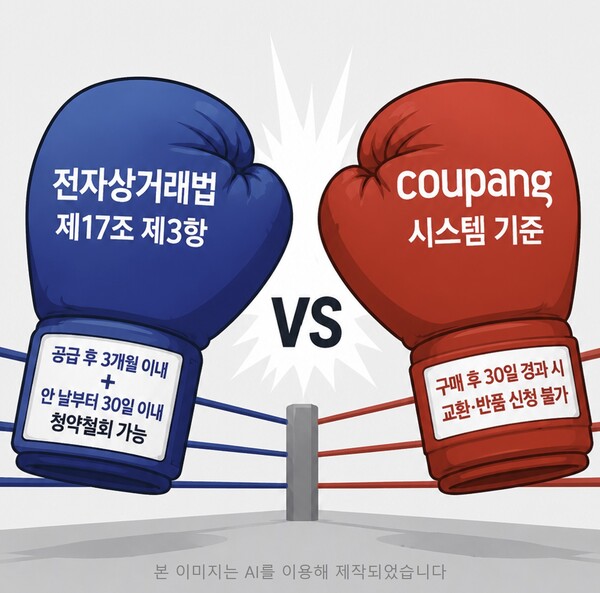
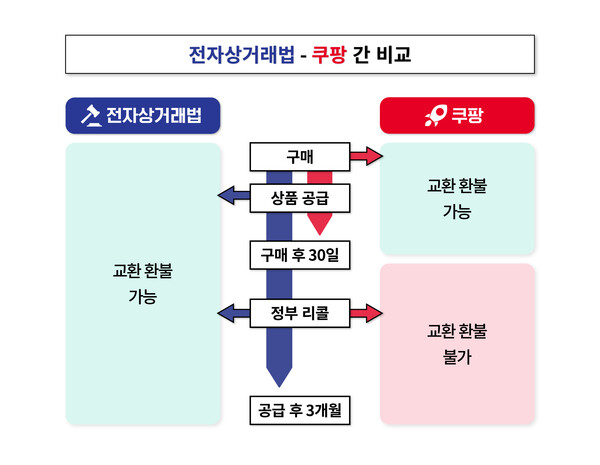
The E-Commerce Law allows consumers to withdraw from contracts within 30 days of discovering that a product was supplied in a manner inconsistent with contract terms, provided this is within 3 months of receiving the goods. However, Coupang has been found to independently block exchange and refund request functions 30 days after purchase.
According to Coupang and the Fair Trade Commission on the 21st, buyers of children's products sold on Coupang cannot request exchanges or refunds on Coupang after 30 days of purchase, even if they receive a recall notice from the National Institute of Standards and Technology.
This is because Coupang's own standard of "30 days after purchase" differs from the statutory withdrawal period under the E-Commerce Law.
Article 17, Paragraph 3 of the E-Commerce Law establishes a separate withdrawal period when product descriptions or specifications differ from advertised claims or are supplied in a manner inconsistent with the contract.
In such cases, consumers may withdraw from the contract within 3 months of receiving the goods and within 30 days of discovering or being able to discover the discrepancy.
In this product case, an investigation by the National Institute of Standards and Technology detected lead levels exceeding safety standards, making the product subject to a "collection and exchange" order.
The buyer had not passed 3 months from receiving the product and had not exceeded 30 days since receiving the recall notice from Coupang and learning of the safety standard violation.
In other words, the statutory withdrawal period remained available.
The procedure for refunding payment following withdrawal is also specified in law.
Article 18, Paragraph 2 of the E-Commerce Law stipulates the refund obligation following withdrawal, and in defining the scope of "telecommunications sales business operators," it includes "those who have received payment from consumers or entered into a telecommunications sales contract with consumers."
When goods are returned, payment already received must be refunded within 3 business days of receiving the returned goods.
The handling method for cases where payment is made through payment methods specified by law, such as credit cards, is also established. Paragraph 3 of the same article stipulates that telecommunications sales operators must request payment processors to suspend or cancel billing.
There are also provisions for cases where multiple businesses are involved in the transaction.
Article 18, Paragraph 11 stipulates that when the telecommunications sales operator, the recipient of payment, and the person who entered into the contract with the consumer are not the same entity, they bear joint and several liability for performing refund obligations related to withdrawal.
Nevertheless, on Coupang, regardless of when the recall was discovered, exchanges and returns could not be requested due to 30 days having passed since purchase. While the law guarantees a separate withdrawal period from when the product defect is discovered, Coupang's system provided no mechanism to exercise this right, and the collection and refund process was transferred to sellers outside the Coupang platform.
Separately from the fact that Coupang is not the direct seller of the product but a telecommunications sales intermediary, there are also duties imposed on intermediaries.
Article 20, Paragraph 3 of the E-Commerce Law stipulates that telecommunications sales intermediaries must promptly take necessary measures to identify causes and damages in resolving consumer complaints and disputes arising from the use of cyber malls and similar platforms.
Provisions for imposing sanctions in cases of failing to fulfill such duties are also in place.
Article 32 of the E-Commerce Law permits the Fair Trade Commission to order corrective measures, including cessation of violation, performance of statutory duties, and consumer damage prevention and remediation for business operators that violate or fail to perform refund obligations under Article 18, intermediary duties under Article 20, and similar requirements.
Acts obstructing withdrawal are also separately prohibited. Article 21 of the E-Commerce Law prohibits acts such as informing consumers of false or exaggerated facts or using deceptive methods to obstruct consumer withdrawal, and these too can be subject to corrective measures under Article 32.
If violations are repeated despite corrective measures or corrective orders are not complied with, as specified in law, this can lead to business suspension orders.
Whether Coupang's operating methods in this case violated these provisions requires judgment from the Fair Trade Commission and others.
Coupang stated that it has "no separate official response" regarding the difference between the statutory withdrawal period and Coupang's exchange and return standards, the reason for not providing a separate application pathway for recalled products, and Coupang's refund responsibility following withdrawal.


Loading comments…