


Analysis Examining Gyeonggi Province's Finance as "Effectively Insolvent" ... Not in Legal 'Crisis,' But Flexibility Has Narrowed
Though Governor Choo Mi-ae of Gyeonggi Province characterized the province's finances as being in an "effectively insolvent state," applying current financial figures to standards under the Local Finance Act shows the situation is considerably distant from a legally-designated financial crisis.
However, as the scale of debt and repayment burden grow year after year and the proportion of essential expenditures remains at high levels, an actual decline in financial management flexibility is also confirmed.
Based on data provided by Gyeonggi Province and the Gyeonggi Provincial Council, Suwon Ilbo calculated that as of the end of June this year, the province's debt-to-budget ratio stands at 15.57%. This is derived by dividing the debt balance of 6.24 trillion won by the fiscal year's primary budget of 40.06 trillion won. This is 9.43 percentage points below the financial caution standard (exceeding 25%) stipulated in Article 65-3 of the Enforcement Decree of the Local Finance Act.
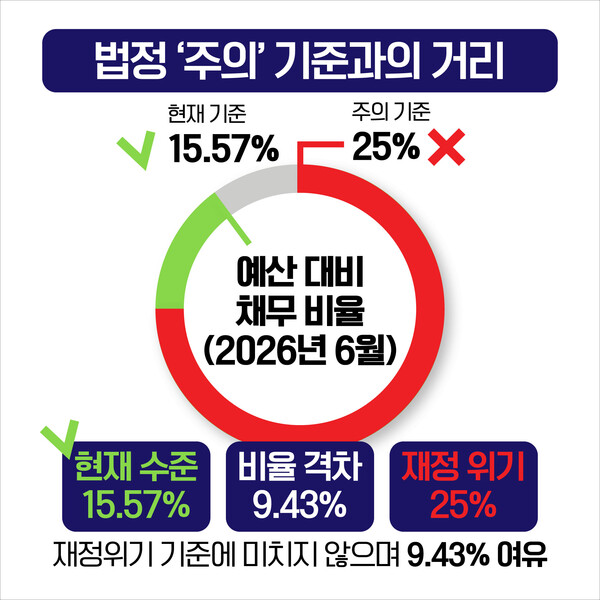
Based on a simple calculation using the primary budget as the denominator, the debt balance would need to reach 10.01 trillion won to reach the financial caution threshold. This represents an increase of 3.78 trillion won from current levels—four times the 943 billion won in local bonds issued by the province last year.
Even if the approximately 7 trillion won in "debts to be repaid" presented by Governor Choo's office were assumed to be debt, the ratio would be 17.47%, still falling short of the caution standard.
However, the 7 trillion won cited by Governor Choo's office and debt as defined under the Local Finance Act are not the same concept. The amount disclosed by Governor Choo's office includes fund borrowings and principal on local bonds, as well as future interest payments. In contrast, the debt balance submitted by the province to the Provincial Council reflects official debt management standards. Since Governor Choo's office has not disclosed detailed calculation breakdown, the precise difference between the two figures cannot be determined from publicly available information alone.
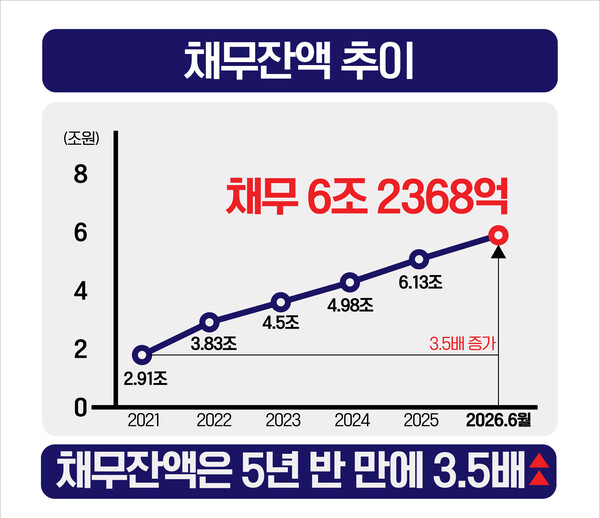
Looking at absolute levels alone, the province is removed from legal financial crisis. However, the trajectory of debt tells a different story. According to data submitted by Gyeonggi Province to the Provincial Council, debt balance increased from 1.77 trillion won at the end of 2020, to 2.91 trillion won in 2021, 3.84 trillion won in 2022, 4.51 trillion won in 2023, 4.98 trillion won in 2024, 6.14 trillion won at the end of 2025, and reached 6.24 trillion won by the end of June this year. This represents a 3.5-fold increase in five and a half years.
The same trend appears in Local Finance 365 disclosures. The province's debt-to-budget ratio rose annually from 4.53% in 2020, to 6.28% in 2021, 9.12% in 2022, 11.61% in 2023, and 11.95% in 2024. The 2025 provincial tally stands at 12.55%.
However, comparing this figure with our calculated 15.57% is difficult due to different denominators. Local Finance 365 uses the final budget amount that includes supplementary budget adjustments, while we applied the confirmed primary budget. The smaller the denominator, the higher the resulting ratio. Regardless, the upward trend year after year remains consistent.
Repayment burdens are also increasing. Based on 2024 figures, the province's managed debt service ratio stands at 8.39%, below the Ministry of the Interior and Safety's diagnostic standard of 12%. However, it has risen nearly fourfold in three years from 2.19% in 2021 to 4.31% in 2022, 7.27% in 2023, and 8.39% in 2024. The ministry's comprehensive financial analysis report for local governments pointed to the need to minimize new local bond issuances and conduct advance due diligence evaluations in light of increased regional development bond issuances.
A more notable indicator is the current account ratio. The current account ratio represents the proportion of recurring expenditures such as personnel costs and welfare expenses within annually recurring revenues. The higher this ratio, the smaller the financial flexibility available for new projects or policies.
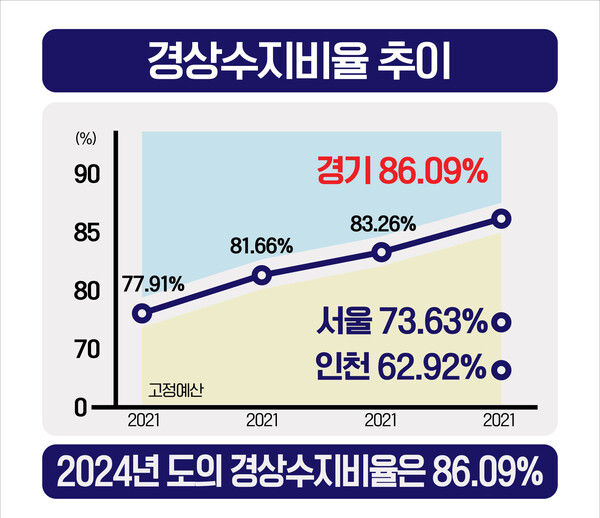
The province's current account ratio in 2024 was 86.09%, higher than Seoul's 73.63% and Incheon's 62.92%. This means 86% of incoming revenue is already earmarked for spending. This ratio has also continued to rise from 77.91% in 2021 to 81.66% in 2022, 83.26% in 2023, and 86.09% in 2024.
Local tax collection this year has also fallen short of projections. According to provincial local tax collection status, acquisition tax collection from January through July totaled 4.57 trillion won with a collection rate of 56.0%. With the period exceeding halfway through the year, this falls 2.3 percentage points short of the appropriate collection rate of 58.3%. The province projects that provincial taxes will fall approximately 300 billion won short of targets by year-end.
These two indicators reveal different stories. The debt-to-budget ratio shows how much current debt compares to the overall budget. The current account ratio and revenue structure show how much money remains available to spend year after year. Even if legal indicators fall short of caution levels, increases in essential expenditures and reductions in revenue can shrink available resources accordingly.
In fact, the province issued 943 billion won, representing most of its local bond issuance limit last year, and drew 558.8 billion won from various funds into the general account. This year, certain livelihood and essential projects reflected only nine months' worth of annual requirements in the primary budget.
Synthesizing the numbers reveals two simultaneous aspects of the province's finances. Under current law, it does not qualify as a caution or crisis-level entity, and its debt ratio is considerably below standards. Conversely, debt balance and repayment burdens have continually increased in recent years, and due to high proportions of essential expenditures and revenue volatility, actual operational flexibility is narrowing.
Based solely on figures currently confirmed, it is difficult to characterize the province's finances as "insolvent." However, if continued increases in debt and expanding fiscal rigidity persist, operational burdens will inevitably grow in the future.

Loading comments…