


Kim Dong-yeon, "Let's Head Toward an 'Economic Great Reversal' on a New Path"
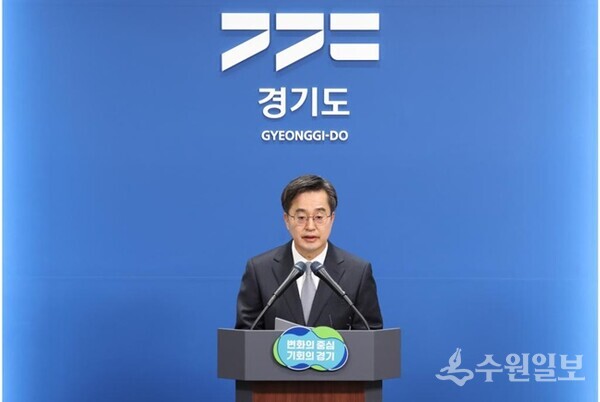
[Suwon Ilbo=Reporter Kim Gap-dong] Gyeonggi Province Governor Kim Dong-yeon stated, "We have no past to return to, nor any normalcy to restore," and added, "We must head down a new path."
On the 19th, Governor Kim held an emergency briefing at the Gyeonggi Province Government briefing room to propose economic reconstruction amid the impeachment crisis, saying, "We need extraordinary emergency measures to transform the Yoon Seok-yeol administration's backward movement into forward progress," and emphasized, "We must achieve a complete reversal across all sectors—fiscal policy, monetary policy, currency, industry, and climate crisis response—to restore Korea's plummeting economic graph into a 'V-shaped curve.'"
In response, Governor Kim stated, "The first priority is an economic policy reversal, starting with changing the fiscal and monetary policy framework," and presented three 'R.E.D.' principles: △Act 'Rapid'ly without delay △Provide 'Enough' resources beyond minimum necessity △Be 'Decisive' enough to defy market expectations.
Governor Kim Dong-yeon also emphasized, "Through expanded fiscal roles, we must invest at least 300 trillion won and beyond in future growth engines and livelihood economy."
He stressed investing at least 100 trillion won in "future growth engines"—including securing AI semiconductor sovereignty, driving bio-health innovation, and building foundations for space-aerospace and quantum industries—and at least 100 trillion won in livelihood economy—including operating cost and labor support for small business owners and youth job innovation—as well as increasing policy financial loans through financial intermediation support, where the Bank of Korea provides low-interest loans to commercial banks to ease mid-to-small enterprise funding shortages, by 100 trillion won.
Governor Kim Dong-yeon said, "Presidential impeachment takes time, but our economy and livelihood cannot wait that long," and added, "We must swiftly impeach economic policy, particularly fiscal policy, and completely break free from the current economic management framework to forge a new path."
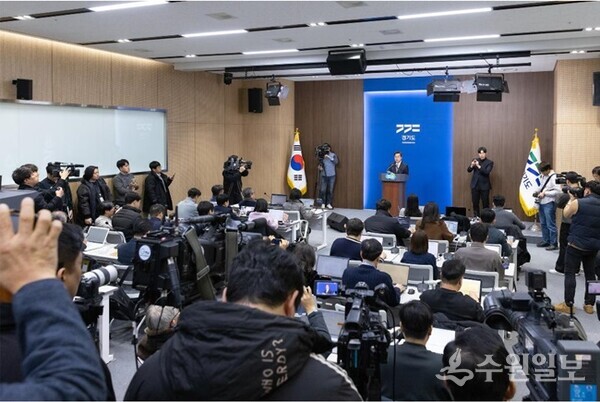
[Full Text of Governor Kim Dong-yeon's Emergency Briefing on Economic Reconstruction During Impeachment Crisis]
Eight years ago, as the inaugural Deputy Prime Minister for Economic Affairs in the new administration launched following presidential impeachment, I was responsible for the economy.
The economic situation was very difficult due to low growth in the 2 percent range becoming entrenched, deepening inequality, and worsening inter-Korean relations.
The new administration immediately compiled an 11 trillion won supplementary budget upon inauguration and rapidly injected fiscal spending, while making all efforts to stabilize external relations.
As a result, the economic trajectory changed.
We raised the economic growth rate from the 2 percent range to the 3 percent range, and per capita national income surpassed the 30,000 dollar mark for the first time in history.
During the 2008 financial crisis, I was on the front lines of overcoming the economic crisis as an economic and financial secretary to the presidential office.
At that time, the bankruptcy of Lehman Brothers dealt a major blow to our financial markets, and shocks extended to the real economy in construction, shipbuilding, and shipping sectors.
At the time, we swiftly produced a revised budget expanding by 100 trillion won from the new year's budget proposal already submitted to the National Assembly, and compiled a 285 trillion won supplementary budget the following year.
As a result, we were able to defend the 2009 economic growth rate, which was expected to be negative, at 0.8 percent, and achieve rapid recovery to 6.8 percent in 2010.
■ Over the past two and a half years, the Yoon Seok-yeol administration moved backward in all respects.
It turned back the clock of the Republic of Korea in all areas—economy, diplomacy, climate response, and even democracy.
The economy in particular faces a comprehensive crisis in domestic demand, investment, and exports. Livelihoods have collapsed.
Major global investment banks project South Korea's economic growth rate next year at 1 percent range.
This is a situation never experienced before except during the two economic crises since industrialization and during COVID.
On top of this, as the landscape of international politics and economics shifts with Trump 2.0's launch, external conditions are deteriorating sharply.
In the midst of this, 'ringleader of insurrection' Yoon Seok-yeol pushed our economy into a desperate crisis through an illegal declaration of martial law. It truly is when it rains, it pours.
The situation now differs from the two previous impeachment periods.
In 2004, China's high growth provided relief, and in 2016, favorable semiconductor market conditions existed, but now—with changes in the international economic order and Trump 2.0's launch—external conditions are more difficult than ever.
Extraordinary emergency measures are necessary.
We must transform Korea's plummeting economic graph back into a 'V-shaped curve.'
We must achieve complete reversal in all respects—fiscal policy, monetary policy, currency, industry, and climate crisis response.
We have no past to return to.
We have no normalcy to restore.
We must head down a new path.
We must transform the Yoon Seok-yeol administration's backward movement into forward progress.
The first priority is economic policy reversal.
First, we must change the fiscal and monetary policy framework.
The principle is threefold: 'R.E.D.'
We must act 'Rapid'ly without delay, provide resources 'Enough' beyond minimum necessity, and be 'Decisive' enough to defy market expectations.
■ The Yoon Seok-yeol administration's fiscal policy must absolutely be impeached.
Through expanded fiscal roles, let us invest at least 300 trillion won and beyond in future growth engines and livelihood economy.
First, we must invest at least 100 trillion won in future growth engines.
We must actively invest in securing AI semiconductor sovereignty, driving bio-health innovation, and building foundations for space-aerospace and quantum industries.
Every country in the world provides various support through industrial policy.
In preparation for the Trump 2.0 era, we must also make bold investments of at least 100 trillion won.
Through such investments, we can expect to close global technology gaps within five years, create 20,000 master's and doctoral-level jobs, and increase exports by 10 billion dollars.
It will become the momentum to rebuild the foundation of our economy anew.
Second, we must invest at least 100 trillion won in the livelihood economy.
We must invest at least 100 trillion won in supporting small business operating and labor costs and innovating youth job creation.
In particular, we must expand the Small and Medium Enterprise Venture Fund contribution, which has been drastically cut by over 50 percent under the Yoon Seok-yeol administration.
We must restore it to the 1 trillion won level of 2020 to nurture small and medium enterprises and startups.
Separately, let us immediately advance 'livelihood recovery support funds.'
We must provide livelihood recovery support funds thicker and more densely to vulnerable groups according to income level.
Through this, we can achieve domestic demand stimulation and economic activation.
According to government calculations, next year's integrated fiscal deficit-to-GDP ratio is -0.8 percent.
Since 300 trillion won represents 1.1 percent of next year's GDP (2,646 trillion won, 2025 budget), even with a '300 trillion won super supplementary budget,' the fiscal deficit ratio will remain below -2 percent.
This still falls short of the 3 percent level set by various international standards, including the EU's fiscal soundness criteria.
Fiscal spending is investment.
Our economy is currently caught in a vicious cycle of economic slowdown → revenue decline → fiscal deterioration → shrinking consumption and investment. We must break this vicious cycle.
We must create a virtuous cycle of expanded fiscal injection → economic recovery → revenue expansion → normalized fiscal function.
■ Along with fiscal policy, preemptive monetary policy is also necessary.
Within a timely manner, the Bank of Korea's base rate must be cut by 0.5 percentage points in a 'big cut.'
Through this, we should reduce the burden on households and businesses and help stimulate domestic demand and activate the economy.
I understand there are opinions that rate cuts should be cautious given possible U.S. interest rate fluctuations following Trump's inauguration and potential burdens on exchange rates and household debt.
But now is not the time to reconsider various factors.
Rescuing our economy through preemptive big cuts is more urgent.
Simultaneously, let us increase 'financial intermediation support loans' by 100 trillion won.
Financial intermediation support loans are policy financing where the Bank of Korea provides low-interest loans to commercial banks to ease mid-to-small enterprise funding difficulties.
I propose expanding financial intermediation support loans by 100 trillion won to support small and medium enterprises, marginal self-employed, and youth startups further devastated by martial law and impeachment.
The current 300 trillion won limit must be restored to the 400 trillion won level seen during COVID.
Such monetary and currency policies are ineffective without leading fiscal expansion.
'Policy mix' between fiscal and monetary policy must be implemented for effectiveness.
Let us do everything we can as quickly as possible through such fiscal and monetary policies.
Subsequently, let us continue to reform industry, real estate, and climate policies.
Presidential impeachment takes time.
Our economy and livelihood cannot wait that long.
We must swiftly impeach economic policy, particularly fiscal policy.
We must completely break free from the current economic management framework.
Only then can we forge a new path.
This is the people's mandate.
Let us forge ahead together.
Thank you.

Loading comments…