


Kim Woo-young's Gwanggyo Column I Hope Hwaseong Sword Dance Will Be Restored and Preserved as Suwon's Heritage
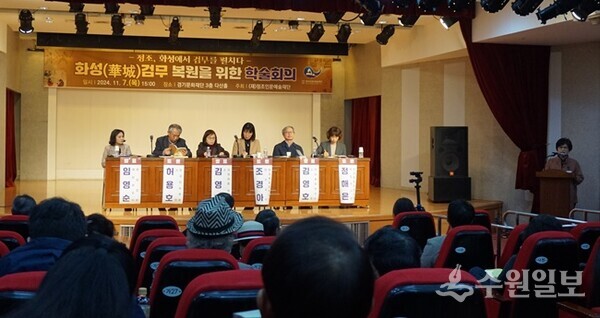
On the afternoon of the 7th, an "'King Jeongjo Performs Sword Dance in Hwaseong - Academic Conference for Restoring Hwaseong Sword Dance'" was held in Dasan Hall on the 3rd floor of the Gyeonggi Cultural Foundation in Ingye-dong, Suwon. It was an informative event to learn about the history and current state of sword dance.
The event, hosted by the Jeongjo Humanities Foundation and sponsored by the Hwaseong Research Association, featured Part 1 academic conference followed by Part 2 sword dance performances.
In the academic conference moderated by poet Jeong Su-ja, whom we call a "master of society," presentations included: △The artistic and historical value of Jinju Sword Dance and Pyongyang Sword Dance (Im Young-soon, Pyongyang Sword Dance Intangible Cultural Property Holder) △How to perform sword dance - the development structure and key concepts of sword dance (Kim Young-hee, Director of Kim Young-hee Dance Research Institute) △The era and people who flourished sword dance - centered on General Yoo Hyeok-yeon and warriors Kim Che-gun, Kim Gwang-taek, and dancer Un-sim (Kim Young-ho, Director of Korea Military Studies Institute). Discussants included Heo Yong-ho (President of the Korean Folklore Society), Cho Gyeong-ah (Research Professor at Korea National University of Arts), and Jung Hae-eun (Senior Researcher at the Academy of Korean Studies).
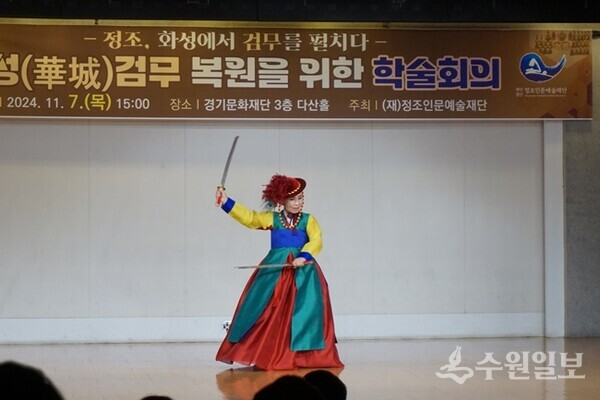
In Part 2, performances included: Pyongyang Sword Dance by Jeong Hye-jeong and Kim Mi-jeong, Pyongyang Sword Dance Successors; Double Sword Solo Dance by Kim Young-soo, Pyongyang Sword Dance Successor; Double Sword Solo Dance by Kim Jae-seong, Martial Arts Dance Researcher; and Double Sword Group Dance by Jeong Hye-jeong and Kim Mi-jeong, Pyongyang Sword Dance Successors.
In truth, I had little interest in sword dance. Dancing while holding toy-like, small, and light metal objects shaped like swords was not to my taste. I had a preconception that sword dance, or sword dancing, should at least be at the level of "Double Swords" or "Korean Sword" or "Jedor Sword" that appear in the Twenty-Four Martial Arts.
So even after hearing about this academic conference, I showed little interest. However, when I heard that among the keynote presentation contents there would be mention of a sword dance from the sixtieth birthday celebration of King Jeongjo's mother, Hyegyeong Princess, held in Bongsudang at Hwaseong Haenggung, my heart was immediately drawn.
The Bongsudang banquet was a grand and elegant royal court banquet that could only be seen in the palaces of Hanyang.
Sword dance was performed at this celebration.
During the Joseon Dynasty, one could not draw a sword before the king. The "Annals of the Joseon Dynasty" contains a record that King Hyojong ordered a warrior to demonstrate sword technique, but a censor from the Office of the Inspector General opposed it by referring to the story of Silla's Hwang Chang-rang.
During the reign of King Yeongjo, there were instances where censors who opposed sword technique demonstrations before the king were removed from office.
However, on the 13th day of the second lunar month of 1795, at the Bongsudang banquet held at Hwaseong Haenggung in the presence of King Jeongjo and his mother Hyegyeong Princess, a sword dance was performed.
This was reportedly the first time sword dance was performed at a royal court event.
Kim Young-hee, Director of the Kim Young-hee Dance Research Institute, stated in her keynote presentation: "Sword dance performed before the king could potentially place the performer in a dangerous situation, so it was not performed at the royal court. However, the high social interest in martial arts during the late Joseon period and King Jeongjo's policy of national wealth and military strength likely made this possible."
Additionally, sword dance was performed at the Nakseong Banquet on October 16, 1796, which celebrated the completion of Hwaseong Fortress. After that, from the 1829 Gichwi Jinchan to the 1902 High King Kojong Imjin Jinyeon, sword dance became an indispensable court performance.
The record book of court performance procedures from the reign of High King Kojong of Joseon, "Jeongcae Mudo Hollgi," contains the dance notation for sword dance. Jinju Sword Dance was designated as a National Intangible Cultural Property in 1967.
The original meaning of "Jeongcae" was "to display one's skills." Another meaning was Heonji (獻技), meaning "to offer one's talents and arts," and it gradually came to be used as a term for court dance.
In Hyewon Shin Yun-bok's "Double Sword Group Dance" and Danwon Kim Hong-do's "Bubyeoknu Banquet," which depicts a banquet welcoming the Provincial Governor of Pyeongyang, scenes of sword dancing are included.
Dasan Jeong Yak-yong also praised sword dance through the poem "Dance Sword Poem, Given to a Beauty" ("舞劍篇, 贈美人"), which he composed at age nineteen.
...(excerpt)...
Like a heavenly maiden descending in flight, she swiftly sits down
Beneath her feet, sword light glimmers like jumping chains
...(middle section)...
One dragon on the ground and one dragon leaping up
Like a blue serpent coiling around the chest a hundred times.
Suddenly holding dual swords in hand, the human form disappears
In an instant, clouds and mist fill the empty sky.
Running left and running right, yet the sword tip does not touch
Striking and thrusting, jumping and rolling, dizzying the eyes
Like whirlwinds and showers filling the cold mountain
Like purple lightning and blue frost contending in an empty valley
Startled geese soar high, never to return
Angry hawks wheel around but cannot catch up
...(rest omitted)...
Let us return to the story of sword dance from the sixtieth birthday celebration of King Jeongjo's mother, Hyegyeong Princess, held at Bongsudang of Hwaseong Haenggung.
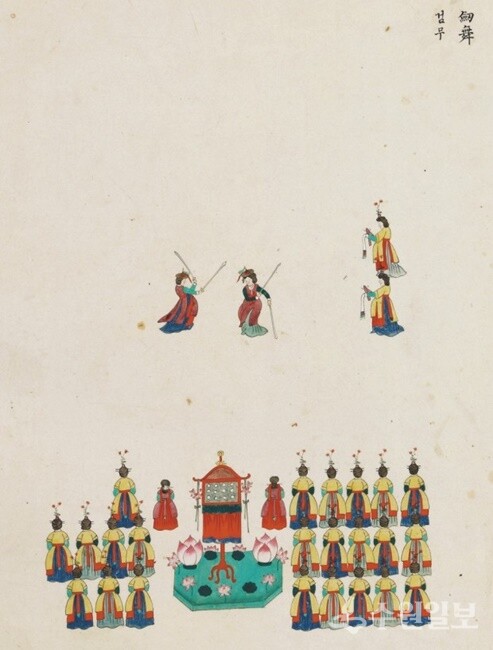
In the "Wonhaeng-eul-myo Jeongri-uigwe," which recorded the sixtieth birthday banquet at that time, there is a drawing of two women dancing with swords in both hands. These women were Seoul gisaeng (female entertainers) and court lady Chun-un (Spring Cloud, 31 years old) and embroiderer Un-seon (Cloud Immortal, 24 years old).
To reiterate, this was the first such court performance in the Joseon Dynasty.
Therefore, the sword dance first performed in Suwon as a court performance is worth restoring and transmitting.
If we study the aforementioned "Jeongcae Mudo Hollgi" a bit further, it appears we could restore it close to its original form.
This record contains the layout diagrams of performers and the procedures of dance progression. The layout diagrams include the roles and placements of each court performance and even the names of performers. Music and movements are described in detail.
If researchers in the relevant fields of the Suwon area and sword dancers actively come forward and restore it, it will become a proud traditional heritage of Suwon alongside the Twenty-Four Martial Arts.

Loading comments…