


Suwon to Launch Resident Priority Parking System Starting October 1, Alleviating Alley Parking Shortages and Neighborhood Conflicts
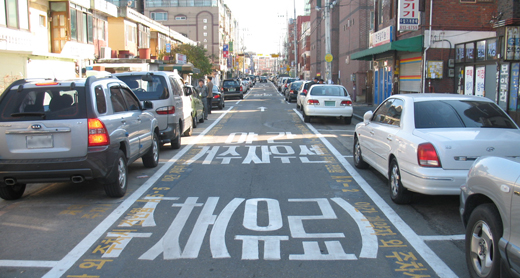
The residential area in front of the Hanil Apartment Complex in Songduk-dong, Jangan-gu, is predominantly comprised of single-family homes and multiplex residences. With restaurants and draft beer establishments frequenting the area, it is a common destination. When the alley is designated as a one-way street, drivers occasionally find themselves unable to move if they have entered incorrectly.
When driving a vehicle in that area, frustration arises from the outset due to parking problems. Even on weekday afternoons, if one wishes to park, luck must be on one's side. Otherwise, one must circle around the alley searching for a parking spot, or resort to using the Manseok Park public parking lot and then proceed to one's destination.
Should an outsider like this reporter park in an alley parking space, residents with vehicles in the surrounding residential area find themselves with nowhere to park. If one occupies the space for an extended period while drinking, the situation becomes even more problematic. While no-parking signs, tire barriers, and cement bollards have been erected, their effectiveness is limited.
Those residing in single-family or multifamily housing neighborhoods have likely experienced heated exchanges or disputes with neighbors over parking in front of their homes or nearby. Henceforth, such parking concerns, quarrels, and disputes are expected to disappear from residential alley parking areas.
This is because Suwon City will implement the "Resident Priority Parking System" starting October 1, which designates parking spaces on minor roads adjacent to residential and commercial areas for use by residents.
Suwon City plans to complete preparatory procedures including selection of target areas for the Resident Priority Parking System, opinion surveys, and parking application reception through September, then begin pilot operations in October. Based on results, the city plans to establish the system by 2013, five years from now.
● Converting Residential and Commercial Back Roads into Parking Spaces
The Resident Priority Parking System is designed to address parking inconveniences for local residents and others by securing parking spaces on minor roads surrounding residential and commercial areas.
When non-residents arbitrarily park in designated resident priority parking zones during prioritized hours, it is considered illegal parking. As such violations fall under the Parking Lot Act and the Road Traffic Act, enforcement measures will be applied and parking disputes cannot occur.
This is a proven system implemented and showing positive results in major cities of developed nations experiencing severe parking issues, such as London, Paris, and San Francisco.
In Korea, it was first introduced by Seoul City in 1997. Busan, Incheon, Ulsan's Nam-gu and Dong-gu, Seongnam, Bucheon, Goyang, and Uijeongbu have adopted and operate this system.
● Granting Parking Priority to Local Residents
The minor roads where resident priority parking zones are installed are designated in the "Rules on Urban Planning Facility Standards" with widths from less than 8 meters to less than 12 meters. These are commonly known as fire service roads used as residential parking spaces.
Those who can apply for resident priority parking are residents living in the parking zone area or people working in nearby business facilities.
Suwon City plans to operate all resident priority parking zones on a full-day basis, without distinction between daytime and nighttime or full-day usage.
The city established an implementation plan for the Resident Priority Parking System in September last year and conducted surveys on pilot operation sites through late June, including minor roads adjacent to schools, parks, apartment fences, areas with high citizen petitions for resident priority parking systems, and areas requiring parking order improvement. Approximately 250 spaces per district, totaling around 1,000 spaces, were surveyed across four districts.
Through the 10th of this month, the city conducted resident briefing sessions for the Resident Priority Parking System targeting residents living on minor roads by district.
Through the 25th, the city will conduct opinion polls asking residents in candidate areas for the Resident Priority Parking System whether they support or oppose the initiative.
From August 1 through August 31, applications for the Resident Priority Parking System will be received by district and dong, and parking zone assignments will be determined.
For areas showing more than 50% support in the poll or areas with high citizen petitions for implementing the Resident Priority Parking System, the city plans to secure approximately 500 or more spaces and operate them as resident priority parking zones.
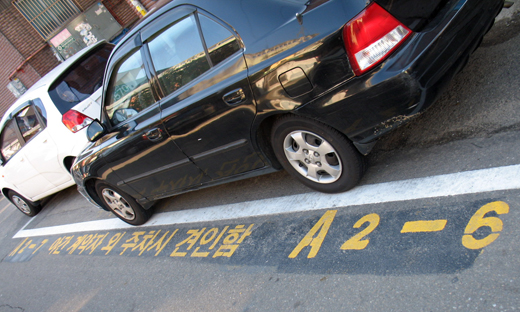
● 30,000 Won Monthly Fee Provides "Personal Parking Lot" Starting October 1
An official from the Road Traffic Division explained, "Single-family and multi-unit residential areas in the four districts will likely become candidate sites for the Resident Priority Parking System," adding, "For example, minor roads in Uman-dong, Paldal-gu, or along the Suwon Stream in Gwonseon-gu are candidate areas."
Resident priority parking zone designation is based on the principle of one vehicle per household, with priority determined by adjusting scores considering distance and engine displacement. (Vehicles with mandatory garage requirements, those with unpaid local taxes, and those with unpaid fines are excluded)
Residents approved for use of resident priority parking zone spaces must pay 30,000 won monthly (90,000 won for three months) by September 31 of this year and will receive exclusive priority parking rights in their assigned zone for three months starting October 1.
After obtaining parking rights and affixing a numbered resident priority parking permit on the vehicle's front, drivers must park only in the zone with this matching number.
The disabled, national veterans, and owners of vehicles with engine displacement of 1,000cc or less can receive a 50% discount on parking fees.
The city plans to consult in advance with permit holders to negotiate parking times, or allow other drivers to park when the space is unoccupied, with no enforcement action taken in such cases.
A city official stated, "While our principle is to tow or impose fines (30,000 won) when other vehicles park arbitrarily, when parking occurs during times the permit holder is not using the space, we will refrain from enforcement from a parking space availability perspective."
However, if a permit holder files a complaint about someone occupying the resident priority parking space without permission or consent, immediate enforcement and towing measures will be implemented.
The city views the three to five years following implementation as an establishment period and plans to operate the Resident Priority Parking System citywide by 2016, eight years from now.
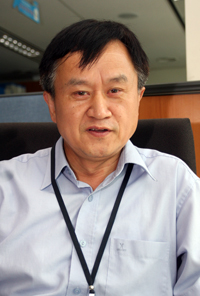
| "Eliminating Illegal Parking and Improving Civic Order" -What is the purpose of introducing the Resident Priority Parking System? ▲The parking shortage in residential and commercial areas, excluding multi-unit housing complexes, is severe. Based on a survey of parking environment conditions over the past year, the ratio of registered vehicles (approximately 360,000) to available parking spaces (290,000) is 78%, which falls below the Gyeonggi Province average of 81%. Taking Gokban-jeong-dong as an example, one officetel building in the area has secured 5-6 parking spaces per building, but the actual number of parked vehicles reaches 20. Although three public parking lots with a total of 160 spaces have been secured nearby, the area continues to suffer from parking shortages. There are even cases of illegal parking near emergency runway access roads. -What budget and number of parking spaces will be allocated to the Resident Priority Parking System? ▲We submitted 300 million won in supplementary budget for the first phase, which passed the preliminary review of the Urban Construction Committee as originally proposed. We plan initially to operate within 1,000 parking spaces on a pilot basis, and we anticipate securing around 900 spaces. Candidate areas include Selyou-dong and Yeonmu-dong around the Suwon Stream, and areas around Uman-dong Park and Suwon High School. -What is necessary for this system to achieve success? ▲Coordination and cooperation between the Parking Facilities Team of the Road Traffic Division and the Traffic Guidance Team (Parking Enforcement) of the Public Transportation Division is essential. Since these two operational teams belong to different departments, efficient work coordination is necessary. Particularly, citizens' awareness regarding illegal parking and stopping must change significantly. The "just one person" mindset that leads to easy illegal parking can cause inconvenience to other neighbors' passage and pedestrians, and in emergencies, can obstruct access for fire trucks and ambulances. The most significant reason for introducing the Resident Priority Parking System is to establish the consciousness that parking must always use designated zones or parking facilities. -What are the future plans? ▲Ulsan Metropolitan City's Nam-gu plans to apply the Resident Priority Parking System across the entire district. We plan to visit and benchmark their operational situation. In addition to the Resident Priority Parking System, we plan to secure attached parking facilities by utilizing underground spaces or adjacent spaces of public facilities. We anticipate increased demands for parking lot installation in front of homes going forward. The city plans to complete design in the second half of this year to continue the "Green Parking" project with a total investment of 2.7 billion won covering 200 households in eight dongs next year. The Green Parking project has generated high positive response not only for parking space availability but also for eliminating illegal waste dumping and providing public safety benefits. |

Loading comments…