


AI Confirms Elderly Residents' Wellbeing and Manages Their Physical and Mental Health
[Suwon Ilbo=Reporter Kim Gap-dong] Gyeonggi Province is actively introducing artificial intelligence (AI) into its elderly care policy. The core is establishing a preventive care system where AI takes charge of periodic wellbeing checks, health management, and emotional care for elderly residents. The province also plans to pilot build AI care towns where such care services can be provided intensively.
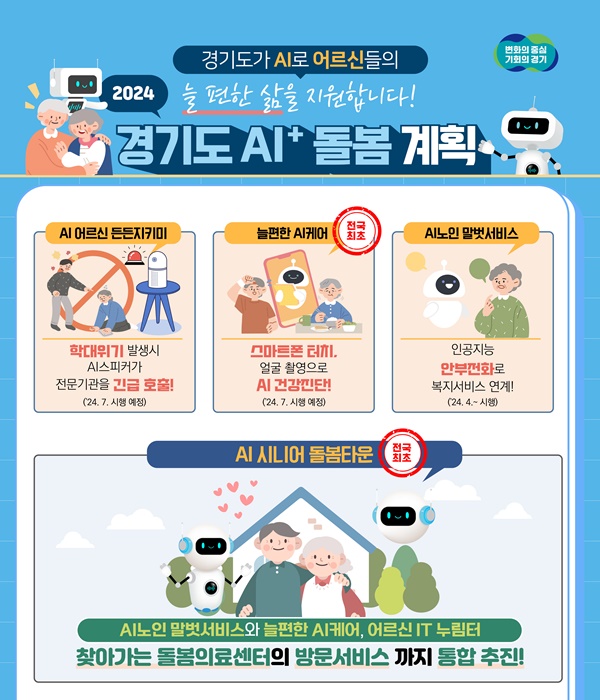
On the 30th, the province announced the 'Gyeonggi Elderly AI+Care' implementation plan with this content, and decided to shift the policy direction of elderly care in Gyeonggi Province from face-to-face post-management to an expanded non-face-to-face preventive management system utilizing AI (artificial intelligence).
The initiative aims to address financial and human resource limitations encountered as demand for care becomes more diverse and increases, by leveraging artificial intelligence. If the effectiveness of the preventive care system is confirmed, the province expects that Aging in Place—pursued by advanced countries, where elderly people spend their remaining years without leaving their homes or communities—will become possible.
The province plans to promote 'Gyeonggi Elderly AI+Care' centered on four AI technology-based elderly care projects.
First, the province plans to designate a specific area as an 'AI Senior Care Town,' providing integrated support including AI care services for the elderly, visiting medical services, and digital education.
AI companion service for the elderly will be provided to all elderly residents in the care town, and a pilot program of 'Always Comfortable AI Care,' where AI conducts health assessments, will be introduced. Additionally, a visiting care medical center operated by Gyeonggi Provincial Medical Center will visit elderly residents' homes to provide services, while spaces for information and communication technology education and experience will also be offered.
The province believes that providing sustainable integrated care using artificial intelligence and strengthening elderly residents' digital literacy will help prevent welfare blind spots. The province plans to select the first care town site by June, while also reviewing ways to designate additional sites through public recruitment.
Second, the 'Always Comfortable AI Care' project will be formally launched in the second half of the year. The Always Comfortable AI Care project is an artificial intelligence-based 'smartphone-enabled care service' that confirms elderly residents' wellbeing and health status through motion detection and biometric recognition via an app installed on mobile phones. It will be implemented for the first time nationwide as a form of providing integrated AI care services using only a smartphone without separate care robots or smartwatches.
Starting in July, the province plans to conduct an 'Always Comfortable AI Care pilot program' targeting 1,000 elderly residents aged 65 and older in the province.
Always Comfortable AI Care checks blood flow by touching a finger to a smartphone camera for 15 seconds and informs users of their cardiovascular health status. An AI algorithm also prepares a health report, periodically conducts self-assessment tests for dementia risk, and sends results to care managers for management.
The province explained that while the existing welfare system has been centered on face-to-face wellbeing checks and periodic health management has been a benefit available only to vulnerable populations, 'Always Comfortable AI Care' is a service that any elderly person in need of care can enjoy regardless of income or age.
Third is the 'AI Elderly Guardian' project. As an artificial intelligence care service for abused elderly residents, when a risk situation of re-abuse occurs, pre-installed AI speakers detect the situation by voice and serve to make emergency calls to 112 or to elderly protection specialist institutions.
Additionally, by conversing with the elderly, the AI speaker alerts the control center to keywords related to depression or loneliness. The province plans to select high-risk groups through monitoring and ensure that professional psychological counseling is provided through the Gyeonggi Province Elderly Comprehensive Center.
The province plans to complete the selection of AI speaker installation recipients by June and begin the 'AI Elderly Guardian' project from July.
Fourth is the AI Companion Service for the Elderly. The artificial intelligence companion service for the elderly aims to prevent elderly care blind spots, providing approximately three-minute wellbeing calls once a week at a designated time to residents aged 65 and older in the province who need wellbeing checks.
If the call is not received three or more times, Gyeonggi Province Social Service Center staff will attempt contact that same day, and if the call goes unanswered, confirmation is made with the eup, myeon, or dong office for a direct visit. Additionally, if emotional or economic difficulties such as 'life is difficult' or 'I feel lonely' are expressed during the AI call, or if warning signs are detected, telephone counseling is provided, and if connection to welfare services is necessary, the call is transferred to the Gyeonggi Emergency Welfare Hotline where specialized counseling can be received.
Last year, an artificial intelligence companion service was started for 1,061 elderly residents, recording a total of 23,852 calls over 29 weeks. This year, services are planned for 5,000 people, and recruitment of eligible recipients is currently underway.
Meanwhile, in addition to care using AI, the province is building a system where any elderly person in Gyeonggi can receive face-to-face or non-face-to-face psychological counseling at no cost. To this end, the province operates 'Gyeonggi Elderly On' telephone counseling (1588-2255), which uniquely nationwide runs '365 days, 24 hours' for elderly telephone consultation.
Additionally, to strengthen the role of 'Our Neighborhood Elderly Mental Health Guardian' at the city and county elderly counseling centers installed at 62 elderly welfare centers in Gyeonggi Province, small-group counseling programs will be newly supported.
Heo Seung-beom, Director of the Welfare Bureau, stated, "By 2028, the province will enter a super-aged society where the elderly population accounts for 20 percent," and added, "The province will actively utilize artificial intelligence technology and streamline existing systems to create a sustainable care system that more residents can experience."

Loading comments…