


City of 1.1 Million Says Reduce Staff When We Need More: "Which Department? Who Do We Send Out?"
Suwon NewsPublished 2008.05.26 14:55
Suwon Countdown to "Streamlining by End of June"
Following the Lee Myung-bak administration's "workforce reduction and shift to large department-large section system," Suwon City has launched a major organizational overhaul. Suwon City, which had previously undertaken "organizational fragmentation" and workforce expansion counter to government reorganization plans, must now reduce its workforce by 78 employees and completely restructure its small department-small section framework. City officials are struggling over reorganization plans, unsure of which positions to cut.
With a population of 1.1 million, Suwon City is in a position where it needs more civil servants, not fewer. Yet it has no choice but to follow the government's reorganization plan, which applies a one-size-fits-all standard. As a result, plans to elevate Suwon to metropolitan city status are also being shaken. Concerns are growing that while administrative demands commensurate with a metropolitan city continue to increase, the quality of services will decline.
● Organizational Expansion Followed by Major Downsizing and Layoffs in Little Over a Month
The city carried out a major promotion and transfer of 293 employees on July 10 following organizational restructuring that included establishing a Culture and Sports Bureau. Consequently, the organization was reorganized from 7 departments and 33 sections to 8 departments and 36 sections, with an increase of 17 employees. The idea was to divide the departments and sections of the overworked Resident Support Bureau, which deals directly with citizen welfare, to improve service quality.
The city also planned to hire a total of 166 local civil servants this year (118 administrative staff and 48 technical staff).
Even compared to Ulsan Metropolitan City with a similar population—5,100 civil servants (2,537 civil servants in Suwon)—Suwon has roughly half the number. The ratio of population per civil servant (427 people) is far higher than the national average (197 people), indicating a severe shortage of civil servants.
However, Suwon City's organizational restructuring essentially runs counter to what the Lee Myung-bak administration announced as "small and efficient organizational operations." This is because the shift to a small department-small section system and the total payroll budget would result in a significant increase in workforce numbers.
Some have pointed out that the establishment of new departments amid peaked personnel dissatisfaction is an inefficient organizational restructuring designed to create "positions."
● 5–10% Reduction in Total Payroll Budget… "Breaking the Iron Rice Bowl"
Meanwhile, on August 1, the Ministry of Public Administration and Security confirmed a "local government reorganization plan" that calls for workforce reduction of up to 10% of the total payroll budget and a shift to a "large department-large section system," recommending it to local governments.
Under the reorganization plan, each local government must reduce the total payroll budget from a baseline target of 5% to a maximum of 10%, and reduce the number of indefinite-term contract workers proportional to the reduction rate of regular civil servants.
Furthermore, each department should comprise 3–4 sections, and each section should have at least 20–30 employees. Small-scale dong (neighborhoods) with "population under 20,000 and area under 3 square kilometers" will be consolidated.
Following this, Gyeonggi Province instructed Suwon City to submit a workforce reduction plan of 78 employees (equivalent to 5% of the total payroll budget) and to amend ordinances regarding civil servant positions by the end of June.
With 17 additional employees added in the April 10 reorganization, the current total of 2,537 Suwon City civil servants is projected to decrease to 2,459.
● Mayor Loses Sleep Over New Organization Structure… "Who Should We Cut?"
Mayor Kim Yong-seo of Suwon is deeply troubled by the civil servant reduction issue. The mayor said, "I've been losing sleep lately over personnel decisions related to improving civil service morale."
First, as the Ministry of Public Administration and Security has ordered consolidation of administrative divisions with populations of 20,000 or fewer, the consolidation of seven dong, including Jowon 2-dong, Seryul 1-dong, and Maegyyo-dong, appears inevitable. Among four districts, boundary adjustments are expected at four locations—Haenggung-dong, Maegyyo-dong, Maesan-dong, and Ji-dong in Paldal-gu.
District organizations will be consolidated from the current 8 departments to 5. This means a reduction of 12 sections across the four district offices.
Public relations and audit departments at each district office will be absorbed into City Hall, and existing construction-related civil complaint departments dealing with outdoor advertisements will be reorganized around the Urban Landscape Division. At City Hall, 21 sections with fewer than 20 employees will be cut in half.
The focus in the civil service is on workforce reduction rather than organizational consolidation. Amid no public disclosure of guidelines or criteria for workforce reduction, it is known that approximately 20 administrative officials (out of 128 total) will be cut. Additionally, as "positions" decrease, grade-6 civil servants (466 total) are not exempt. The shift to the large department-large section system will substantially reduce "team leader (grade 6)" positions at City Hall, with a reduction of at least 20 or more predicted.
Moreover, grade-4 secretaries, who have held their positions until near retirement despite losing justification for their roles, are also expected to be included in the reduction targets. Added to this is the burden of hiring 116 new civil servants.
● Metropolitan City Plans Likely to Come to Naught
If this happens, plans for Suwon to achieve metropolitan city status will likely come to nothing.
This is because of the government's policy to eventually abolish the general district system introduced in cities with populations over 500,000 and to expand the scope of dong-level administrative units. Therefore, since the operation of autonomous districts will be inevitable, if district-level administrative agencies are consolidated into dong-level units, the elevation itself becomes difficult.
Suwon's current population of 1.1 million is expected to increase by 10 to 15 million or more once major residential development projects such as Gwanggyo New Town (approximately 31,000 households) and Homaesil (approximately 19,000 households) are completed. Yet the administrative workforce will actually decrease.
A city official said, "Suwon City with a population of 1.1 million has a budget of nearly 1.5 trillion won," adding, "It is the height of contradiction to allocate workforce reductions using a one-size-fits-all standard when the city is already severely understaffed."
The official further added, "Suwon City is at a point where workforce expansion at the metropolitan city level is necessary."
● "Violation of Local Government Autonomy"… Likely Strong Opposition to Reorganization
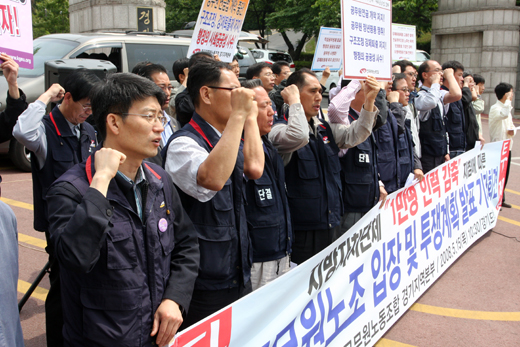
The Suwon branch of the Korean Federation of Civil Service Unions defined the government's unilateral civil servant reduction plan as a violation of local government's inherent authority over civil servant positions and budgets.
The union stated, "Since Suwon's population is continuously increasing and requires administrative capacity at the metropolitan city level, decisions should be left to local autonomy."
A senior city official said, "It is not easy to identify reduction targets," and "While the personnel department will present a fair and equitable reduction plan, the backlash and resulting morale decline that will follow personnel decisions cannot be ignored."
Some observers note that the central government risks infringing on the inherent authority of local governments, and questions about government fairness arise from different reduction rates between the central government (2.6%) and local governments (5%).
In particular, Suwon City is bracing for expected resistance from administrative civil servants anticipating the "reduction storm" targeting grades 5–6.
However, a variable factor is whether the government will amend the Civil Service Pension Act, which centers on reducing pension benefits.
An administrative official said, "If the pension law is amended, pensions would be reduced by approximately 30% compared to the current level, so expectations are building that more civil servants will consider early retirement, fostering hope for natural workforce reduction."
Kim Jung-soo, director of the General Affairs Division, said, "Considering 89 vacancies, no civil servants will be laid off," adding, "Position adjustment is a bigger headache than workforce reduction."
© Suwon Ilbo. Unauthorized reproduction and redistribution prohibited.




Loading comments…