


Domestic Research Team Supported by Gyeonggi Province Develops AI Service to Alleviate Depression in Single-Person Households
[Suwon Ilbo=Reporter Park No-hun] A domestic research team supported by Gyeonggi Province has developed an artificial intelligence health management service that is effective in alleviating depression among single-person households, including elderly living alone.
The research team plans to install this service on robots by the end of this year to enable its use in homes of elderly people living alone.
According to Gyeonggi Province on the 7th, Professor Hwangbo Taek-geun's team from the Department of Computer Engineering at Gachon University, conducting research at the Gyeonggi Regional Cooperation Research Center (GRRC), has developed an artificial intelligence health management service that enables elderly individuals and single-person households to manage mental health issues such as depression through conversations with emotionally empathetic virtual characters.
The Gachon University research team converted approximately 30 questionnaire sentences based on the Geriatric Depression Scale (GDS), a representative screening measure for depressive disorders, into conversational format.
They subsequently constructed learning data consisting of 13,500 answer sentences with data organized into positive, neutral, and negative categories, and 36,000 additional conversation sentences.
All sentences are classified into topics of interest primarily to elderly individuals such as health, hobbies, and interpersonal relationships, as well as eight emotions including joy, sadness, anger, and disappointment, enabling the artificial intelligence (AI) to understand the emotion and topic of the conversation partner's utterance and respond accordingly.
For example, the virtual character can ask questions such as "Have you been feeling tired, down, or gloomy recently and frequently?"
If a user responds with "My pet dog is so affectionate and playful that I don't have time to feel depressed," the character answers "That sounds wonderful. Pets really seem to bring happiness to people," in this manner.
In another conversation, if the virtual character asks "Do you find yourself getting angry over trivial matters these days?" and the user responds "It seems to be getting worse. My children don't even call. I know they're busy, but it still bothers me and makes me sad. I wasn't like this in the old days," the character responds "You must be feeling very hurt. My heart feels sad along with yours," thus enabling responses matched to the conversation partner's emotions.
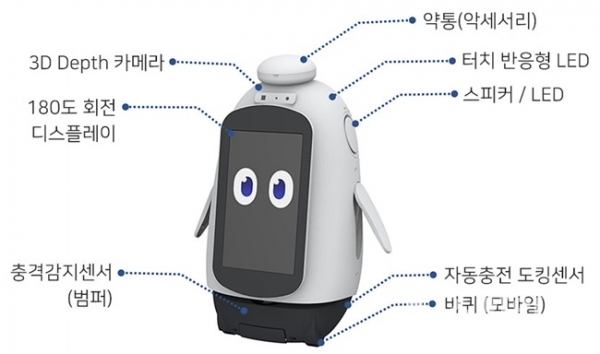
The Gachon University Regional Cooperation Research Center plans to continue collaboration with participating company RoboCare Co., Ltd. to sequentially apply the artificial intelligence health management service to 'Bomi,' a home daily care robot, starting this year.
The Bomi I and II robots, launched in 2020 and 2021 respectively, are autonomous mobile robots for cognitive training and daily care aimed at enhancing brain function, capable of cognitive games, emergency alert notifications, and medication reminder services.
Gyeonggi Province anticipates that with the newly developed technology installed, the robot will achieve enhanced functionality as an intelligent healthcare robot capable of comprehensive nursing as well as conversation.
Gyeonggi Province also expects the related robots to replace nursing and caregiving workforce for the elderly, contributing significantly to society.
An Chi-gwon, Director of the Science and Technology Division of Gyeonggi Province, said "It is expected that the developed artificial intelligence (AI) health management technology will achieve mental health treatment effects for the elderly" and "We will make our best efforts to actively promote commercialization and increase sales of healthcare companies within the province."
Meanwhile, the Gyeonggi Regional Cooperation Research Center (GRRC) project is a private-public collaboration model in which Gyeonggi Province connects small and medium-sized enterprises with universities and research institutes within the province to support technology development activities for enterprises lacking research and development infrastructure, with the goal of revitalizing the regional economy through improved technological competitiveness in related industries.
Gyeonggi Province provides 510 million won per research center, and 10 centers, including Gachon University, are actively conducting research and development.

Loading comments…