


Rapid Increase in Fire Blight in Gyeonggi Province...Provincial Government Mobilizes Full Response to Prevent Spread
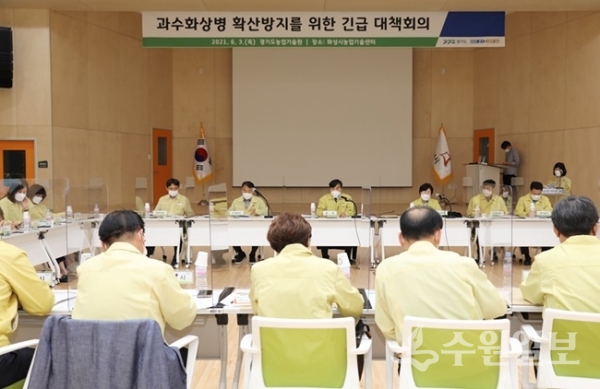
[Suwon Ilbo=Reporter Park No-hoon] As concerns grow over the rapid increase of fire blight in fruit orchards within Gyeonggi Province, the Gyeonggi Province Agricultural Technology Institute has launched emergency response measures.
The Provincial Agricultural Technology Institute held an emergency fire blight control meeting on the 3rd, targeting directors of agricultural technology centers across cities and counties in Gyeonggi Province.
As of the end of May, fire blight had occurred in 35 farms across 27.9 hectares in the province, showing a trend of more than three times increase compared to the same period last year.
Last year, it occurred in a total of 7 cities and counties across 170 farms spanning 85.6 hectares, resulting in the complete burial of apples and pears from affected orchards.
The province discovered fire blight through emergency winter surveillance, May regular surveillance, and voluntary reports from farmers. With new outbreak of fire blight in Namyangju City, a major pear production area, emergency surveillance was conducted, confirming 4 additional cases.
At the emergency countermeasure meeting, the Provincial Agricultural Technology Institute requested on-site technical support so that agricultural technology centers in cities and counties could strengthen fire blight surveillance and implement swift control measures. Information on fire blight status, control measures, and support in affected areas was shared.
Fire blight affects approximately 180 species of the Rosaceae family including apples and pears, with leaves, flowers, branches, and fruits becoming blackened or brown and drying as if burned by fire. It is a quarantine-regulated prohibited pest.
Since there are currently no curative pesticides and it causes significant damage, immediate burial control is necessary upon occurrence, and host plants including apples and pears cannot be planted for 3 years. Prevention through continuous surveillance of suspected symptoms, thorough compliance with prevention guidelines by farmers, and voluntary reporting are essential.
Farmers must thoroughly disinfect work tools by soaking them in 70% alcohol or bleach diluted 200 times, and must immediately report any suspected symptoms to their city or county agricultural technology center or the Gyeonggi Province Agricultural Technology Institute. Failure to report may result in administrative fines.
Kim Seok-chul, director of the Gyeonggi Agricultural Technology Institute, stated, "Since a second round of joint surveillance involving the central government, province, and cities/counties will be conducted over two weeks from June 7 to 18, please conduct precise investigations and prepare equipment companies in advance to establish a system enabling swift burial control upon confirmation," and emphasized, "Publicity and education must be thoroughly conducted to raise farmers' awareness of fire blight."


Loading comments…