


Gyeonggi Institute: "Central Government-Led Housing Policy Has Caused Metropolitan Overcrowding and Haphazard Development"
[Suwon Ilbo=Park No-hun] Arguing that central government-led housing policy has caused side effects such as metropolitan overcrowding and haphazard development, an opinion has been raised that the central government's authority over housing policy should be transferred to local governments through amendments to the Housing Basic Act and the Special Act on Public Housing.
The Gyeonggi Institute announced the release of
In Korea, the central government (Minister of Land, Infrastructure and Transport) establishes and implements comprehensive housing plans, while local governments carry out housing construction and land development projects according to central government plans and must submit plans by relevant department for policies and projects required by the Ministry of Land, Infrastructure and Transport.
The institute pointed out that in this central government-led housing policy structure, when housing problems occur, the government has chosen large-scale housing site development in the metropolitan area over decentralization strategies, resulting in metropolitan overcrowding.
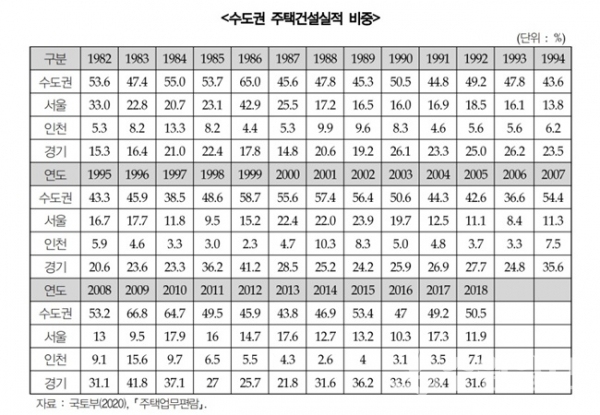
From 1982 to 2018, the share of metropolitan housing construction performance compared to the national total recorded a peak of 66.8% in 2009, generally maintaining around 50%.
Particularly during the move-in period of the first new towns (1990-1995), the population growth rate in the metropolitan area reached 3.12 times that of the national population growth rate.
The institute argued that the central government's unilateral housing policy centered on land development led to ▲haphazard development with insufficient jobs and infrastructure ▲undermining local governments' urban planning tailored to regional characteristics ▲transferring the burden of transportation and environmental costs and conflict resolution to local governments ▲hindering local governments' redevelopment and urban regeneration projects due to aging in established urban areas.
Considering recent incidents such as the 'LH scandal' where policy implementation side effects appeared due to information monopoly, it diagnosed that major surgery on housing policy is necessary.
As a specific method, it proposed the transfer of central government authority to local governments through amendments to the Housing Basic Act and the Special Act on Public Housing.
In the case of the Housing Basic Act, according to Article 5, the Ministry of Land, Infrastructure and Transport must establish a 'comprehensive housing plan' containing specific supply and demand plans for housing, housing sites, and public housing. The proposal is to change this to a guideline level to increase local government autonomy.
In the same context, it emphasized the need to abolish the authority of the Minister of Land, Infrastructure and Transport as specified in Article 6 of the Special Act on Public Housing to designate public housing districts of 300,000 square meters or more, and to unify all public housing district designation authority under metropolitan local governments.
Through this, the opinion is that local governments should establish autonomous planning authority, while the central government should retain post-monitoring authority.
Jo Sung-ho, senior research fellow at the Gyeonggi Institute, said, "Central government authority over housing plans should be limited to presenting guidelines for housing policy, and local governments should establish substantial city and provincial housing basic plans," and "We must transfer the current central government-centered authority to designate public housing districts to local governments to unify them under metropolitan cities and provinces, and also improve development profit reinvestment regulations and discrimination between LH and local public enterprises."
Continuing, fellow researcher Jo said, "Now that Korea's housing supply rate exceeds 100%, we must move away from uniform housing site development," and "Along with transfer of authority, we must also transfer central government manpower and finances to metropolitan cities and provinces to shift housing policy to a demand-focused approach. This is the way to resolve housing problems caught in the 'devil's cycle' of rising housing prices and worsening charter lease shortage (caused by the central government's persistence in ineffective centralized regulations leading to national vicious cycles)."




Loading comments…