


Gyeonggi Province Pushes Forward with 'Basic Housing Sales Model' Supplementing Lease-to-Own Housing...Recommends Special Law Enactment

[Suwon Ilbo=Reporter Park No-hun] Gyeonggi Province is pursuing a 'Basic Housing Sales Model (Public Repurchase Lease-to-Own)' that preserves the advantages of existing land lease-to-own housing while supplementing its shortcomings, enabling homeownership at affordable prices.
This is the province's second housing measure for non-homeowners following the long-term rental type Basic Housing announced in July. The province plans to recommend special law enactment to the government and National Assembly to establish legal grounds.
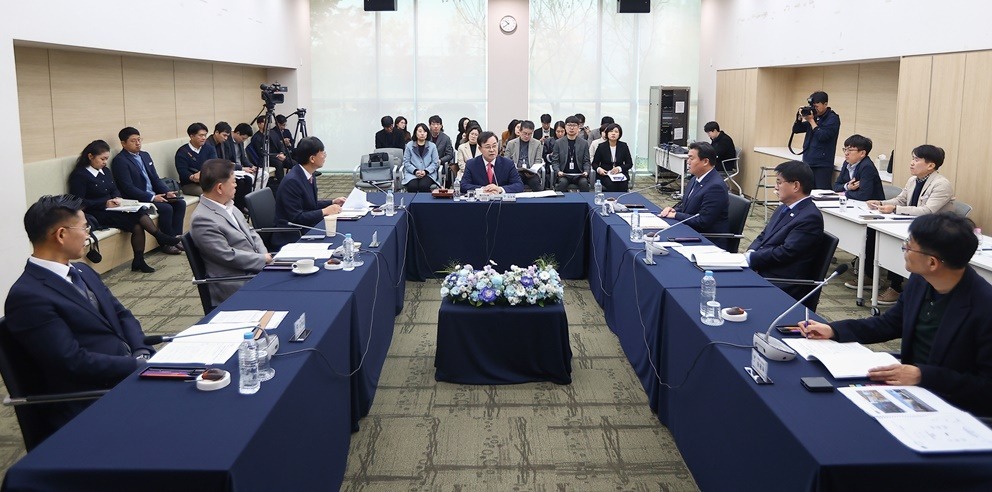
Son Im-sung, Urban Policy Director of Gyeonggi Province, held a press conference at the Gyeonggi Provincial Government Office on the 17th to announce policy proposals for 'Basic Housing Sales Model' along with institutional improvement plans.
Director Son said, "With recent sharp rises in housing prices, it has become difficult for non-homeowners and ordinary citizens to easily purchase housing with their income levels," and "To provide universal housing services, various housing types must be presented where non-homeowners can reside stably for a lifetime," explaining the background of the introduction.
The 'Basic Housing Sales Model' announced by Gyeonggi Province is a new model that preserves the advantages of existing land lease-to-own housing where public institutions such as Korea Land & Housing Corporation (LH) and Gyeonggi Housing & Urban Development Corporation (GH) own land and only sell housing, while supplementing its problems.
The current land lease-to-own housing supplied 358 units in Seocho, Seoul in 2011 and 402 units in Gangnam, Seoul in 2012.
The problem is that after the 5-year resale restriction period, private sales are possible, which undermines the original policy goal of providing affordable housing to non-homeowners.
These properties recently recorded asking prices exceeding 6 times the original sales price, with purchasers gaining tens of millions of won in speculative gains, turning them into speculative instruments.
Accordingly, the province plans to mandate repurchase by the public institution that originally sold the housing if the owner wishes to sell after the resale restriction period, and will set the repurchase price as the original sales price plus adjustment amounts reflecting inflation and other factors to block speculative demand.
For example, similar to Singapore, options may include recognizing up to 25% of market value gains, but the province plans to calculate specific repurchase prices through future National Assembly forums, expert discussions, and consultations with the government.
Gyeonggi Province's 'Basic Housing Sales Model' allows any non-homeowner to move in without residency restrictions like the Basic Housing, and enables stable lifetime residency through monthly reasonable land lease payments.
Sales prices will be supplied at construction cost plus minimal fees, and land lease fees will be set based on land acquisition costs (development costs) or appraised values reflecting increases in land value. The resale restriction (occupancy obligation) period is planned to be set within 10 years.
For example, if 1,000 units (200% floor area ratio) are developed on land with development cost of 20 million won per 3.3 square meters, the province's projected estimate through simulation would be a sales price of approximately 257 million won for a 74 square meter (approximately 30 pyeong) exclusive area unit, and monthly land lease fees of approximately 602,000 won.
Director Son said, "With low sales prices and affordable lease fees enabling homeownership, and with some market value gains possible, we believe there are non-homeowners who need this," and added, "However, to ensure that the Basic Housing Sales Model does not become another privilege, institutional improvements must be made through public permanent repurchase, expansion of land lease and occupancy obligation periods, establishment of systems for returning asset value appreciation gains, and introduction of mechanisms to preserve public land ownership," he said.
Furthermore, the Basic Housing Sales Model (Public Repurchase Lease-to-Own) is expected by the province to become one of various alternatives to solve housing problems for non-homeowners, along with 'Long-term Rental Type Basic Housing' where residents can live for a lifetime without housing concerns in well-located areas near transit hubs, and 'Gyeonggi-type Social Housing' implemented by social economy entities.
Accordingly, the province plans to recommend special law enactment to enable supply of Gyeonggi Province's 'Basic Housing Sales Model'.
The main contents of the proposed special law for Gyeonggi Province's 'Basic Housing Sales Model' include ▲public permanent repurchase of housing ▲expansion of land lease period to 50 years and occupancy obligation period to 10 years ▲return of asset value appreciation gains to society ▲establishment of mechanisms to preserve public land ownership ▲non-application of civil code repurchase period and prohibition of redemption option contract execution by local public enterprises ▲resale price setting considering surrounding housing prices ▲appropriate standards for land lease fee adjustments, etc.
Simultaneously, the province plans to recommend amendments to related laws and regulations including ▲'Housing Act,' ▲'Public Housing Special Act,' ▲'Local Public Enterprise Act' for the sale-type Basic Housing by proposing ▲priority supply of land at development cost in public housing sites and areas with lifted development restrictions ▲reflection of Basic Housing Sales Model (Public Repurchase Lease-to-Own) supply plans in comprehensive housing plans ▲establishment of public support grounds such as Housing-Urban Development Fund to support land acquisition and construction costs, etc.
Furthermore, through National Assembly forums and conferences scheduled for early next year, the province plans to publicize the necessity of related institutional improvements and pursue special law enactment as a priority.
Loading comments…