


I Will Take Root in Civic Politics Working from the Citizens' Perspective
Hong Gi-heon, chairman of the Suwon City Council, causes no burden no matter when, where, or with whom you meet him. He quickly becomes close with anyone. He exudes a ripe, mature charm. His distinctive talent for harmoniously soothing difficult surroundings while creating new horizons requires wisdom and experience—a unique quality only he possesses.
Because of these great strengths, his minor shortcomings are overlooked and hidden. Perhaps that's why so many people of all ages surround him. Many younger colleagues follow him. It's his greatest asset. Perhaps his character transformed journalist Hong Gi-heon into politician Hong Gi-heon.
He took office on July 8, so the 18th will mark his 100th day. How is the Suwon City Council he leads being evaluated by citizens? What evaluation does Chairman Hong render? And what score does he give himself? I'm curious.
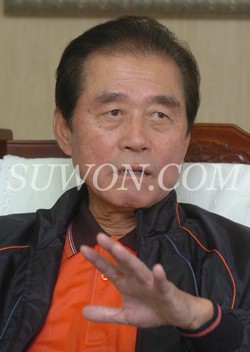
▲ Has it already been that long? When I first became city council chairman, I felt bewildered. Now I think I'm beginning to understand what the functions and roles of the city council and chairman should be. I believe the city council and councilors must be different from the past.
The 8th Suwon City Council is the first paid councilors. Since citizens are watching, I believe councilors must have the professional spirit that 'councilors who don't work their weight in pay will be eliminated.' We must study. How can we conduct council activities if we don't even know how to read a budget planning document?
Each Suwon city councilor represents 1.07 million citizens. While it's important to look after one's district, I'm leading the council to conduct council activities representing the overall regional development of Suwon and public interests.
We're monitoring, checking, and supervising whether Suwon efficiently executes its budget without waste and appropriately allocates funds to various issues. We're striving to receive evaluations from citizens that we work hard for citizen welfare and Suwon's development.
Both the operation of the city council and the council activities of councilors work from the citizens' perspective. The city council is a deliberative body. As city council chairman, I work like an orchestra conductor, ensuring the city council operates in harmony, drawing out consensus, and reflecting and making recommendations to city administration.
In particular, I believe it's important to support individual councilors in conducting their district activities well. In that regard, I'm encouraging councilors to designate and operate civil complaint housewife monitors by district.
With the mid-size electoral district system in place, one councilor oversees multiple neighborhoods. It's difficult to identify civil complaints in the responsible districts. With civil complaint housewife monitors, we can easily grasp various issues and complaints occurring in neighborhoods, which will greatly help council activities.
- As city council chairman, are there any tasks you're particularly focusing on or promoting in your council activities?
▲ It's a well-known fact that our country has already entered an aging society and is experiencing the fastest aging progression among OECD countries.
In an aging society, elderly welfare and medical health issues are most important. There are even predictions that we'll enter a high-aged society within 10 years. Yet, measures for this are being pushed down in policy priorities, overshadowed by various other issues. This is true for central government, local governments, and basic self-governing bodies alike.
In Suwon's case, there are 4,900 elderly aged 64 and above who cannot afford the monthly 5,000 won local medical insurance premium and thus don't receive medical benefits. No children and... Through ordinance enactments, I plan to make efforts to ensure they receive medical benefits with institutional support and encourage the executive branch to place greater emphasis on advancing elderly welfare.
Additionally, following the recent tragic death of siblings from a fire in Jidong ahead of Chuseok, similar to cases involving disabled children, I'll make efforts to allocate more budget to expanding social welfare facilities for their care. The council will take the lead in expanding welfare for the marginalized and in preparation for an aging society.
- You had planned a council retreat to Sokcho but canceled it and replaced it with educational training in the council's main conference room.
▲ It came from thinking that councilors needed to change something. With nuclear experiments from North Korea creating unease in the national situation and the common people's economy being difficult, I questioned whether we really needed to use considerable budgets to go on a retreat elsewhere. We had vigorous discussions by rank.
If all councilors were to attend a retreat, it would cost 1.7 million won per person in hotel fees, plus meal expenses and team-building event costs, totaling 25 million won. However, if training is provided in the city council's main conference room, even with external instructor fees, it costs less than 10 million won.
'We have facilities, we have a dining hall, we won't waste time going back and forth. The tax money paid by citizens should be saved by us, the representative body of citizens'—with this thinking, more than half the councilors agreed. The decision was made this way.
To conduct high-quality council activities, as I mentioned earlier, councilors must have basic knowledge to review administrative audits and budgets, don't you think? Especially with 19 first-term councilors, we must study to review the executive branch's budgets and financial statements. We reached agreement in this direction, and we'll continue conducting council retreats this way.
- The mayor of Suwon is a member of the Grand National Party, and the council leadership and councilors are all Grand National Party members, so there are concerns that the council's fundamental function as a 'sound watchdog' is weakened.
▲ With the mayor, we have a senior-junior alumni relationship and belong to the same Grand National Party, but I believe public and private matters must be separate. Shouldn't we point out what needs pointing out, challenge what needs challenging, and acknowledge what's done well?
The role of the council as a sound watchdog is ultimately achieved naturally if we handle everything from the citizens' perspective.
When I took office as chairman, in gatherings with councilors, I consistently said, "Let's transcend partisanship." Since Suwon citizens elected us, I emphasized that we're all councilors from the 'Suwon Citizen Service Party.'
All 36 city councilors—25 from the Grand National Party, 10 from the Open Our Party, 1 from the Democratic Labor Party—are uniting and cooperating with this spirit, taking the lead in implementing civic politics for improving citizens' quality of life.
There's no need to worry about the weakened role as a sound watchdog. Rather, the executive branch is on high alert because the 8th-term councilors' determination and studious attitude in conducting council activities differ from previous terms.
- Do you think basic-level councilors should also receive party nominations?
▲ In the past, they actually received party recommendations internally. While it wasn't explicit party nomination on the surface, it could be considered substantive party nomination. However, now that the party nomination system has been institutionalized, even basic self-governing councils—which are essentially civic politics—have been placed within the framework of central parties.
Since it's still in early implementation stages, problems haven't surfaced yet. The concerns expressed by scholars and media about being swayed by central politics or influenced by same-party regional National Assembly members haven't materialized. I believe an accurate judgment can only be made after at least the first half-term passes. However, personally, I wondered whether party nomination truly needs to be done even for selecting civic politics practitioners. Perhaps not for provincial councilors... but sometime, might we not return to that direction?
- I understand you love Gwanggyo Mountain more than anyone. There's been much discussion about the two-level parking building at Gwanggyo Park entrance, which is becoming an issue.
▲ This is the most difficult question to answer among today's questions. I regret the damage to Gwanggyo Mountain more than anyone, and I always make efforts to prevent it, not just as city council chairman but as a citizen. I founded the Gwanggyo Mountain Love Movement headquarters six years ago and started the Gwanggyo Mountain love movement for this reason. Four years ago, when a mixed-use building was about to be constructed at the current Gwanggyo Park site, I was the first to submit a petition to the city and prevented it.
Actually, I didn't know about building a parking building next to Gwanggyo Park. While coming down from Gwanggyo Mountain, I saw construction underway and confirmed they were building a parking building. Construction was already in progress and first-phase construction was completed in September. I thought it would be good to finish at that level.
Initially, additional construction was completely cut from the city council's Urban Construction Committee. The executive branch requested reconsideration, saying that the first-phase parking spaces couldn't possibly meet citizens' parking demands and would inevitably cause additional complaints.
After visiting the site to verify, I approved the supplementary budget with the condition of adopting eco-friendly methods that wouldn't damage the landscape. As a result, additional parking building construction proceeded, but I share citizens' view that the landscape of Gwanggyo Mountain was compromised.
I believe designating Gwanggyo Mountain as a provincial park is urgent for its protection. The ground layer is subsiding and damage from countless hiking trails is severe. Without designating it as a provincial park and managing it systematically, preventing damage will be difficult. It only takes the provincial governor's will. I'll take the lead in designating Gwanggyo Mountain as a provincial park.
- When people hear Hong Gi-heon, they think of someone who engages in more diverse activities than anyone else in the Suwon community. How do you usually take care of your health?
▲ I wake up unfailingly at 4 in the morning. Usually going to bed after 11 at night, my daily sleep is 4–5 hours. It's become a habit. I take walks in the fields near my home or hike for about an hour in the hills behind Kyung Hee University. Also, I climb Gwanggyo Mountain about twice a week.
Sometimes I drink excessively, but I burn off the alcohol with exercise. That's why my weight always maintains 59–60 kg. Living comfortably with those around me while always exercising seems to help my health. I'd like to recommend to younger colleagues in professions involving heavy drinking to develop healthy habits through exercise.
- Finally, a word to the citizens.
▲ Initially, I intended to run as a district councilor and become a councilor serving citizens while cycling around. Surrounding people discouraged me, and I wouldn't yield, saying I was trying to do one final service to the region—why stop me? Since there are proportional representatives and all, I accepted the surrounding suggestion to reconsider running in the district, and I became a proportional representative councilor for Suwon.
The process of becoming chairman as a proportional representative councilor was initially very negative. However, since I came forward to serve the region, I decided it's desirable to take an active role in city council activities while serving as chairman.
I directly stepped forward and persuaded people with negative views, and my surroundings also made efforts for me to become city council chairman. With this determination, I became city council chairman and now operate the city council with councilors with this same determination.
I believe the mission and role of a basic-level council is to monitor whether city administration is handled from the citizens' perspective. It's important to play the role of a sound watchdog to see whether administration that touches citizens' lives unfolds.
Ultimately, I'll do my best to take root true civic politics conducted from the citizens' perspective in all matters. Please watch us. And if we do something wrong, please point it out each time so we can correct course.
Interview conducted by/ Kim Dong-il, Editorial Director
Organized by/ Reporter Lee Young-mi glory@suwonilbo.kr


Loading comments…