


Gyeonggi Province Allocates 22 Trillion 99.7 Billion Won for 2018 Budget... First Time Exceeding 20 Trillion Won in Main Budget
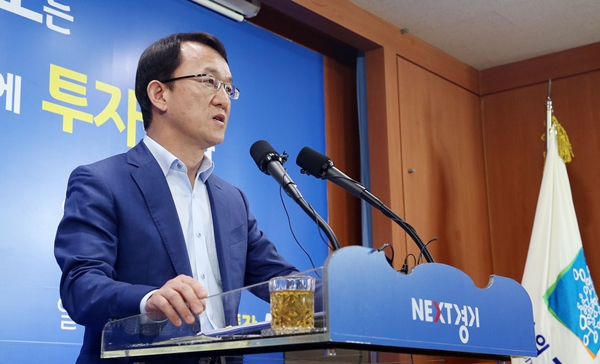
Gyeonggi Province has allocated 22 trillion 99.7 billion won for the 2018 budget, an increase of 2 trillion 42.94 billion won from this year's 19 trillion 670.3 billion won.
Director Jo Cheong-sik of the Gyeonggi Province Planning and Coordination Office held a press conference at 2 p.m. on the 6th and announced that the 2018 budget proposal containing these details was submitted to the Gyeonggi Provincial Assembly the same day.
This is the first time in the province's history that Gyeonggi Province's main budget has exceeded 20 trillion won. The province allocated 21 trillion 345 billion won in the second supplementary budget in 2015, but the main budget at that time was 17 trillion 332.3 billion won.
The 2018 budget proposal of Gyeonggi Province consists of a general account of 19 trillion 281.5 billion won and a special account of 2 trillion 818.2 billion won.
Looking at the main revenue categories of the general account, the estimated local tax for next year is 10 trillion 749.8 billion won, and dependent revenue sources including national treasury subsidies are 7 trillion 22.8 billion won. Expenditures include administrative operating expenses such as civil servant salaries of 366.2 billion won, financial activities expenses of 1 trillion 473.6 billion won including special fire safety and disaster management fund transfers, and 17 trillion 441.7 billion won allocated for policy projects.
Policy projects consist of legal expenses of 6 trillion 179.5 billion won such as transfers to cities and counties and the Office of Education, national treasury subsidy projects of 8 trillion 165 billion won, and autonomous projects of 1 trillion 927.8 billion won. Autonomous projects refer to available funds that Gyeonggi Province can use, representing an increase of 350.4 billion won compared to the main budget of 1 trillion 577.4 billion won in 2017.
Director Jo stated, "While the government is pursuing expansionary fiscal policy to increase expenditures, we see high uncertainty in provincial tax revenues centered on acquisition taxes due to strong real estate policies. Based on fiscal soundness, we plan to continue economic revitalization policies, including the Working Youth Series, which is a key policy of the 6th popularly elected Gyeonggi provincial administration," revealing the 2018 fiscal management direction.
Accordingly, the province has decided to focus investment on four major provincial policy goals next year: ▲Prosperous Gyeonggi Province, ▲Safe Gyeonggi Province, ▲Balanced and Convenient Gyeonggi Province, and ▲Warm and Happy Gyeonggi Province.
Looking at the detailed budget proposal, first, to realize a prosperous Gyeonggi Province, the province has allocated 1 trillion 542.1 billion won to employment budgets including the Working Youth Series and high-value-added industry development.
The Working Youth Series, which recently received consent from the Social Security Committee of the Ministry of Health and Welfare, has been allocated 147.8 billion won, 28.7 billion won for the Working Youth Bankbook in its third year of implementation, and 8 billion won for youth job-seeking support funds, concentrating financial capacity on job creation for youth.
Additionally, 201.2 billion won has been allocated for creating a favorable business environment, and 629.3 billion won for small and medium enterprise competitiveness enhancement including strong small enterprise development and small business revitalization. To foster high-value-added industries that will lead the Fourth Industrial Revolution, 499 billion won is invested in bio and AR/VR industry development, 254 billion won in new technology development and eco-friendly agricultural product production, and 77.9 billion won in culture and tourism resource development, totaling 381.8 billion won.
Second, for a safe Gyeonggi Province, a safety budget of 941.8 billion won has been allocated.
374.9 billion won has been allocated to disaster safety infrastructure improvements including flood-prone area improvements, hazardous area district improvements, and emergency recovery system maintenance. 147.6 billion won has been assigned to disaster response and environmental hazard mitigation including reduction of airborne dust, construction of AI-exclusive laboratories, and establishment of quarantine systems. 207.7 billion won has been allocated for expanded investment in public health safety including vaccinations and improvement of aging residential water supply, eliminating blind spots in resident safety. In particular, 183 billion won including 126.4 billion won for fire equipment reinforcement such as purchase of fire and emergency vehicles and 30.6 billion won for improving the work environment for firefighters has been allocated to strengthen firefighting capabilities directly linked to resident safety.
Third, for 'Balanced and Convenient Gyeonggi Province,' 1 trillion 123.9 billion won has been allocated.
192.8 billion won has been allocated to infrastructure expansion in underdeveloped northern regions including the Peace Nuuri Bike Path construction and five major northern road projects, and 92.4 billion won for future-oriented urban development including deteriorated residential environment improvement and urban regeneration projects. 368.2 billion won has been allocated for resident-friendly transportation facilities including expansion of double-decker bus introduction of 9 billion won, 252.7 billion won for transfer discounts and transportation provision services, and 217.8 billion won for national road construction and local road projects, totaling 838.7 billion won for establishing a convenient and safe transportation environment system.
Fourth, for 'Warm and Happy Gyeonggi Province,' a welfare budget of 4 trillion 113.6 billion won has been allocated.
First, to expand income support systems for vulnerable groups, 1 trillion 64.5 billion won has been reflected in basic living, education, housing, and medical benefits, and 128.8 billion won has been invested in infinite care for crisis families and emergency welfare support.
Disability welfare has allocated 399.9 billion won for disability pensions and activity support, child welfare has allocated 380 billion won including child allowance and air purifier support for childcare facilities, and elderly welfare has allocated 1 trillion 923.3 billion won for basic pensions and elderly long-term care facility benefits. Additionally, 74.7 billion won has been allocated for ecological forest remodeling and garden creation projects.
In addition, 1 trillion 606.1 billion won will be invested in a total of 192 joint government-provincial projects as next year's joint budget.
Gyeonggi Province examined budget reflection for 194 projects excluding 74 non-budget projects and 20 projects requiring no request among a total of 288 joint government-provincial projects due to incomplete project specification. As a result, 122 projects (1 trillion 64.1 billion won) were fully reflected, 70 projects (542 billion won) were partially reflected, and 2 projects (3.1 billion won) were not reflected. The reason for non-reflection is unconfirmed project implementation timing.
Additionally, to achieve 'Zero Unpaid Debt' by 2018, the province has allocated 265.4 billion won to the local bond repayment reserve fund in 2018. Unpaid debt refers to unpaid city and county adjustment grants and education office transfers where payment obligations occurred in the past but were not paid, and borrowings of regional development funds, integrated management funds, and similar instruments.
Meanwhile, the province submitted a third supplementary budget proposal for 2017 in the amount of 22 trillion 304.1 billion won along with the main budget proposal for 2018. The main content of the third supplementary budget proposal for 2017 includes adjustment of amounts according to changes in dependent revenue sources such as national funds.
The 2018 main budget proposal and 2017 third supplementary budget proposal of Gyeonggi Province are scheduled to undergo standing committee review from the 27th through November 30th and budget and settlement committee review from December 1st through December 14th.

Loading comments…