


Former Gyeonggi Province Governor Son Hak-gyu, Northern Gyeonggi Concert Message [Full Text]
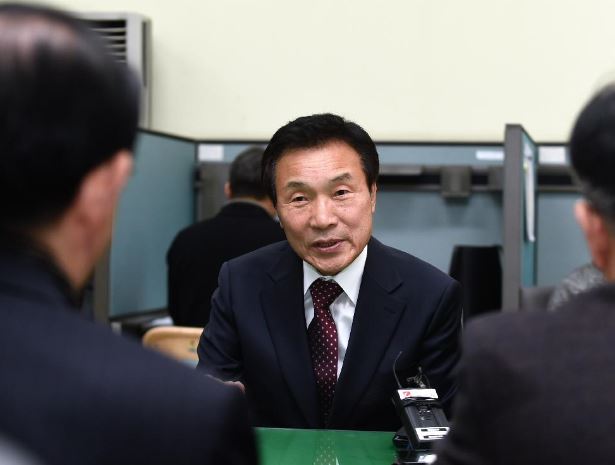
Coming to Uijeongbu brings fresh feelings.
I vividly recall the time when I worked hard for the development of northern Gyeonggi Province, including Uijeongbu, during my tenure as Gyeonggi Province governor. When visiting the Second Provincial Office, I took helicopters countless times to save time. When National Assembly members pointed out in parliamentary audits that I took helicopters too often, I would protest, saying, 'Who wants to ride a helicopter?' and 'My wife hates riding helicopters.'
Among my accomplishments as Gyeonggi Province governor, attracting investment is most frequently cited, with the representative example being the development of the LG Display complex in Paju in northern Gyeonggi. There were many hardships and many memories. After arguing so much with the central government, at the completion ceremony, President Roh Moo-hyun said at the beginning of his congratulatory remarks, 'Governor Son, are you satisfied now?' and I remember standing up and bowing at a 90-degree angle, replying, 'Yes, thank you.' I hear that Paju's population was 1.7 million then, but has now become 4.2 million.
Investment must create jobs. As we face the fourth industrial revolution, investment's employment effect is minimal. Rather, it increases unemployment. Nevertheless, we must increase investment and develop advanced industries. Paju's development becomes that exemplary case.
Every time I visit Uijeongbu, I cannot suppress feelings of regret. While serving as governor, I feel guilty that I did not achieve any special accomplishments in this city, Uijeongbu, the central city of northern Gyeonggi Province. Things must change now. Uijeongbu must also have advanced industrial complexes established to create jobs.
The model is the Pangyo TechnoValley that I painstakingly developed during my tenure as governor. Today, that complex with 200,000 pyeong has approximately 1,100 cutting-edge companies employing 72,000 top-tier personnel, generating 70 trillion won in annual sales—it is the finest advanced industrial complex. After witnessing Pangyo's success, the nation announced it would develop an advanced industrial complex of the same scale right next door.
The same can be done by creating such an advanced industrial complex in Uijeongbu. By establishing an IDC (Internet Data Center) on the grounds of the 306 Supplementary Base or the site of the relocated U.S. military base, we can first create 40,000 high-quality jobs. Once an IDC is established, cutting-edge companies will follow suit. This is also an idea from Chairman Jang Hwa-chul, a native of this region and one of Korea's top IT experts. The reality that there is not a single IDC within a 50-kilometer radius in northern Gyeonggi Province well demonstrates how poor the advanced industrial infrastructure is in northern Gyeonggi.
Furthermore, I would like to say that now is the time to actively pursue the division of northern Gyeonggi Province. Currently, the northern region has a population of 3.6 million, making it the region with the largest population after Seoul, Gyeonggi Province, and Busan.
Now, with the infrastructure of a metropolitan body in place, we have laid the groundwork for independent development, and only by becoming independent can we develop further. The police have already separated the Gyeonggi Northern Police Agency to establish an independent administrative system. The metropolitan autonomous body, which is the center of administration, must now eliminate inefficiency and establish the foundation for independent development. If I stand at the center of national governance, I will certainly achieve the division.
Esteemed residents of northern Gyeonggi Province,
Through more than two months of candlelight protests that began in late last year, the desire for change in government has reached an all-time high. Particularly among young people, nine out of ten reportedly hope for a change in government. While the Park Geun-hye administration's manipulation of state affairs is the direct cause, our people have become increasingly difficult to live under conservative rule over the past ten years.
If a change in government is almost beyond doubt, now is the time to consider what kind of change in government it will be. The mission of the next government is weighty. The next government must not only correct the failures of the ten-year conservative administration but also settle the accumulated evils of decades. The people gathered in the squares are already looking further. The sigh of 'Is this a country?' filling the squares means our people are intensely demanding a 'new Korea.'
Looking back, the accomplishments of the ten-year democratic government that began with a horizontal change in government are not insignificant. However, there are many regrettable aspects that make one doubt the significance of the change in government. Inequality, which has emerged as a challenge of the times, began to worsen from 1998 when the democratic government took office.
The non-regular employment legislation enacted during the Roh Moo-hyun administration pushed workers' lives into an abyss and intensified wage inequality. Chaebol, which became the key target of dismantling vested interests, and the chaebol-centered economic system are legacies of the Park Chung-hee administration, yet remained unchanged regardless of political power transitions. Rather, the Roh Moo-hyun administration was even chaebol-friendly to the point of being suspected of collusion with Samsung, a representative chaebol. The status and influence of the political prosecution and bureaucrats remained unchanged. The two presidents who led the ten-year democratic government, Kim Dae-jung and Roh Moo-hyun, themselves regretted not pursuing bolder reforms during their tenure.
When the next administration ends, there must not be greater regrets than accomplishments. For this, the leading forces of change in government need firm principles and philosophy.
First, a complete break with vested interest groups. Chaebol reform is the foremost. Chaebol reform is not about punishing chaebol. It benefits large companies belonging to chaebol. If chaebol reform reduces the risk of the founding family stubbornly maintaining management rights, corporate value rises. Power institutions such as the prosecution, National Intelligence Service, and police must also be reformed to become institutions subject to popular control rather than servants of power.
Second, eliminating inequality. Our level of inequality has reached a level that threatens the existence of the national community. Discrimination and inequality between a small privileged class and the majority, between large and small enterprises, between regular and non-regular workers are severe. By resolving inequality, we must create a 'country where everyone prospers together,' a true republic.
Third, a coalition government. Regardless of which political force takes power, it is likely to become a minority party in the National Assembly. As a minority party, there is no strength to pursue the fundamental reforms the people demand. Again, only strife and no reform will be repeated. Political forces committed to reform, regardless of party affiliation, must join forces to create a coalition government.
Forming a multiparty system and constituting a coalition government through coalition is the political behavior of all politically advanced nations. Policy continuity is greater, and politics are more stable. The Park Geun-hye government, which was a government only for Park supporters, failed. The next government must not again become a government dominated by a small hegemonic group.
Finally, constitutional amendment. Constitutional amendment means creating a new national governance system befitting a new Korea. The presidential system proven to have failed cannot lead Korea any longer. We must create a decentralized power structure that shares power with the legislature and returns it to the people.
Forces based on these principles and philosophy must be the driving force of change in government. Change in government must not be a feast for the political arena but a national festival where ordinary people receive fair treatment and build a country where they prosper together without inequality and disparity. It must be a celebration where many good jobs are created and young people build a fair society with hope for tomorrow. This is the appearance of the Seventh Republic. Let us move forward with vigor toward the construction of the Seventh Republic, where we redesign all aspects—politics, economy, society, security—and every single citizen becomes the master of the country.
January 16, 2017
Son Hak-gyu
Loading comments…