Gyeonggi Province Begins Full Implementation of Semiconductor Ecosystem through Relaxation of 'Non-Capital Region Preference' Clauses
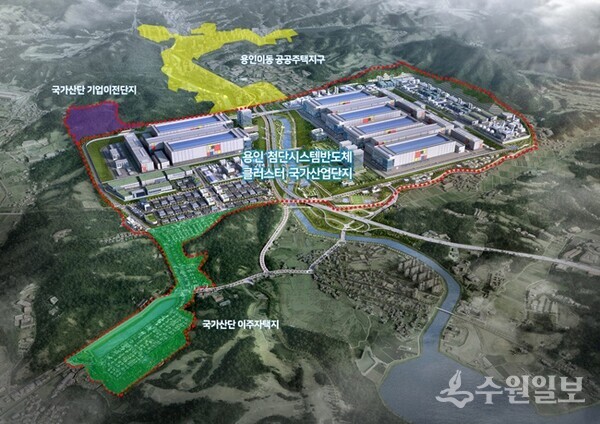
With the implementation of the 'Enforcement Decree on Strengthening Competitiveness and Support for the Semiconductor Industry' on August 11, multiple recommendations from Gyeonggi Province have been reflected, indicating heightened feasibility for the semiconductor ecosystem initiative pursued by the ninth-term Gyeonggi Province administration.
According to Gyeonggi Province on the 19th, six recommendations submitted by the province during the legislative notice period for the 'Enforcement Decree on Strengthening Competitiveness and Support for the Semiconductor Industry,' which ran from June 25, were either fully or partially reflected.
First, the deletion of the application requirement stating 'must be located outside the capital region' for semiconductor cluster formation plans, which was included in the enforcement decree draft presented by the Ministry of Trade, Industry and Energy in May when opinions were solicited from related ministries and local governments, has been confirmed.
Among partially reflected provisions, the clause 'must prioritize non-capital regions' in the designation of semiconductor clusters and support requirements for resident companies and institutions in semiconductor clusters has been relaxed to 'shall be given priority consideration.'
Among the requirements for overseas talented workforce support, the clause 'may provide preferential treatment to overseas talented personnel employed or conducting research at semiconductor clusters or business sites located outside the capital region' has also been relaxed from preferential treatment to 'may be implemented with priority.'
Regarding matters related to the designation of semiconductor industry professional personnel training institutions, the clause 'shall endeavor to ensure priority designation of institutions located outside the capital region' has been modified to 'shall endeavor to ensure designation.' The clause concerning support for contract curriculum establishment and operation has been relaxed from 'preferential measures may be provided to contract curricula established by industrial education institutions located outside the capital region' to 'comprehensively consider workforce demand and supply contributions of the semiconductor industry, cooperation systems with semiconductor operators, etc. However, contract curricula of industrial education institutions located outside the capital region may be prioritized for support,' shifting focus from regional distinctions to comprehensive consideration of enterprise workforce demand, educational capacity, and employment linkage effects.
Gyeonggi Province evaluated that through this enforcement decree enactment, it has minimized potential disadvantages for semiconductor companies and institutions within the province in institutional support. Beyond cluster designation application requirements, several non-capital region preference-related clauses applied to semiconductor cluster designation and support, overseas talented workforce support, professional workforce training institution designation, and contract curriculum establishment and operation have also been relaxed during the enforcement decree enactment process.
Accordingly, the province plans to accelerate subsequent responses including semiconductor cluster designation to connect the 'application eligibility' secured through this enforcement decree enactment to substantial industrial competitiveness enhancement.
Upon designation as a semiconductor cluster, various support and special measures can be received, including industrial infrastructure development and operation support, administrative and financial support for resident companies and institutions, expedited processing of permits and licenses, priority selection and exemption from preliminary feasibility studies, and workforce development and technology support.
The province plans to begin policy research with the Gyeonggi Research Institute for 'semiconductor cluster designation application,' preparing basic concepts and formation plans for clusters encompassing major semiconductor industry bases in Gyeonggi Province. During the research process, the province will collect opinions from cities and counties, companies, and research institutions, and will specify current semiconductor industry status and infrastructure, industrial agglomeration plans, workforce development and research infrastructure establishment measures, and funding acquisition strategies.
Meanwhile, the province maintained close communication with the offices of National Assembly members from Gyeonggi Province including Kim Seung-won, Kim Tae-nyeon, Lee Eon-ju, Lee Sang-sik, Sohn Myung-soo, and Bu Seung-chan to modify the initial enforcement decree draft, explaining Gyeonggi Province's position to the Ministry of Trade, Industry and Energy. Additionally, the province and 19 cities and counties jointly submitted formal requests for improvements to the government, while making multiple visits to the Ministry of Trade, Industry and Energy to consistently explain the problems that could arise from excluding the capital region from application targets and the necessity for system improvements.
Governor-elect Choo Mi-ae of Gyeonggi Province also swiftly formed a 'Special Committee for Semiconductor Ultra-Gap Strategy' after her election in June and maintained comprehensive responses involving the province, cities and counties, National Assembly members, and the transition committee, strengthening efforts to improve the capital region exclusion requirements in the enforcement decree.
Hyun Byung-cheon, Director of the Future Growth Industry Division of Gyeonggi Province, stated, "The greatest achievement in the enforcement decree enactment process is resolving the institutional barrier that could have excluded Gyeonggi Province from semiconductor cluster designation application targets," and added, "We will not stop at securing application eligibility but will prepare a cluster formation plan that can enhance the competitiveness of Gyeonggi Province's semiconductor industry by fully reflecting opinions from cities and counties, companies, and research institutions."