Mayor Choi Won-yong's Transportation Innovation in Pyeongtaek... Will a '30-Minute Living Zone' Be Possible?
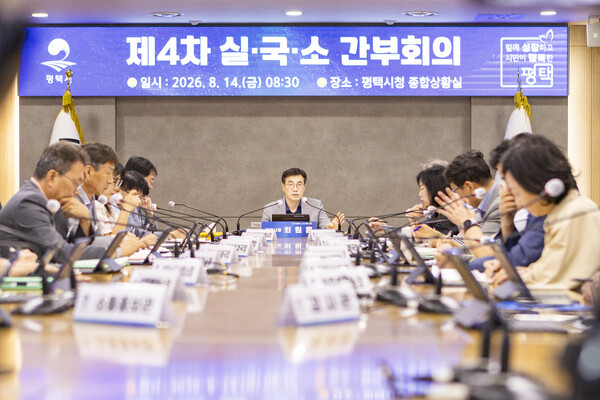
Pyeongtaek City is embarking in earnest on creating a '30-minute living zone' to reduce residents' travel time and eliminate transportation disparities between regions. The city announced its public transportation innovation plan to realize a '30-minute living zone' at an executive meeting on the 14th.
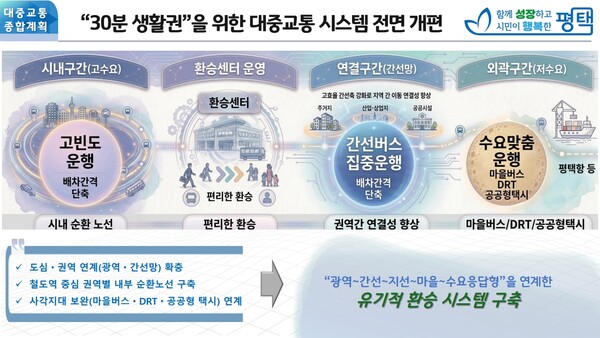
The '30-minute living zone' is a system that allows residents to conveniently access major hubs necessary for daily life within approximately 30 minutes, with the key being to densely connect the city's transportation network. The announcement presented implementation plans for the public transportation sector, which has high resident recognition among the 30-minute living zone projects.
The main initiatives include five strategies: △expanding wide-area and airport buses △expanding circular village buses △introducing student commute shuttle buses △creating a Songtan intercity bus waiting facility △strengthening connections between village buses, smart buses, and public taxis.
To reduce the commute burden for residents traveling to and from Seoul and major metropolitan areas, the city is expanding its wide-area transportation network. Specifically, the city plans to establish new wide-area and airport bus routes and the Pyeongtaek G-bus route, and to reduce congestion during rush hours through adding buses to existing routes and expanding double-decker buses. To this end, the city is actively coordinating with the Metropolitan Area Wide-area Transportation Committee and Gyeonggi Province. In fact, Mayor Choi Won-yong met with the chairman of the Metropolitan Area Wide-area Transportation Committee in July to directly request expansion of wide-area buses in Pyeongtaek.
The city also plans to expand community-focused village buses for residents' daily travel. Beginning with the launch of route 6881 (Pyeongtaek Port~Poseung-eup~Hwayang District~Anjung Terminal) in August, the city plans to expand regional routes including the Godeok New City circular route and the Gaejae District~Brain City circular route by 2027 to enhance public transportation accessibility.
Student commute shuttle buses will also be introduced to reduce students' commuting burden. This measure is being pursued after a survey revealed that among 4,772 high school students in six schools in the northern region, nearly half—2,339 students—expressed a desire to use shuttle buses due to commuting difficulties. The city plans to operate a pilot route connecting Godeok New City and northern high schools beginning in November, with plans to expand operations to other regions in the future.
To resolve ongoing passenger inconveniences since the closure of the old Songtan Terminal in January 2024, the city is also creating a 'Songtan intercity bus waiting facility.' The plan involves leasing existing terminal commercial spaces to provide waiting areas for boarding and alighting as well as convenience facilities including restrooms, and will offer smart transportation services such as bus information guidance systems and unmanned terminals (kiosks).
The city will also strengthen connections between village buses, smart buses, and public taxis tailored to regional conditions. In rural areas, smart buses and public taxis will be utilized to supplement mobility, while new development areas will prioritize smart bus deployment. Additionally, the city plans to organically connect circular buses with existing public transportation routes to reduce transportation gaps by region.
Mayor Choi Won-yong stated, "This public transportation innovation plan goes beyond simply increasing bus routes to represent a structural reform of the transportation system connecting all of Pyeongtaek as one '30-minute living zone.'" He added, "We will actively reflect residents' opinions and make seamless efforts to reduce travel burdens in daily life such as commuting and school transportation, and to ensure convenient access to public transportation from anywhere."