


What Are the Government's Measures to Address Social Polarization?
Rep. Lee Ki-woo of the Open Our Party raised the need for government measures to address social polarization and pension system reform based on independence and publicness of the National Pension Service operating organization during a National Assembly interpellation on social and cultural affairs on the 17th.
He also urged the government to promptly take measures to address childhood obesity, emphasizing that national-level management of obese children must be implemented.
Taking the floor at the final session of the National Assembly's interpellation on social and cultural affairs, Rep. Lee Ki-woo presented policy alternatives under the theme of "New Proposals for the Era of $20,000 Per Capita Income."
△Emphasizing the Necessity of Building a Social Safety Net
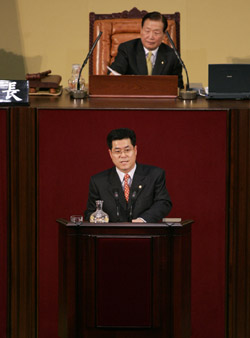
▲ On the 17th, an interpellation on social and cultural affairs was held at the National Assembly plenary session. Rep. Lee Ki-woo of the Open Our Party was raising questions to the government. /Yeouido Communications, Kim Jin-seok
To this end, Rep. Lee emphasized "welfare and growth through job creation" and "the necessity of public policy to address polarization."
During the interpellation, Rep. Lee stated, "A new national philosophy is needed for the era of $20,000 per capita income," and argued that "public policy intervention must be strengthened to address social polarization."
Rep. Lee also stated, "Public responses to poverty resolution, social integration, and economic and social polarization are divided into social safety net reinforcement strategies and job supply strategies," emphasizing that "it is necessary to find fundamental solutions when both public policies in Korea are inadequate."
Rep. Lee stressed, "Pension reform must be carried out so that the National Pension can serve as a true foundation for national unity," and "a multi-layered income security system at the government level must be established to eliminate blind spots in retirement income security."
To this end, Rep. Lee stated, "Independence and publicness of the pension fund management organization must be secured," and added, "An organization that efficiently manages funds and takes responsibility at a level that does not cause national anxiety is needed."
Rep. Lee asked, "As the National Health Insurance Financial Soundness Special Act expires in 2006, advance preparation is necessary for post-2006 revenue measures," and inquired, "What is the government's measures to secure financial stability of the National Health Insurance?"
In response, Health and Welfare Minister Kim Geun-tae stated, "Strengthening health insurance coverage is important," and replied, "The government will sufficiently discuss measures to secure financial stability within the government."
Rep. Lee also ordered the government to conduct systematic research on childhood obesity, stating, "What is a bigger problem than adult obesity is precisely childhood obesity."
△Social Welfare Services and Job Creation Can Occur Simultaneously
On this day, Rep. Lee Ki-woo drew attention by ordering measures to address social polarization through social welfare services and job creation.
Rep. Lee stated, "Female and elderly workforce utilization in the fields of public administration, education, and health and welfare is greater than in other industries," and argued, "If the social service industry is brought to the OECD average employment ratio of 24 percent, approximately 2.3 million additional jobs would be needed, and if the ratio is raised to the 17 percent level by 2008, approximately 700,000 jobs can be secured."
In particular, Rep. Lee estimated, "The scale of new job creation for educational welfare targeting low-income students is expected to reach 10,000 people," and emphasized, "It is necessary to place welfare specialist counseling teachers in each school."
During the interpellation, Rep. Lee drew attention by emphasizing the necessity of administrative system changes to complete the national philosophy for strengthening social safety nets and employment creation strategies.
Rep. Lee stated, "For strengthening social safety nets and employment creation strategies, efforts by economic ministries such as the Ministry of Finance and Economy alone are insufficient," and emphasized, "Social job creation with a welfare-oriented mindset and construction of a social safety net targeting all citizens must proceed together."
To this end, he stated, "It is desirable to place multiple vice ministers prioritarily in the social, welfare, and culture fields," and emphasized, "The government's willingness to introduce the multiple vice minister system is necessary."
<Yeouido Communications=Reporter Kim Dong-hyun>
| Full Text of Rep. Lee Ki-woo's Interpellation to the Government at the National Assembly The following is the full text of the interpellation titled "A New National Philosophy Is Needed for the Leap to the Era of $20,000 Per Capita Income," which Rep. Lee Ki-woo presented to the government. As this is important material that shows the political philosophy of a member of the National Assembly at a glance, we present the full text here / Editor's Note
Therefore, a new national philosophy at the state level is necessary for the era of $20,000 per capita income. ■ Distribution and Economy: A Fated Partnership ○ Due to improved national consciousness and enhanced social responsibility, the state cannot be managed with a "follow me" or "let's grow the pie first and then share it; don't talk of sharing before growing" mindset of 1970s-style economic growth. Growth and distribution should not be configured as a trade-off relationship, but rather as a partner relationship where distribution can induce growth and growth can contribute to distribution. I would like to ask the Prime Minister for your views on this. This member believes that balanced policies are needed that create jobs through welfare policies, not charitable welfare perspectives of the past 1970s and 1980s, and induce effects of economic stimulus. ■ Public Policy Intervention Is Essential to Address Economic and Social Polarization ○ What Korea now needs is not only economic revitalization but also strengthening of social safety nets to realize a welfare community where people live together, and do you agree that increasing household income through job creation in the social service sector is necessary? Trends in household finances of urban workers show income disparities growing wider, with statistics from the National Statistical Office and analysis articles showing that there are approximately 1.3 million working poor and 4 million people per household, meaning about 10 percent of our citizens suffer from poverty. This phenomenon of income polarization hinders national unity and becomes a social instability factor. There have been regrettable news articles about indiscriminate murders of the wealthy and a four-year-old child who met his fate in a closet due to starvation. ○ To address this social polarization, it is difficult to rely solely on simple market mechanisms, and public policy intervention must be strengthened. To achieve national unity, it is the path the Participatory Government must take to devise measures to address polarization issues and realize them through policies. Prime Minister, I request that you present the government's measures to address the polarization problem. Public responses to poverty resolution and social integration and economic and social polarization are broadly divided into two strategies: social safety net reinforcement strategy (household income support) and job supply strategy (household income generation). Korea currently finds itself in a situation where both of these public policies are inadequate, and it will be necessary to find fundamental solutions to address this. First Strategy: Building a Strong Social Safety Net All citizens of Korea have the right to "live a life worthy of human dignity," and the state bears the "obligation to work for the promotion of social welfare," as stipulated in the Constitution. Korea currently appears to have constructed a retirement income security system through the National Basic Livelihood Security Program, Old-Age Pension, National Pension, Retirement Benefits, and Individual Pensions, but a considerable number of elderly people are exposed to blind spots. 1. National Pension Reform and Construction of a Multi-layered Income Security System: The Only Retirement Income Security System I will ask the Minister of Health and Welfare. According to the National Pension Service's recent plan to "Establish an Income Security System in Preparation for an Aging Society," 58.9 percent of the elderly population aged 65 and over (3.97 million people) are excluded from public income security programs. Even by 2010, the situation has not improved significantly, with about half of the elderly remaining neglected in income security blind spots. In this sense, substantial reform of the National Pension System, the only social security system preparing for the future society, is necessary, and efforts must be made to overcome public distrust and institutional illegality regarding the pension system. Looking at cases of pension reform abroad, they demonstrate that if the timing of pension reform is missed and reform is attempted belatedly, additional social burdens result in greater national suffering. Therefore, the government must achieve pension reform with appropriate benefits and appropriate contributions, and realize pension reform so that the National Pension, as a social safety net, can serve as a true foundation for national unity. ○ In handling legislation, what measures are you preparing to draw social consensus and maintain the National Pension system stably in an era of low birth rates and aging? ○ Various incentives should be devised so that as many people as possible participate in the National Pension, and despite these efforts, to eliminate blind spots in retirement income security that inevitably occur, a multi-layered income security system at the government level must be established. What is your plan for this? Necessity of Securing Independence and Publicness of Pension Fund Management Organization The National Pension's accumulated fund will reach 158 trillion won in 2005 and 329 trillion won by 2010, far exceeding national finances, making it a matter of national concern that must be managed based on the three principles of fund management stability, profitability, and publicness. During deliberation of the pension law amendment last year, reorganization of the fund management structure for managing such massive funds was deeply discussed. Along with concerns about fund depletion, citizens worry that in pursuing profitability in the management of accumulated pension funds, they may not receive returns in the future, and regarding the argument by some to completely separate the fund-managing organization from the government, citizens also express concern about who to hold responsible for its management. ○ I believe that an organization that efficiently manages funds at a level that does not cause citizen anxiety and takes responsibility for such management is necessary. Minister, I request that you clearly explain the government's position on fund management and the fund management organization. 2. Long-term Care Insurance System for the Elderly: Implementation Process Must Be Thorough Society's Responsibility for Elderly Care - Independent Long-term Care Security System Should Be Actively Reviewed As society ages, the number of elderly requiring long-term care due to dementia, stroke, and similar conditions is significantly increasing, and this has become a universal risk that can happen to any elderly person. As medical costs for such care-dependent elderly rapidly increase, appropriate sharing through social solidarity has become inevitable for elderly care that was primarily the responsibility of families and individuals, and currently, advanced countries and Japan are implementing active policies targeting all elderly people. As of 2004, the elderly population aged 65 and over comprises 8.7 percent of Korea's total population, and the National Statistical Office projects that by 2026, Korea will reach a super-aged society with 0.0 percent, meaning one in five will be elderly 65 and over. According to recent National Statistical Office data on "Future Population Special Projection Results," the average life expectancy is 77.9 years in 2005, exceeding the advanced country average of 76.2 years, and the support burden of the working-age population (15-16 years old) for the elderly population 65 and over is projected to increase from approximately 8 people supporting 1 elderly person in 2005 to 1.4 people supporting 1 by 2050. Therefore, if we fail to establish a public long-term care security system for the elderly in the early stages of an aging society and thereby reduce the anxiety of the public regarding old age and lessen the burden on elderly families, we will be unable to properly respond to the rapidly increasing demand for elderly long-term care. ○ I understand that the Participatory Government is planning to implement a pilot program for long-term care insurance for the elderly starting this July to assist in elderly care and support. I believe that based on the outcomes of the pilot program, a substantive model of a Korean-style long-term care security system can be designed. Please provide answers regarding the government's promotion plans and progress on this matter. I wish to especially urge the Minister of Health and Welfare that the pilot program serves as a model for the overall system including evaluation judgment, fee schedules, care plans, and cost calculations, and thorough management is necessary to ensure differentiated results by target region—large cities, medium-sized cities, and rural areas—and by long-term care service type. 3. Need to Expand Social Safety Net in Healthcare I will ask the Prime Minister. 1) Financial Soundness of Health Insurance Must Be Specified and Concretized National medical security through health insurance, where each citizen properly addresses disease risks and conducts prevention through health insurance, is a social safety net for national health. The prerequisite for achieving this goal is financial soundness of health insurance. Since the 2001 financial crisis, continuous measures to stabilize health insurance finances have been implemented, and finally, health insurance has achieved current-period surpluses. However, since the "Health Insurance Financial Soundness Special Act," the basis for the government providing 50 percent of regional finances, expires in 2006, advance preparation for revenue measures thereafter and rapid achievement of national consensus on this matter are necessary. If we were to secure 5 trillion won in financial expansion according to the beneficiary burden principle, it would require raising insurance premiums by over 20 percent on average, which is realistically impossible. ○ Social insurance should have efficiency added on the foundation of fairness and social solidarity and publicness. Among the two revenue methods of insurance premiums and tax methods, considering the realistic acceptance of citizens, there is an opinion that government budget support through general taxation should be provided. What is the government's preparation process to secure financial stability of the National Health Insurance? I will pose questions to the Minister of Health and Welfare. According to last year's Health Insurance Service investigation, as of 2004, the out-of-pocket rate paid by patients among total medical costs averaged 43.6 percent, which is significantly higher than the burden rates of major OECD countries, indicating that Korean patients bear excessive burdens when utilizing medical institutions, making it difficult to avoid criticism that health insurance fails to properly perform its social security function. In particular, minor illnesses like colds, where patients pay only 3,000 won when visiting clinics, account for 85 percent of total health insurance visits, while high-cost serious patients bear large individual medical cost burdens, such that health insurance is not adequately functioning as social security when serious illness strikes and crisis situations occur. The Participatory Government has already announced plans to raise health insurance coverage to 70 percent by 2008 and expand the share of public medical costs from the supply side to the 30 percent level. Regarding this, expansion of benefits for individual items such as MRI coverage and exemption from out-of-pocket costs for childbirth-related expenses has been implemented, but concrete and phased plans for 70 percent coverage rates have not been presented. Particularly since the Health Insurance Financial Soundness Special Act expires in 2006, it is urgent to present a blueprint to the people on how to strengthen health insurance coverage and achieve sufficient discussion and social consensus regarding financial measures to this end. ○ Minister, please provide answers on how you will promote strengthening of health insurance coverage. 2) National-Level Management of Childhood Obesity Must Be Implemented I will pose questions to the Deputy Prime Minister and Minister of Education and Human Resources Development. Recently, it was revealed that school lunches provided to malnourished children were being distributed inadequately, causing major social controversy. I also made a fact-finding mission to Seogwipo, Jeju, where the problem occurred at that time. While support for malnourished children was being discussed, implemented, and executed on one front, the issue of childhood obesity was being raised on another. According to a recent research result, tracking 773,915 disease-free adults in their 30s and older who received health checkups from the Corporation in 1992 through 2002 (a ten-year period), when calculated with Korea's adult population at 30 million, approximately 300,000 to 400,000 people are becoming obese annually. More problematic than adult obesity is precisely childhood obesity. Also, according to a Chosun University research team survey, when the obesity rate of 1,559 seven-year-old children was investigated in 1992 and then tracked when these children were 13 and 17 years old, the obesity prevalence rate, which was 3.1 percent at age 7, increased to 7.1 percent at age 13 and 13 percent at age 17, representing more than a fourfold increase over a ten-year period. ○ The increase in childhood obesity has social reasons such as diet and convenient living environments as well as causes from genetics and disease, but I believe the primary cause lies in exam-focused education resulting in children's absolute lack of exercise. Please share the Deputy Prime Minister's views. According to research results, 80 to 85 percent of childhood obesity progresses to adult obesity or develops into pediatric diseases in adults such as arteriosclerosis, diabetes, myocardial infarction, and hypertension, and can also lead to psychological illnesses such as inferiority about appearance, interpersonal relationship disorders, and depression, making it a particularly serious issue. Furthermore, as appearance-oriented values become prevalent, schools are experiencing ostracism of obese children. ○ Are regular obesity checks being conducted for our children? Looking at the "School Physical Examination Rules," there is no mention of obesity examination anywhere. I believe Korea also needs regular obesity checks for children. Please share the Minister's views and measures. According to my investigation, while there are studies conducted by obesity management specialists or nutritionists implementing obesity management programs and evaluating their effectiveness, there do not appear to be cases where schools led obesity management programs and evaluated their effectiveness. ○ I believe systematic research on childhood obesity is necessary. Please present your measures. ○ Students currently attending elementary, middle, and high schools spend much time at school. Therefore, schools must now pay more careful attention to childhood obesity. Therefore, I believe the government needs to operate systematic school obesity prevention programs. Please present the Deputy Prime Minister's views and measures. Second Strategy: 700,000-Job Social Service Job Creation Strategy I believe social polarization can be addressed through job creation in the social service sector. The social service sector is an area relatively rich in quality jobs through which blind spots can be reduced and advanced service delivery systems achieved. The small-scale service and self-employed sectors in over-employment states face difficulties in structural adjustment, and employment decline is the trend. For sectors where private investment is difficult to activate, such as welfare, education, and environment, the government must actively pursue employment creation policies, and social services can become a new source of job creation. Job creation is the best welfare and growth policy. Looking at advanced country cases, in the transition process from the $10,000 per capita income era to the $20,000 era, as economic structures advanced, employment in manufacturing declined while demand for public and social services increased. As mentioned above, the realistic problem of deepened economic and social polarization can be addressed through job expansion in the social service sector. Currently, compared to advanced countries with similar economic capacity at that time, we have very low levels of social service jobs. In fields such as public administration, education, and health and welfare, the utilization of female and elderly workers is greater than in other industries. Job creation in these fields can yield social and policy effects of strengthening national competitiveness through female workforce utilization (Women Korea Report, 2002) and securing livelihoods for the elderly. If the social service industry reaches the OECD average employment share of 24.0 percent (1998), approximately 2.3 million additional jobs would be needed. If the employment share in the social service sector is raised from the current 12.5 percent to the 17 percent level by 2008, approximately 700,000 or more jobs can be secured in this sector through arithmetic calculation. Through expansion of public administration services, social service demand is created, which in turn creates social jobs and achieves economic revitalization, thus implementing "productive welfare, participatory welfare, welfare where we live together" policies. In the past, the concept of social jobs was thought of as short-term and temporary jobs through public work projects, with charitable characteristics and income supplementation purposes. However, the social service job creation I am now presenting is different in dimension from such past social jobs, referring to job creation through advanced country-type service industry utilization. 1. Need for Expansion of Public Administration Services: Approximately 20,000 Jobs I will pose questions to the Minister of Government Administration and Home Affairs. First, adequate workforce securing for public services related to education and small business support, employment stability, labor inspection, and welfare is necessary. It is necessary to strengthen the social welfare and employment-related service delivery system through expanding dedicated civil servants and personnel, and thorough review of this is necessary. Civil servants handling social welfare currently manage National Basic Livelihood Security, elderly, disabled, child, and family welfare affairs at the city/county/district and township/village levels, with approximately 12,300 such personnel. At the frontline city/county/district and township/village levels, an average of 561 welfare recipients per person is being managed. Even if social welfare dedicated civil servants are doubled from their current level, adequate preparation for increased welfare-related work demand cannot be achieved. With 70 to 80 percent of welfare-related work concentrated on 1 to 2 social welfare civil servants at the township/village level, field operations are vulnerable, and proper specialized services and discovery of the vulnerable population cannot be adequately performed. ○ I believe there is a need to increase social welfare dedicated civil servants by more than 20,000. Of course, regarding civil servant workforce increases, as they result in government budget requirements, I believe employment increase plans should be established annually through social consensus. I would like to ask the Minister of Government Administration and Home Affairs for his opinion on this. 2. Social Service Job Creation in Health and Welfare Sector: Approximately 320,000 Jobs Next, I will pose questions to the Minister of Health and Welfare. As welfare demand increases and new systems are introduced, workforce expansion can be planned. By 2011, facility capacity must be sufficiently secured for elderly to receive long-term care at advanced country levels, and care labor areas such as childcare, elderly care, and after-school education can be socialized to create market demand. This can shift low-income populations from being recipients of welfare policy to becoming implementers, changing their social position. According to a research paper titled "Public and Private Sector Job Creation Methods in Health and Welfare Fields" released by the Korea Institute for Health and Social Affairs, the job creation scale in the health and welfare service sector was calculated at approximately 320,000 jobs. Job creation for the elderly and expansion of welfare facilities are our goals in an aging society. Therefore, through elderly jobs such as streetscape improvements and forest and cultural heritage interpretation, 130,000 jobs can be created. Through expansion of vocational rehabilitation facilities for the disabled, approximately 3,000 new jobs can be added, and through preferential authorization of vending machines and canteen businesses for approximately 4 low-income disabled people per 243 basic local government units, an employment effect of 1,000 people annually can be achieved. Additionally, by establishing 1,120 new national and public childcare facilities, 13,440 jobs can be created, and through staffing of social welfare facilities, approximately 16,000 personnel can be expanded. With the introduction of public long-term care insurance for the elderly, new welfare specialists such as care specialists and care managers create approximately 120,000 personnel. Furthermore, with public healthcare reorganization, necessary personnel for regional hub hospital development, strengthened public health services such as home healthcare projects and postpartum care services, and new personnel such as health consultation officers and social monitoring officers (hazardous food monitoring officers, hospital wastewater monitoring officers, etc.) create 42,000 jobs. Thus, a total of approximately 320,000 jobs can be created in the health and welfare sector. ○ As the overall minister for the social and cultural affairs sector, what concrete plans does the Minister of Health and Welfare have for such diverse job creation in the health and welfare sector? 3. Job Creation Through Educational Welfare Realization: Approximately 10,000 Jobs I will pose questions to the Deputy Prime Minister and Minister of Education and Human Resources Development. As far as I understand, the government is currently implementing pilot programs by selecting educational welfare investment priority areas to enhance academic achievement, emotional development, and health promotion of low-income area urban students. As an interim evaluation result of pilot programs to comprehensively improve the education, culture, and welfare levels of low-income students who were previously in educational welfare blind spots, positive effects have been shown including emotional stability and improved confidence in students and prevention of learning loss. In addition to low-income area urban students, I wish to propose placing welfare specialist counseling teachers in each school to promote emotional stability and human rights protection for all elementary, middle, and high school students and to provide welfare services in schools. As of 2003, there are 5,464 elementary schools, 2,865 middle schools, and 2,095 high schools nationwide, totaling 10,424 elementary, middle, and high schools. By placing a dedicated social welfare teacher in each school, approximately 10,000 new jobs can be created. ○ In addition to positive effects such as emotional stability, human rights protection of students, and provision of welfare services, I ask whether you would be willing to specifically examine a method to catch two birds with one stone through job creation in social services. Please provide your views on this. ■ Government Must Lead Overseas Job Connections to Resolve Youth Unemployment I will pose questions to the Prime Minister. Among the most concerning issues in poverty and unemployment problems is the youth unemployment problem. The actual decrease in job opportunities for young people due to industrial structure changes and the weak infrastructure of the vulnerable labor market cannot be solved solely through job creation in new concept social services. Preparation is necessary for overseas employment policies where youth expand to the wider world, disseminate Korean culture and technology, and return with advanced technology. In 2004, approximately 564.3 billion won was expended to address the youth unemployment problem, yet the perceived unemployment rate approaches 10 percent, a very serious level. Youth unemployment is a difficult issue to resolve in the short term, originating from structural factors such as job decreases for youth, lack of systematic career guidance and education, weak labor market infrastructure, and prolonged job search periods. I believe a social consensus has formed around the necessity of bold investment in youth jobs and job creation in new concept areas. Now, groundbreaking policy changes will be necessary. ○ I believe the government should actively consider providing incentives for young people who participated in overseas dispatch programs when returning to Korea for employment and establishing special provisions in military service. What is your view on this? ○ Furthermore, as our party's Speaker Lim Chae-jung has repeatedly emphasized in the New Year press conference and temporary National Assembly negotiation group representative speech, there is a need to develop concrete measures to realize a project to send 100,000 young people overseas to Southeast Asia and beyond, to disseminate Korean culture, learn the global market, and develop it. Please present the Prime Minister's views on this matter. Continuing with questions to the Prime Minister. The completion of the national philosophy for strengthening social safety nets and employment creation strategies should be led by government agencies in the social and cultural sector. I believe efforts by economic ministries such as the Ministry of Finance and Economy alone are insufficient. Job creation in social sectors with welfare-oriented mindset and construction of social safety nets targeting all citizens must proceed together. Changes in the administrative system are also necessary for this. Placing multiple vice ministers is for heavy workloads or to efficiently provide direct administrative services to citizens. Therefore, it is desirable to prioritize placement in the social, welfare, and culture sectors, which relate more closely to citizens than other departments. Looking at the organizational scale of the Ministry of Health and Welfare, the headquarters has approximately 450 personnel and affiliated organizations have approximately 3,100 personnel, totaling approximately 3,550 personnel. This is 5 times the Ministry of Finance and Economics and 3 times or more larger than the Ministry of Commerce, Industry and Energy. I believe that the Ministry of Health and Welfare, with such diverse tasks and large organizational scale, should also have multiple vice ministers. Additionally, for the multiple vice minister system introduction to gain persuasiveness and avoid controversy over validity, multiple vice ministers should be placed in departments where actually necessary. Only then can social safety nets be properly established, and ultimately, a one-to-one welfare system that all citizens can feel firsthand can be created. Let Us Establish a New National Governance Philosophy for a Society Where We Live Together Thus far, I have presented various proposals regarding construction of a solid social safety net where all citizens are comfortable and can live together, and job creation in social services as the basis for Participatory Government's national governance. Now, differentiated policies different from the development-oriented policy mindset of the 1970s-1980s for high-speed growth are necessary. While basic social management occurs within market structures, when solid social safety nets are established and the number of citizens employed in newly created social service sector jobs increases, unemployment rates decline and the state can guarantee social risks such as poverty, disease, and old age. I am confident this will accelerate the era of $20,000 per capita income. As we move beyond the era of the "devil's $10,000" to $20,000 per capita income for our citizens, I earnestly request that the Prime Minister and members of the State Council, who are sparing no effort in state affairs, approach national governance with such devotion. Thank you for your attention.
|



Loading comments…