


Is the Location of the Gwonseon Administrative Town Complex Appropriate?
Friction between the city and residents has intensified as residents in the area related to the location of the Gwonseon Administrative Town Complex have formed an emergency countermeasures committee and expressed absolute opposition.
The Suwon City website has seen opposition views from citizens flood in regarding this matter, emerging as a hot issue.
 | ||
| ▲ Gwonseon Administrative Town | ||
Last August, the city announced plans to utilize the site as an administrative town complex while considering how to utilize the Seoul National University College of Agriculture and Life Sciences campus site in Seodun-dong. Accordingly, the city conducted a feasibility study on the suitability of the agricultural college site for the administrative town complex and went through various reviews, ultimately deciding on the area around Hanil Computing High School in Tap-dong, Gwonseon-gu as the final site for the administrative town complex.
However, the area around Hanil Computing High School, the final candidate site, is classified as consolidated farmland with numerous legal restrictions. Additionally, concerns have been raised about plans to construct a Hwanggujicheon sewage treatment facility, the absence of bus routes creating inconvenience for use of public facilities, and potential educational disruption due to proximity to a high school. Despite significant opposition, the city designated this as the final candidate site.
 | ||
| ▲ Survey results on Gwonseon-gu Office location | ||
Meanwhile, the Seoul National University College of Agriculture and Life Sciences site was excluded from administrative town candidate sites for reasons including anticipated friction in land acquisition, a narrow sellable area of approximately 6,000 pyeong, concerns about damage to green spaces, and high land prices.
Consequently, landowners in Tap-dong, where the Gwonseon Administrative Town Complex is planned to be built, are resisting, claiming they have lived their entire lives through farming and now the city plans to take away even their livelihoods.
Similarly, neighboring residents argue that the Seoul National University College of Agriculture and Life Sciences site is the optimal location, claiming that if the administrative town is located in Tap-dong, accessibility will suffer due to insufficient public transportation facilities.
◆Gwonseon Administrative Town Progress
The Gwonseon-gu Office notes that the current site is narrow and its facilities, constructed in 1956, have become outdated. Additionally, insufficient parking and cultural spaces create considerable inconvenience for citizens using the office, making the need for relocation apparent for some time.
Furthermore, following the establishment of Yeongdeungpo-gu Office in 2003 and the subsequent revision of district administrative boundaries, the current Gwonseon-gu Office building came to be located within Paldal-gu's administrative district, prompting consideration of relocation.
The city commissioned the Suwon Development Research Institute, a research institute affiliated with Ajou University, to conduct location selection research. The institute comprehensively reviewed development potential of surrounding areas, accessibility, land utilization efficiency, and resident survey results. Eight candidate sites within Gwonseon-gu were examined and analyzed, narrowed down to the top four candidate sites, and a public hearing was held on April 22. Following consultation with related stakeholders and expert advice, Tap-dong (area around Hanil Computing High School) was selected as the final candidate site.
 | ||
| ▲ Detailed Gwonseon-gu facility planning contents | ||
The administrative town complex planned for approximately 42,260 pyeong (139,690 square meters) of farmland around Hanil Computing High School in the area of Lot 633-36, Tap-dong, Gwonseon-gu will feature consolidated public facilities including the Gwonseon-gu Office, police station, health center, and post office, aimed at improving administrative efficiency and providing improved living convenience to Gwonseon residents. In accordance with Article 30 of the National Land Use Planning and Management Act, the city intends to determine the Suwon Urban Management Plan (Administrative Town: public offices, roads, plazas, public open spaces) and is currently implementing related procedures including resident opinion consultations.
Therefore, if the administrative town plan is finalized and determined, the city plans to request property appraisals from government-recognized appraisal agencies in the first half of 2005 and provide compensation based on the appraised values in 2005.
In this regard, the city has been conducting consultations with related departments and agencies since mid-last month, and has confirmed that it has not yet held consultations with the Ministry of Agriculture and Forestry regarding agricultural land conversion.
Additionally, the city had planned to conduct review by the Suwon City Urban Planning Committee on the 27th and announce the urban management plan determination and topographical map on the 30th. However, due to prolonged consultations with related departments and agencies, these plans are expected to be pushed back to next year.
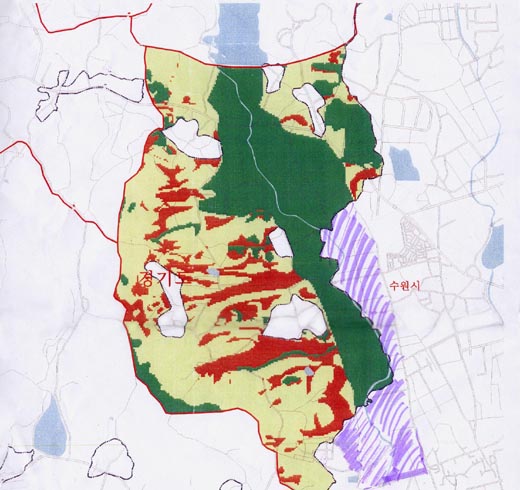 | ||
| ▲ Suwon City environmental assessment map | ||
◆Will Suwon City Abandon Seoul National University College of Agriculture and Life Sciences Site?
Initially, as the Seoul National University College of Agriculture and Life Sciences moved to Seoul's main campus, leaving behind its history as the Suwon campus, the city planned to acquire approximately 6,000 pyeong of the approximately 90,000 pyeong site this year and establish the Gwonseon-gu Office relocation site and lacking public infrastructure facilities for the western Suwon area.
However, dialogue and negotiations between the three parties—the agricultural college, the National Agricultural Products Quality Management Service, and Suwon City—were discontinued, leaving the utilization plan for the agricultural college site adrift.
Over the past period, since the Seoul campus moved to the Seoul Gwanak campus last August, the National Agricultural Products Quality Management Service and Suwon City have engaged in intense behind-the-scenes efforts regarding utilization plans for the approximately 70,000 pyeong Seoul National University College of Agriculture and Life Sciences site in Seodun-dong, Gwonseon-gu, Suwon City.
However, even one year and four months after the city announced its utilization plan for the Seoul agricultural college Suwon campus last August, the city has taken no action.
The National Agricultural Products Quality Management Service negotiated for an exchange whereby the agency would preserve the university site in its original form while remodeling some university buildings to utilize them as a large-scale bio-venture complex and agricultural genetic resources storage facility, in exchange for 40,000 pyeong of the National Agricultural Products Quality Management Service's Jamsagon Insect Division site in Mangpo-dong, Yeongtong-gu, Suwon City.
However, this plan has also stalled since the National Agricultural Products Quality Management Service was designated as a target agency for relocation under the Presidential Committee on Balanced Regional Development.
Suwon City also engaged in behind-the-scenes competition with the National Agricultural Products Quality Management Service and the agricultural college, proposing to Seoul National University that some areas be utilized as administrative sites for offices, schools, and welfare facilities, while others be used as parks. The city expressed its intention to purchase the land.
However, Suwon City claims to have received no responses from either the National Agricultural Products Quality Management Service or Seoul National University despite nearly three years of discussions regarding utilization plans for the agricultural college site, and has abandoned efforts.
Furthermore, the city initially announced plans for the Gwonseon-gu Office relocation and now, having commissioned a feasibility study to Ajou University, claims it concluded that Tap-dong is appropriate. Meanwhile, the city's purchase plans for the agricultural college site remain unresolved.
A spokesperson from the city's Urban Planning Division stated, "We have not abandoned plans to purchase the Seoul National University College of Agriculture and Life Sciences site," adding, "The purchase plan remains unchanged; we are simply not relocating the office to the agricultural college site."
 | ||
| ▲ Gwonseon-gu Office location | ||
◆ Landowners Form Emergency Committee...Launch Opposition Campaign
Residents maintain the position that they cannot condone the unilateral expropriation of land without properly reflecting their opinions.
Accordingly, landowners established an emergency countermeasures committee at the end of November and have launched full-scale opposition campaigns by submitting petitions to the city.
Through its petition, the committee stated, "We cannot help but lament the sudden, unilateral publication of land use notification without prior notice to the landowners regarding the creation of the Gwonseon Administrative Town Complex. We have spent decades as farmers and have never dreamed of transitioning to another profession. Since surrounding land prices have risen and we cannot afford alternative land, land expropriation is absolutely unacceptable."
Jo Mo, age 48, a farmer residing in Guun-dong, said, "Agricultural land must not be expropriated," and questioned, "Why is the Seoul National University agricultural college site left as an eyesore? If remodeling is done, construction costs can be reduced and natural green spaces can be preserved, can't they?"
Kim Mo, age 52, a farmer, also stated, "I cannot understand how the city plans to forcibly expropriate agricultural land, into which poor farmers have poured their blood and sweat, without consulting with landowners and to build an administrative town there," and added, "All landowners will struggle with their lives on the line to protect their farmland and guarantee their right to survive."
Seo Mo, age 51, from Guun-dong, said, "News of the administrative town site is like a bolt from the blue for farmers who specialize in agriculture," and requested, "Please do not take away our livelihoods when life is already becoming increasingly difficult."
Lee Dong-sik, chairman of the Resident Emergency Countermeasures Committee, is demanding realistic compensation measures from the city, stating, "Given that the Tap-dong location for the administrative town has been decided, residents who own land want compensation based on current market transaction prices rather than assessed land values or standard market prices. If compensation is not provided accordingly, residents who own land cannot continue farming."
| <Q&A; with City Councilor Son Jong-hak (Seodun-dong, Budget and Settlement Committee)> -What is your position on the Tap-dong location for the Gwonseon Administrative Town Complex? =I clearly oppose it. This is an issue involving the survival rights of local landowners, and western Suwon area development must be viewed with a long-term perspective. The National Committee for Regional Balanced Development has designated the National Agricultural Products Quality Management Service as a target for relocation to regional areas, and there is no utilization plan for the 1.1 million pyeong National Agricultural Products Quality Management Service site. In this situation, constructing an administrative town in Tap-dong while destroying green spaces should be reconsidered as it encourages wasteful spending.
=The administrative town feasibility study was conducted by the Suwon Development Research Center, affiliated with Ajou University, following the city's request, but the designation of Tap-dong as the final candidate site for the Gwonseon Administrative Town Complex is an incorrect selection. Despite Tap-dong receiving a Grade A preservation value rating from the Environmental Research Institute and being an area that should be preserved, it was designated as the final candidate site solely because it is considered the center of the western Suwon area. -Some argue that the Gwonseon Administrative Town Complex represents wasteful spending of taxpayer money. The Gwonseon Administrative Town Complex is planned to require a total investment of 38.5 billion won, comprising 12 billion won in facility costs and 26.5 billion won in land expropriation compensation. However, if the administrative town complex is built on the Seoul National University agricultural college site, half of the total budget would be sufficient. Remodeling existing facilities would yield budget savings. If the city insists on stubbornly designating Tap-dong as the location for the Gwonseon Administrative Town Complex despite this, it will ultimately result in wasteful spending of taxpayer money. Meanwhile, the entire 12 billion won in facility costs allocated in next year's budget has been cut. -I understand the Ministry of Construction and Transportation designated certain areas in Suwon's 2020 Urban Plan, including Geumgok-dong and Guun-dong land slated for urbanization, as preservation land. =The city prepared the Suwon 2020 Urban Management Plan in early this year and requested approval from the Ministry of Construction and Transportation. However, the ministry designated the Seoul National University agricultural college, Geumgok-dong, Guun-dong land slated for urbanization, Geumgok-dong and Homaesil-dong parks, and Goesaek-dong land slated for urbanization as preservation land. This means that while the Gwonseon Administrative Town Complex to be built near Hanil Computing High School would be surrounded by preservation land, developing productive green spaces constitutes green space destruction. Since the Suwon 2020 Urban Master Plan has not been finalized, rushing to pursue the Gwonseon Administrative Town Complex leads to hasty administration, creates additional civil complaints, and results in repeated budget waste due to basic plan modifications. -What is your plan to address this going forward? | ||||||||||||

| <Q&A; with Choi Jong-guk, Director of Suwon City's Urban Planning Division> - How were resident and public opinions solicited in the process of selecting the administrative town site? =In July this year, we held a public hearing for citizens regarding administrative town site selection. Additionally, we conducted a review study (Ajou University Suwon Development Research Center) for site selection and conducted surveys on candidate sites. - What is your response to criticism that the study results for the administrative town site were incorrect? =As mentioned earlier, we went through sufficient opinion-gathering processes, and around October this year, city councilors from the Gwonseon-gu area expressed support and approval for the administrative town to be located at the current planned site. - According to the survey results for administrative town candidate sites, the Seoul National University agricultural college site ranked first with 38 percent. =That simply reflects survey results regarding the agricultural college's public awareness, as it is located near multiple bus routes and in the vicinity of a subway station. - Then what are the future utilization plans for the agricultural college site? =First, the agricultural college site will be utilized under the basic principle of green space preservation. However, considering the agricultural college's review of site utilization and the city's management plan, there are currently no specific plans being pursued with urgency. - How do you respond to criticism that taxpayer money will be wasted if the administrative town is built in Tap-dong as currently planned? There is no wasteful spending as claimed. The relocation of the Gwonseon Administrative Town Complex is a public interest project to secure service spaces for citizens. In addition to the Gwonseon-gu Office, a police station, health center, and Gyeonggi Province Workforce Management Corporation will be located here. Should we suspend the project simply because a small number of residents oppose such a public interest project? The Tap-dong site in Gwonseon-gu has been confirmed as the location, and the plan is to proceed with construction completion next year after land compensation proceedings. |

Loading comments…