


Symbol of Reform Awakening Conservative City, Transforms into Welfare Expert; Both Reformism and Negotiation Skills Secure, but Must Avoid 386 Complacency
A year is drawing to a close. 2004 was a year swept up in waves of unprecedented change: the presidential impeachment, the April 15 general elections, and the Constitutional Court's ruling on the unconstitutionality of the special bill on capital relocation. The winds of change were no exception for Suwon. Breaking through the thick conservative wall of the region—stretching from the Republican Party to the Democratic Justice Party, the Democratic Liberal Party, and the Hannara Party—the reform-oriented Uri Party secured 3 out of 4 parliamentary seats. With great expectations, the 17th National Assembly began its work. We review the parliamentary activities of our regional representatives over this past year.
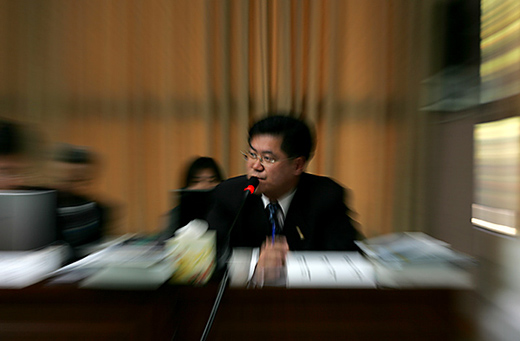 | ||
| ▲ Rep. Lee Ki-woo of the Uri Party ⓒ Kim Jin-seok | ||
The election of Rep. Lee Ki-woo, who gained experience in grassroots local politics as a Gyeonggi Provincial Assembly member, deserves to be recorded as an event in the region. The election of Rep. Lee Ki-woo, a former activist from the 386 generation who served as the third chairman of the National Council of Student Representatives (Jundaehyeop), can be considered a symbol of the "reform winds" that swept through conservative-leaning Suwon following the presidential impeachment.
Particularly noteworthy is that Rep. Lee's election, being a graduate of Yusin High School—a relatively new school amid the traditional electoral geography divided between Suwon Agricultural High School and Suwon High School—is being accepted as a signal of generational change in local politics.
Chosen by the majority of voters hoping for reform, Rep. Lee Ki-woo's parliamentary activities this year began with great expectations. However, over just eight months of parliamentary work, he has demonstrated both the potential and limitations of a first-term legislator.
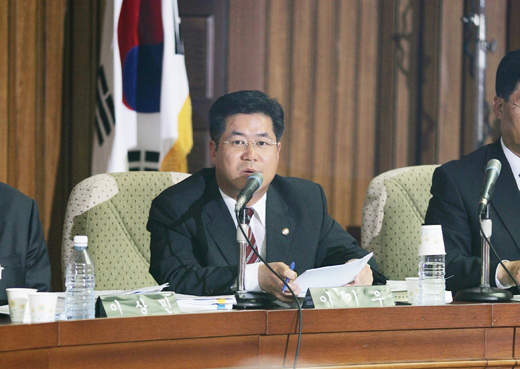 | ||
| ▲ Rep. Lee Ki-woo of the Uri Party questioning Supreme Court Justice candidate Kim Young-ran at a confirmation hearing ⓒ Kim Jin-seok | ||
△Maintains hardline stance on reform bills including National Security Law
Shortly after the opening of the 17th National Assembly, Rep. Lee Ki-woo was assigned to the Health and Welfare Committee—where he had long hoped to serve—and also took on the role of ruling party secretary, leading to busy days.
Rep. Lee Ki-woo's political color becomes somewhat apparent in the nature of the groups he belongs to. As a member of "New Exploration," composed of legislators from the 386 activist generation, and a member of the People's Politics Research Institute, a gathering of anti-establishment politicians centered around Rep. Jang Young-dal within the ruling party, he is classified as a hardliner within the party.
On the issue of the National Security Law abolition bill, which is heating up the year-end political stalemate, he has consistently advocated for its processing within the year. Signing requests for within-year processing of the National Security Law abolition bill centered on 386 activist legislators, he does not hesitate to engage in all-night sit-ins.
Though he possesses a clearly defined political color, when the Constitutional Court ruled the relocation of the capital unconstitutional, he voiced the position that "we must accept the result," focusing weight on seeking rational alternatives.
△Shows capable negotiation skills as ruling party secretary
Despite his clearly defined political views, Rep. Lee receives evaluations that he smoothly handles the role of ruling-opposition negotiations for processing livelihood-related bills in his standing committee on Health and Welfare. It is generally agreed that his role in coordinating between the ruling and opposition parties somewhat contributed to the Health and Welfare Committee being selected as an outstanding standing committee by NGO monitoring groups during the legislative inspection.
During the state audit period, this legislator intensively investigated the Red Cross's mismanagement of blood supplies and the aging of expensive medical equipment at large hospitals. In particular, he consistently raised the need for expanding public medical services, urging the government to abandon competition between national medical institutions and large private hospitals and to promote public emergency medical measures.
His interest in such public medical services is also evident in his remarks on the ruling party's "Special Law on Private Complex City Development to Vitalize Private Investment (Special Law on Corporate Cities)."
Rep. Lee clearly opposed the "Corporate Cities Special Bill," which the government and the Uri Party sought to promote as a key project of the "Korean-style New Deal" policy, stating that "the government's proposal allowing for-profit corporations to establish and operate hospitals directly conflicts with the existing public medical system."
Additionally, this month he submitted eight bills in the welfare sector in accordance with the government's policy of individual processing of the "Comprehensive Local Transfer Act."
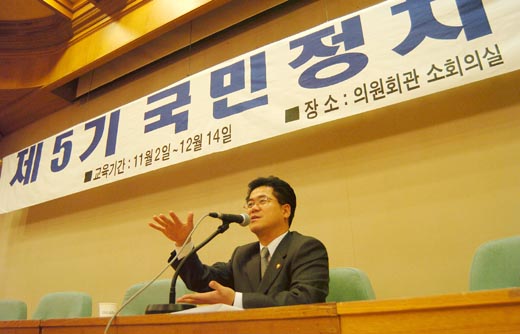 | ||
| ▲ On the 31st of last month, the 5th People's Politics School was held in a meeting room of the National Assembly Members Hall. Rep. Lee Ki-woo of the Uri Party as lecturer. ⓒ Minjung Ilbo Han Seung-ho photo@ytongsin.com | ||
△Potential and limitations of a first-term legislator
While displaying ambitious parliamentary activities as a first-term legislator, Rep. Lee still has a long way to go. Most of all, the continued unfavorable view from established regional forces and the fact that he stands as a test case for generational change in local politics remain burdensome.
The difficulty in relying further on the merit of being "activist" background in party power dynamics is also expected to somewhat influence the legislator's consolidation of his political position within the party in the future.
Two-term legislators Rep. Im Jong-seok and Rep. Oh Young-sik, both from the 386 activist generation, received attention during the 16th Assembly due to the "rarity value" of their activist background, but in the 17th National Assembly, 386 activists can no longer rely on such rarity value. With 12 legislators alone from the Jundaehyeop, and some 20 legislators including the 475 generation—those activist-era politicians before Jundaehyeop—such as Rep. Won Won-sik, Rep. Yoo Seung-hee, Rep. Min Byung-doo, and Rep. Yoo Si-min, the activist background no longer serves as a merit in political activity.
However, the result of next year's party convention will likely determine what role this legislator will play within the party. If the People's Politics Research Institute, a gathering of anti-establishment politicians to which this legislator belongs, takes control of party leadership at next year's party convention, it is hoped that he may assume a certain role within the party.
<Yeouido Correspondent=Reporter Kim Dong-hyun>


Loading comments…