


We Must Teach the People What to Fear
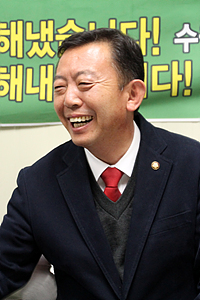
These were the first words spoken by Lee Chan-yeol (52), a sitting member of the National Assembly and the Democratic United Party candidate for Suwon District A, when he first entered the National Assembly, explaining amendments to the Construction Mutual Aid Cooperative Act.
We heard Candidate Lee's determination to create a happy world for the 99 percent of the nation.
-What is your position on the integration of Suwon, Hwaseong, and Osan?
Above all, the will of Suwon citizens, Hwaseong citizens, and Osan citizens is most important.
However, Suwon University, Suwon Women's University, Suwon Science College, and Suwon Catholic University are all located in Hwaseong, not Suwon, yet no one raises objections, and people use these names without any hesitation.
This is because Suwon, Hwaseong, and Osan share administrative and cultural identity as a region for over 1,000 years, their current separation lasting only about 60 years. Geographically, they are not disconnected, and through the construction of various transportation systems and road networks, they form a single living area through exchange of people and goods.
I believe that if Suwon, Hwaseong, and Osan, which feel such homogeneity toward each other, become one, they would become one of the top five cities in Korea with an area of 853 square kilometers, a population of 2 million, and a financial scale of 3 trillion won. This would enable mutual compensation of strengths and weaknesses, and create the foundation for development as a central city in Northeast Asia with competitiveness in the global era.
-What is your position and strategy regarding the recruitment of a 10th professional baseball team to Suwon?
Attracting a 10th professional baseball team to Suwon can play a major role in improving the quality of life for citizens through the cohesion and unity of Suwon citizens, fostering love for their hometown, enhancing the city brand, and providing entertainment for leisure activities.
Economically, it is projected to significantly help revitalize the regional economy through an estimated economic ripple effect of 137.3 billion won and job creation effects of 1,441 people.
The commercial area near Jangan-gu Office intersection could also be greatly activated, and since the station for the 'Indeokwon-Suwon Double-Track Railway' project, for which basic planning is currently underway, is expected to be located nearby, it is anticipated to be a catalyst for Jangan-gu's advancement to the next level.
I will provide maximum support so that Suwon City can attract the 10th professional baseball team.
-What about the promotion of the Metro Line 4 extension project?
The Metro Line 4 extension project is a long-cherished wish of Jangan-gu residents. The official name is the 'Indeokwon-Suwon Double-Track Railway Project,' and it was finalized with great difficulty. This was made possible thanks to the aspirations and support of the people of Jangan-gu.
Now what remains is to begin construction and complete it as soon as possible. However, this timeline has already been accelerated by one year.
Before the preliminary feasibility study results were announced, I had previously secured 5 billion won in budget for basic planning during last year's budget review of the National Assembly's Land and Maritime Affairs Committee.
If we had not secured the budget in advance last year, the project would have been delayed by one year. The contractor for basic planning was selected on the 21st, and the project will proceed for 300 days.
Now I will explore various methods such as simultaneously pursuing basic and detailed design, and conducting construction in phases to advance the construction timeline as much as possible. I will also secure the total project cost of 2.4474 trillion won annually and accelerate completion as much as possible.
-Residents are experiencing inconvenience due to the 30-year-old Sungkyunkwan University Station. Is there a solution?
I visit Sungkyunkwan University Station almost every morning to greet commuters, and it breaks my heart to see elderly people struggling up and down the stairs.
The Sungkyunkwan University Station has been pursuing private-sector station development since 2007, but it was abandoned due to contractor bankruptcy.
After becoming a member of the National Assembly, I worked to revive the dying project by strongly demanding the Korea Railroad Corporation proceed with constructing a new station building and exploring various options.
However, progress was difficult due to disagreements between Suwon City and the Korea Railroad Corporation over development methods and cost-sharing.
With the determination not to disappoint the residents of Jangan once again, I conducted multiple consultations with Suwon City and the Korea Railroad Corporation to reach an agreement: the Korea Railroad Corporation would develop it as a complex station building, and Suwon City would share part of the construction costs. An MOU was concluded between the two parties on February 28.
By 2015, a state-of-the-art complex station building with 2 basement levels and 4 above-ground levels will be installed, and elevators and escalators will be available, so elderly residents will be able to use Sungkyunkwan University Station without the inconvenience of climbing stairs.
I will make efforts to resolve all previously raised inconveniences, including establishing a bus and taxi transfer system, expanding parking lots, and diversifying ticket gates.
-Public institutions in Jangan-gu, such as the National Institute of Public Administration, are being relocated to provincial areas, raising concerns about local economic stagnation. Is there a solution?
Given concerns about local economic stagnation due to the relocation of public institutions to provincial areas, we must expand knowledge service industries with significant economic ripple effects and create jobs to strengthen self-sufficiency.
First, at the National Institute of Public Administration, I will establish a startup support center by partnering with Sungkyunkwan University and leveraging SKC's infrastructure.
We will provide customized support from preliminary startup through successful business establishment to create jobs and support employment.
At the National Institute of Horticultural and Herbal Science, we will attract an advanced R&D complex center to create jobs and promote local economic revitalization.
Through the synergy effects of the startup support center and advanced R&D complex center, Suwon's Jangan-gu can become a catalyst for advancing to the next level.
To this end, we will amend the 'Metropolitan Area Readjustment Planning Act' to designate relocated public institution sites as development and development districts, ease various regulations, and promote investment cooperation with the government, local governments, and private enterprises to attract advanced R&D facilities to relocated public institution sites.
In the case of the National Civil Service Commission Education Institute, we will pursue partial functional residency, including conducting short-term training.
-If there is something you must say to voters?
I recall the words of an elderly person I heard at a traditional market not long ago.
"It's my fault for being deceived by the show of reviving the economy while eating national soup at the market!"
The Lee Myung-bak Saenuri Party government is trying to deceive the people again by changing only the outer packaging while keeping the inside the same as before. We cannot be deceived twice.
Dear voters, we must teach the Lee Myung-bak Saenuri Party government—which destroyed the livelihood of the 99 percent of the nation for the 1 percent privileged class—what the people should fear. This Saenuri Party government is just the old Democratic Liberal Party with the outer packaging changed.
On April 11, starting from Suwon's Jangan-gu, the number one political district of Gyeonggi Province, I earnestly urge you to punish the Lee Myung-bak Saenuri Party government that serves only the 1 percent privileged class, and to create a world where all 99 percent of the people can be happy together.
Profile
Education/Career
- Graduated from Seokcheong Elementary School and Samgoe Middle School
- Graduated from Suwon Samil Vocational High School (Samil Industrial High School Mechanical Engineering, 1st Class)
- Graduated from Inha University Department of Mechanical Engineering
- Graduated from Yonsei University Graduate School of Economics (Master's Degree in Economics)
- Former Political and Labor Policy Advisor to Democratic Party Leader Sohn Hak-kyu
- Current 18th National Assembly Member
- Current Democratic United Party Deputy Floor Leader
Religion: Christianity
Family: Married to Baek Seung-il; 1 son and 3 daughters
Age: 52
Date of Birth: July 15, 1959
Hobbies: Kendo
Life Motto: Politics that treats the people as heaven
The Greatest Book of My Life
- "The European Dream" by Jeremy Rifkin
Most Respected Person: Father

Loading comments…