


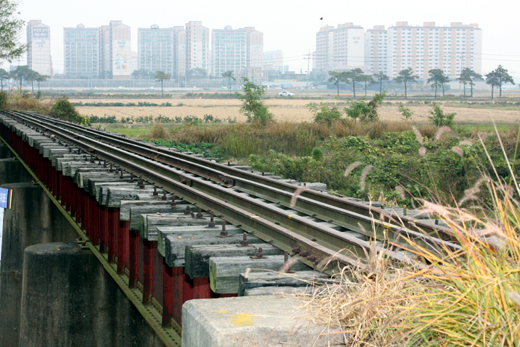
The Suin Line double-track railway Phase 2 project has been in limbo, held back by issues over rail yard relocation and underground construction in urban areas <See Suwon Ilbo dated August 12, 2008> as Suwon City has now proposed to Gyeonggi Province that a Suin Line Railway Construction Support Conference be held to expedite Phase 2 construction, drawing keen attention.
According to the city on the 6th, Suwon City has decided to request Gyeonggi Province to hold a Suin Line Railway Construction Support Conference (hereinafter, "railway conference") with the participation of relevant agencies, local residents, and civic representatives to resolve pending issues for early Phase 2 construction and early opening of the entire Suin Line.
When requesting the holding of the railway conference, composed of five organizations—Gyeonggi Province, Suwon City, Hwaseong City, Ansan City, and the Korea Railroad Facility Corporation—Suwon City plans to send an official letter regarding plans for participation by city council members and civic representatives from the region. It is expected to take place as early as this month. Through the conference, the city plans to seek ways to address grievances regarding demands for underground construction and rail yard relocation.
Kim Bong-hee, director of the Urban Railroad Division, stated, "Until now, the conference has been operated mainly by government officials. We aim to create an opportunity to accurately convey local grievances and pending issues, and to examine whether there are any practical solutions to address the rail yard relocation problem, which has remained largely unresolved."
To date, Suwon City and the Korea Railroad Facility Corporation have only engaged in tedious exchanges of position papers over responsibility for the rail yard relocation costs (estimated at approximately 70 billion won), failing to narrow their differences and moving in parallel. While Suwon City argues that the Korea Railroad Facility Corporation should bear the costs as it is a metropolitan railway project, the Corporation maintains that the local government should bear the costs resulting from design changes.
As the Suin Line railway project proceeds in phases, Ansan and Hwaseong cities have little urgent need, but Suwon City, which begins construction and opens service last, faces a different situation.
The Suin Line double-track railway project (total project cost 1.24 trillion won) spanning 52.8 km from Incheon Station to Suwon Station has seen its project period extended by at least five years due to demands for underground construction and budget issues, leaving even the 2015 opening for the Suwon section uncertain.
Phase 2 of the 4.9 km section from Suwon to Omok-cheon-dong is currently only constructing a partial 460-meter section at Suwon Station that connects with the Bundang Line extension.
As the Ori-Suwon Bundang Line extension double-track railway project falls behind schedule, and with the Jeongja-Homaesil Shinbundang Line extension project also confirmed for phased implementation, only the Jeongja-Gwanggyo section is scheduled to open in 2014. While Phase 2 of the Gwanggyo-Homaesil project is announced to open in 2019, local opinion suggests it remains uncertain how this might change if transportation conditions shift.
As metropolitan railway projects connecting the Seoul metropolitan area proceed haphazardly in this manner, discontent over delays in the Suin Line project is mounting. While it remains unknown whether the Province will accept the railway conference proposal, the expectations that Suwon City and residents place on it are uniquely high.
A 38-year-old resident of Gosaeok-dong said, "The Phase 1 section from Oido Station to Songdo Station is scheduled to open in 2011, two years ahead of schedule to coincide with the hosting of an international event. The Phase 2 project from Songdo Station to Incheon Station is entirely underground, and considering regional circumstances and local government budgets, funding should be increased for the Phase 2 project."
Loading comments…