


How Does Gyeonggi Province Rank in Promise Fulfillment?
In the evaluation results of electoral promise fulfillment for the second anniversary of the fourth direct election of 16 metropolitan autonomous regions nationwide, announced by the Citizens' Coalition for Economic Justice (hereinafter CCEJ) on the 29th, Gyeonggi Province's ranking fell outside the published top rankings, indicating poor performance in promise fulfillment.
The comprehensive scores across three categories—specificity of promises, degree of fulfillment, and content of promises—were disclosed only for the top 5 rankings, while remaining rankings were not released. Gyeonggi Province managed to rank in the top 5 only in the "content of promises" category, the sole category among the three where it achieved a published ranking.
According to the CCEJ, the Local Autonomy Committee of the CCEJ organized an evaluation team and assessed 16 metropolitan autonomous regions on three categories of promise fulfillment—specificity, degree of fulfillment, and content—(on a scale of 100 points). As a result, Seoul was selected as the autonomous region with the best promise fulfillment performance, averaging 79.3 points.
Following Seoul were South Chungcheong Province (74 points), North Jeolla Province (73.9 points), North Chungcheong Province (73.3 points), and Jeju Province (72.9 points). The national average score was 70.6 points.<See table>
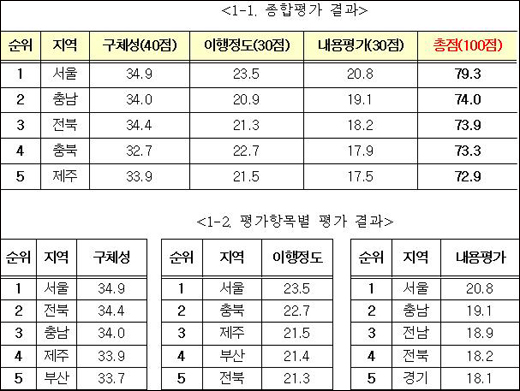
In the category-by-category evaluation results, Seoul ranked first in both specificity and degree of fulfillment, as well as in content evaluation. Gyeonggi Province recorded 5th place in the content evaluation category with 18.1 points.
Particularly regarding promise content, among development and environment-related promises, autonomous regions emphasizing regional development ranked as follows: North Gyeongsang Province (36.9% versus 3.6%), Gyeonggi Province (27.9% versus 4.4%), South Gyeongsang Province (36.0% versus 7.0%), and North Jeolla Province (40.3% versus 9.7%), showing a concentration on development promises of 10 to 5 times the environmental focus. In contrast, Seoul (10.5% versus 18.1%) and Ulsan (11.7% versus 20.0%) placed greater emphasis on environmental policies than development policies.
Additionally, when looking at promises for resident convenience, such as improved administrative services, Seoul (26.7%), Gyeonggi Province (26.5%), and Daejeon (22.7%) were found to be promoting many policies for regional resident benefit.
An official from the CCEJ stated, "We conducted this evaluation with the meaning of establishing local elections as policy (competition) elections and monitoring local autonomous regions to reinvent themselves as those implementing promises and policies for regional residents," and added, "While we have set an internal policy to disclose evaluation results up to the top 5 positions, we plan to rank and disclose all autonomous regions through continuous evaluation by 2010."
Meanwhile, the CCEJ excluded from evaluation a total of 1,484 promises and approximately 20 major promises per region (352 in total) from the 16 provincial promises that either lacked value as promises, were primarily state-funded projects, were one-time event projects, or had minimal ripple effects on implementation.
Loading comments…