


Ruling Party Leader Kim Min-seok Party Members Nurtured by Chung Chung-rae Choose Kim Min-seok
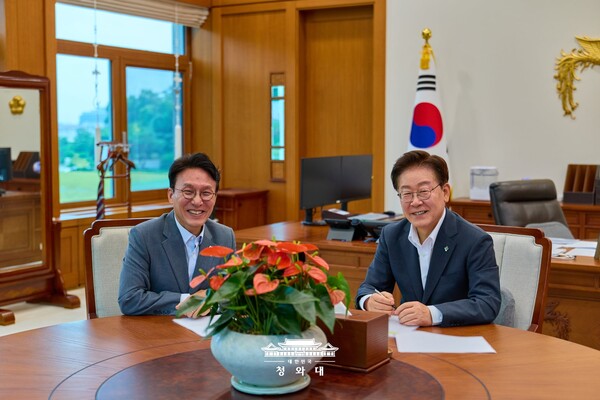
At the Democratic Party's National Convention with the introduction of the '1 person, 1 vote' system, which raised the relative value of each regular member's vote to approximately 17 times higher, new leader Kim Min-seok secured party leadership by maintaining an advantage among both delegates and regular members.
According to the Democratic Party on the 18th, leader Kim obtained a final 54.08% through preferential voting at the 3rd regular National Party Convention held at the Daejeon Convention Center the previous day, defeating candidate Chung Chung-rae, who recorded 45.92%, by 8.16 percentage points and was elected party leader.
As no candidate secured a majority in the first round of voting, a preferential voting system was applied to redistribute second-preference votes cast by voters who selected third-place candidate Song Young-gil.
This convention marked the first time the '1 person, 1 vote' system was applied, calculating delegate and regular member votes as having equal value.
In last year's convention where candidate Chung was elected party leader, the results reflected delegates 15%, regular members 55%, and public opinion poll 30% respectively. Although the delegate electorate was significantly smaller than regular members, each delegate vote carried an influence equivalent to approximately 17 regular member votes by separately allocating 15% of the total results.
This year, delegate and regular member votes were combined on a 1-to-1 basis to reflect 70% of the total results. The public opinion poll weight remained at 30%, the same as last year.
While maintaining the overall party sentiment reflection rate at 70%, the 'vote value' between delegates and regular members within party sentiment was made equal. Consequently, the relative value of each regular member vote compared to delegates rose approximately 17 times higher than last year.
The 1 person, 1 vote system was a measure promoted during candidate Chung's tenure as party leader.
At last year's convention, candidate Chung secured party leadership based on overwhelming support from regular members.
At that time, candidate Chung obtained 428,470 regular member votes, significantly ahead of candidate Park Chan-dae who received 212,195 votes. In terms of vote share, candidate Chung received 66.48% and candidate Park 33.52%.
Among delegates, however, candidate Chung obtained 6,142 votes, trailing candidate Park's 6,951 votes. In vote share, candidate Chung received 46.91% and candidate Park 53.09%.
In the public opinion poll, candidate Chung led with 60.47% compared to candidate Park's 39.53%.
Although candidate Chung lost among delegates, he secured an advantage in regular members and public opinion polls, obtaining a final 61.74% and was elected party leader.
The 1 person, 1 vote system, applied for the first time a year later, was a change in the system direction that relatively increased the value of regular member votes where candidate Chung had shown strength last year.
However, party members' choices differed at this convention.
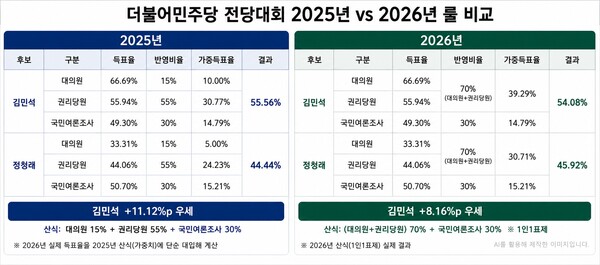
Leader Kim obtained 55.94% in regular member voting, leading candidate Chung's 44.06% by 11.88 percentage points.
The gap widened among delegates. Leader Kim obtained 66.69% while candidate Chung received 33.31%. The gap was 33.38 percentage points.
The only area where candidate Chung led leader Kim was the public opinion poll. Candidate Chung obtained 50.70%, leading leader Kim's 49.30% by 1.40 percentage points.
Candidate Chung, who showed advantages in both regular members and public opinion polls last year, this time led only in the public opinion poll.
Notably, applying this convention's results to last year's election method allows us to assess the impact of the system change on both candidates.
When the 2026 actual delegate, regular member, and public opinion poll vote shares are simply applied to the 2025 formula, leader Kim calculates to 55.56% and candidate Chung to 44.44%. Leader Kim would lead by 11.12 percentage points, 2.96 percentage points larger than the actual final gap of 8.16 percentage points at this convention.
This is because if last year's separate weighting of 15% were applied to the delegate voting where leader Kim obtained 66.69%, the advantage secured in delegate voting would be reflected more significantly in the final results.
However, this is a simple conversion assuming that this year's vote shares among each electorate would have been identical under last year's system. Had the election system been different, candidate strategies and voting behavior could have differed, which does not represent actual election results.
Nevertheless, the simple conversion result shows that this 1 person, 1 vote system reduced the influence of delegate votes where leader Kim held an advantage.
Although leader Kim led candidate Chung by 33.38 percentage points among delegates, the gap among regular members was 11.88 percentage points. Unlike last year's system that separately allocated 15% to delegates, this year's equal calculation of both electorates' votes diluted the substantial advantage leader Kim secured among delegates within overall party member voting.
Ultimately, while delegate weighting disappeared and the value of regular member votes increased at this convention, where candidate Chung had been relatively weak and strong respectively last year, the system change did not alter the winner as leader Kim led among both delegates and regular members.
A political circle official stated, "Applying this vote share to last year's system would actually expand leader Kim Min-seok's victory margin as he led overwhelmingly among delegates," and added, "The fact that he secured regular member support even as delegate weighting disappeared suggests that party sentiment prioritizing early ruling coalition stability and the success of the Lee Jae-myung government affected the outcome."
Loading comments…