


Special Report Suwon Transforms 7: Building a 'Grid-Type Broad-Area Railway Network'
[Suwon Ilbo=Reporter Jung Jun-sung] The Metropolitan Express Railway (GTX)-C line construction project, which had been delayed due to disputes over total construction costs between the Ministry of Land, Infrastructure and Transport and project operators, is now being promoted in full swing.
After the Ministry of Land, Infrastructure and Transport agreed on April 1 to increase the total project cost following the Korea Commercial Arbitration Board's mediation results regarding construction expenses for the GTX-C private investment project, the project gained renewed momentum.
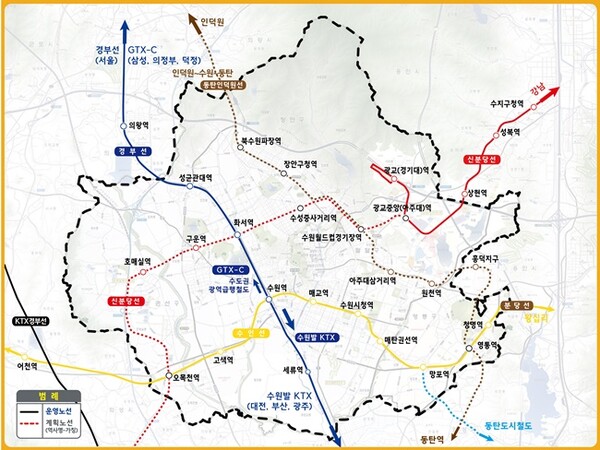
The GTX-C line will be constructed over an 86.4 km section starting from Suwon Station, passing through Indeokwon Station, Samsung Station, Wangsimni Station, Cheongnyangni Station, Uijeongbu Station, and reaching Deokjeong Station (Yangju City). With the Ministry of Land, Infrastructure and Transport's decision to increase total project costs, the project is accelerating.
Fourteen stations will be built on the line, and all of them are transfer stations connecting to subway lines. When the GTX-C, which operates at an average speed of 100 km/h, opens, travelers will be able to reach downtown Seoul from Suwon Station in about 30 minutes, and can reach northern Gyeonggi Province in less than an hour.
Suwon rises as a 'broad-area railway network city'
A broad-area railway network that will serve as the foundation for Suwon City's 'spatial transformation' is being constructed. In addition to the GTX-C line, the Shinbundang Line Gwanggyo~Homaesilsil extension project, the Dongtan-Indeokwon Line construction project connecting Indeokwon (Anyang) through Suwon to Dongtan (Hwaseong), and the Suwon-origin Korea Train Express (KTX) direct connection project are underway.
Fourteen years ago, Suwon City had only four subway stations: Sungkyunkwan University Station, Hwaseo Station, Suwon Station, and Seryuu Station on National Railroad Line 1. When the Bundang Line section from Giheung Station to Mangpo Station opened in 2012, and the Mangpo Station to Suwon Station section opened in November the following year, Suwon began to transform into a 'broad-area railway network city.'
When the Shinbundang Line Jeongja Station~Gwanggyo Station section opened in 2016, it became possible to reach Gangnam Station in Seoul from Gwanggyo Station in 37 minutes. In 2020, the Suin Line Suwon Station~Handae-apgugi Station section opened, connecting the entire Suin Line after 25 years. The number of subway stations has now increased to 14.
Shinbundang Line Extension to complete in 2029, Dongtan-Indeokwon Line to open in 2028
The number of railway stations will continue to increase. The 'Shinbundang Line Gwanggyo~Homaesilsil Construction Project' extending the section from Gwanggyo to Homaesilsil began construction in June 2024. It is planned to be completed in 2029. Upon completion, five additional subway stations will be created, including Hwaseo Station and Suwon World Cup Stadium Station, which are transfer stations.
When the Shinbundang Line extension opens, transportation conditions in the western Suwon area will improve. Using the Shinbundang Line will cut commute time from Homaesilsil-dong to Gangnam, Seoul to about half.
The 'Dongtan-Indeokwon Line Construction Project,' connecting Indeokwon (Anyang) through Suwon to Dongtan (Hwaseong), is being promoted with a target opening date of 2028.
The project will be constructed over a 38.3 km section, and in the Suwon City section (13.6 km, Work Packages 4-9), six stations will be built: Buksuwon Pajang, Jangan-gu Office, Suwon World Cup, Ajou University Samgeori, Gwanggyo Woncheon, and Yeongdong Station (tentative name). There will also be transfer stations with the Shinbundang Line and Suin-Bundang Line.
When the Dongtan-Indeokwon Line opens, traffic demand on Gyeongsu Avenue is expected to be distributed, alleviating traffic congestion during rush hours.
'Suwon-origin KTX Direct Connection Project' to be completed in December
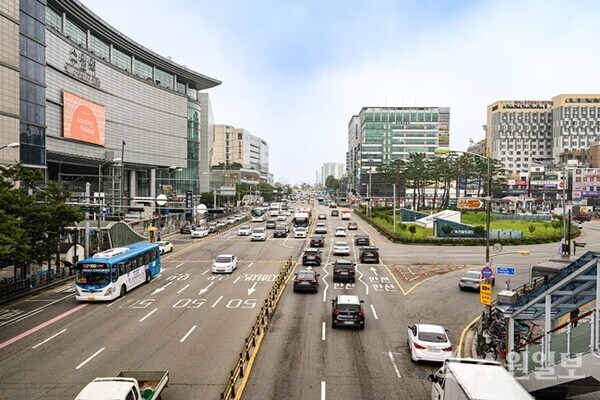
The 'Suwon-origin KTX Direct Connection Project,' which constructs a 9.99 km railway connecting Seojongni Station on the Gyeongbu Line and Jije Station on the Suseo High-Speed Railway to make Suwon Station a KTX departure point, is scheduled to be completed in December. As of the end of March, the project progress rate was 79.2%.
Once the Suwon-origin KTX opens, the number of operations will increase and operation time will be shortened. Currently, the Suwon-Busan KTX runs 4 times per day, but when the direct connection project is completed, it will increase to 12 times per day. KTX routes to Gwangju Songjeong (3 times per day) and Mokpo (3 times per day) will be newly established.
Travel time to Busan will be reduced by about 30 minutes from the current time. Travel time to Gwangju Metropolitan City will be reduced by about 1 hour 40 minutes, and to Mokpo by about 1 hour 45 minutes.
The Southern Gyeonggi Broad-Area Railway, jointly promoted by Suwon City, Gyeonggi Province, and Yongin, Seongnam, and Hwaseong Cities, is a line of total length 50.7 km starting from Seoul's Olympic Gymnastics Arena and connecting Seongnam, Yongin, Suwon, and Hwaseong Cities. With an economic feasibility (B/C) ratio of 1.2, it is expected to become the core railway network of the southern Gyeonggi region, connecting major advanced industrial complexes.
Creating 22 compact cities in Suwon through station-area complex development
When all the broad-area railway projects currently being promoted are completed, a 'grid-type railway network' will be established in Suwon. Suwon Station, where KTX and the Metropolitan Express Railway (GTX)-C line depart and the Suin-Bundang Line and National Railroad Line 1 pass through, is expected to position itself as a hub of the Southern Gyeonggi Broad-Area Railway Network. Travel time to major stations across the metropolitan area and the nation will be significantly reduced.
The construction of the broad-area railway network is linked to the 'Suwon-Style Station-Area Complex Development Activation Project,' the core of the 'spatial transformation.' Activation projects will first be promoted in 22 station areas with confirmed openings. Through station-area complex development, the plan is to create 22 compact cities in Suwon.
A city official said, "When the grid-type railway network is constructed, citizens will be able to move more conveniently using public transportation," and added, "We will actively support the broad-area railway network construction project to proceed without delay."
Loading comments…