


78% of Gyeonggi Residents See Real Estate Illegal Activities as Serious, Call for Stronger Enforcement
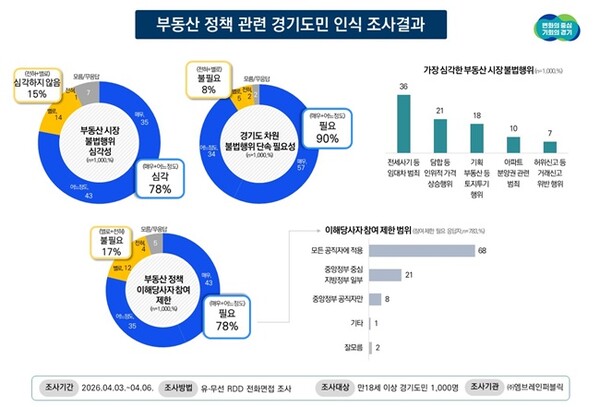
[Suwon Ilbo = Reporter Kim Gap-dong] A survey has found that 78% of Gyeonggi residents view illegal activities in the current real estate market as serious, and 90% of residents agree on the necessity of strengthening enforcement at the provincial level.
The Gyeonggi Province announced on the 20th that according to the results of a 'perception survey on real estate policy' conducted from the 3rd to the 6th targeting 1,000 residents, 78% perceived illegal activities in the real estate market as 'serious,' with 'rental-related crimes including jeonse fraud (36%)' identified as the most significant problem.
Concerns about illegal activities varied by age group. Among those aged 18-29, 60% viewed jeonse fraud as the most serious problem, while in their 50s, 'artificial price increases such as housing price cartels' accounted for the highest proportion at 30%.
Regarding illegal activities, 90% of respondents stated that 'strengthening enforcement at the province level is necessary.'
Gyeonggi Province currently operates joint special investigations between the province and municipal governments and a reward reporting system (up to 500 million won) centered on its real estate market disruption special countermeasures task force, continuing enforcement activities including detection of housing price cartel cases and prosecution referrals.
Additionally, the province is developing the 'Gyeonggi Real Estate Transaction Safety Network (GRTS)' platform, which uses artificial intelligence (AI) to analyze registry information and market prices by simply entering a house address and provides guidance on transaction risk. As a proactive prevention system where AI monitors all processes from risk diagnosis before contracts to notification of registry changes after contracts, it plans to conduct pilot operations in the second half of 2026 and full-scale implementation thereafter.
As a priority task for housing market stabilization, 'strengthening property taxes for multi-property owners (29%)' showed the highest response. 'Expanding housing supply (21%)', 'alleviating housing cost burden (21%)', and 'financial regulation management (20%)' were surveyed at similar levels.
In a survey on public housing policy receptivity, 78% approved of 'expanding supply to the middle class' and 74% approved of 'expanding mid-to-large floor plans.' 80% also agreed on the necessity of introducing 'equity-building housing' with reduced initial burden.
This demand aligns with the real estate policy direction of 'Gyeonggi-type public housing' being promoted by the province. The province is pursuing various floor plans considering housing demand and equity-building housing supply.
The survey also confirmed demands for fairness in real estate policy. 78% approved of restricting policy participation by public officials holding multiple properties or high-value properties, with 68% of them answering that it should be applied without distinction between central and local government.
Shon Im-sung, director of the Provincial Urban Housing Division, stated, "It has been confirmed that there is strong demand from residents for establishing real estate market order and housing stability," and added, "We will pursue effective policies through strengthening jeonse fraud enforcement, introducing an AI-based prevention system, and expanding public housing supply."
The survey was conducted by M Brain Public at the request of Gyeonggi Province using wired and wireless RDD telephone interview methods, with a sampling error of ±3.1%p at the 95% confidence level.
Loading comments…